A US C-Corp earning money abroad pays tax twice on the same dollar — once abroad, once at home. Section 901 gives a credit against US tax for foreign income taxes paid or accrued. Form 1118 computes it. The trap: Section 901 grants the credit and Section 904 takes most of it back, basket by basket, capping the credit at the US tax attributable to foreign-source income. Pay $1,200,000 of foreign tax on $4,000,000 of foreign income and only $840,000 is creditable; the other $360,000 waits in a carryback and carryforward queue that expires after ten years.
What Section 901 actually gives
§901(a) states the grant: a taxpayer choosing the benefits of this subpart credits the tax imposed by the chapter with the amounts in §901(b), plus, for a corporation, the taxes deemed paid under §960. The election can be made or changed any time before the credit-or-refund period expires.
§901(b) sets the amount allowed, subject to the §904 limitation and to disallowances: §901(e) mineral income with percentage depletion; §901(j) listed countries; §901(k) minimum holding period on dividend stock; §901(m) covered asset acquisitions, worked in example A6.
The alternative is a deduction under §164, and the two cannot be mixed for the same year. The credit is worth a dollar of US tax per dollar of foreign tax, up to the limitation; the deduction is worth 21 cents on the dollar at the flat 21% rate (§11(b)). The credit wins whenever the limitation leaves room.
The Section 904 limitation
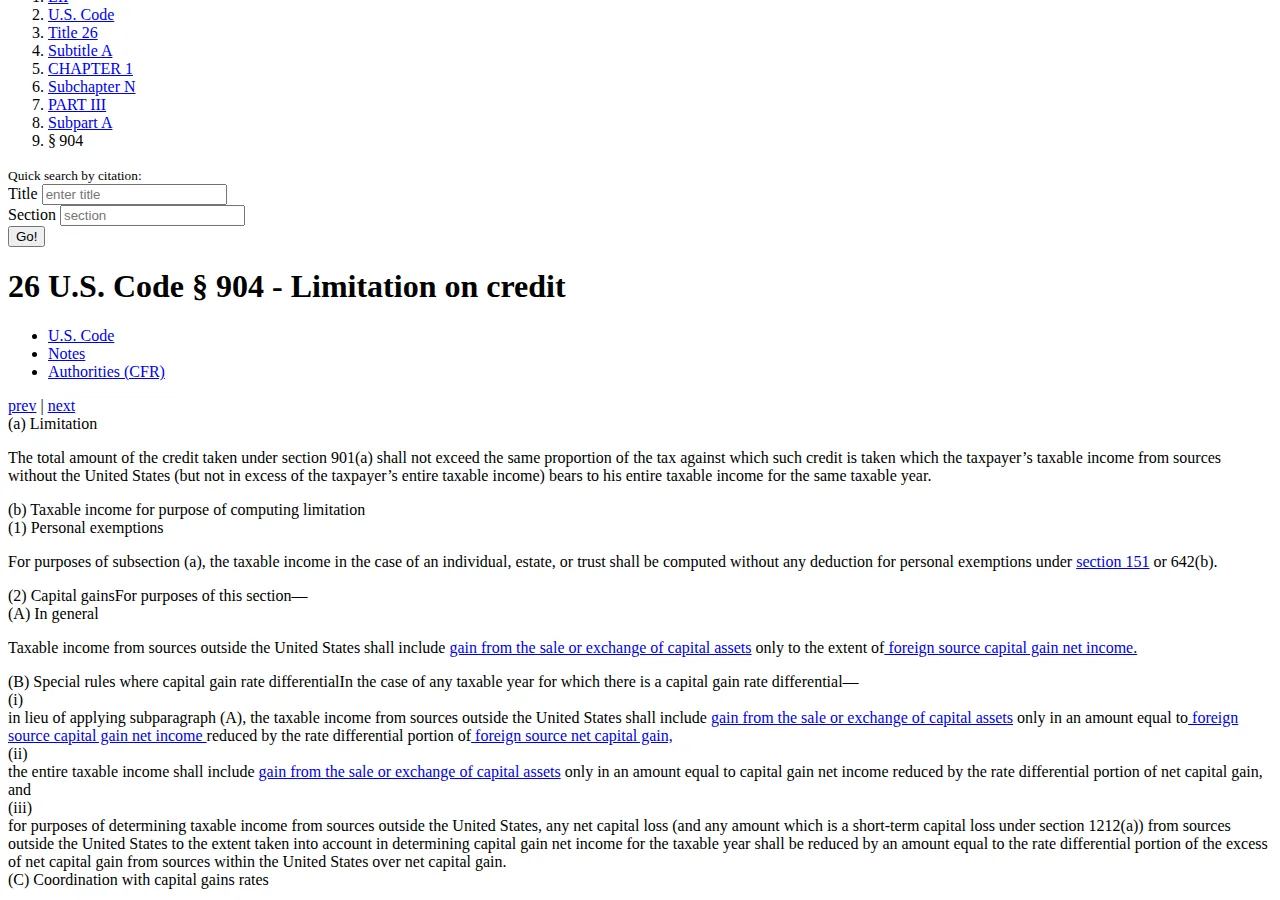
Section 904(a) governs everything here: The total amount of the credit taken under Section 901(a) shall not exceed the same proportion of the tax against which such credit is taken which the taxpayer's taxable income from sources without the United States (but not in excess of the taxpayer's entire taxable income) bears to its entire taxable income for the same taxable year.
In algebra (T = US tax before credit, F = foreign-source TI, E = entire TI):
Earning 40% of its income abroad caps the credit at 40% of its US tax bill, however much foreign tax it paid. The excess does not vanish: §904(c) deems it paid in the first preceding year and in any of the first 10 succeeding years, to the extent the limitation there exceeds the tax paid.
§904(b) adjusts the inputs: capital gains enter only to the extent of foreign-source net capital gain; §904(b)(4) excludes the foreign-source portion of dividends from a specified 10-percent owned foreign corporation from the limitation, because §245A deducts that portion outright; §904(b)(5) allocates the §250 deduction to net CFC tested income for that basket, and no interest or research expense to it.
The four baskets
§904(d)(1) applies the limitation separately to four categories of income, each with its own limitation and loss account. Unused limitation in one basket never shelters excess tax in another.
| Basket | What sits in it | Credit computation | Authority |
|---|---|---|---|
| Section 951A category | Net CFC tested income (formerly GILTI) | 90% deemed-paid; no carryback or carryforward | §904(d)(1)(A); §960(d)(1) |
| Foreign branch category | Foreign branch income | Direct taxes; 1 back, 10 forward | §904(d)(1)(B); §904(c) |
| Passive category | Passive income under §954(c) | Direct taxes; 1 back, 10 forward | §904(d)(1)(C); §904(d)(2)(A) |
| General category | Active operating income, sales, services | Direct taxes; 1 back, 10 forward | §904(d)(1)(D); §904(d)(2)(A) |
Basket assignment is the first decision on every Form 1118, made on Schedule A. Passive income is income of a kind that would be foreign personal holding company income under §954(c) — foreign-source FDAP such as dividends, interest, and rents — except export financing interest and high-taxed income. Look-through rules keep CFC dividends, interest, rents, and royalties in the basket of the income that produced them.
Form 1118, schedule by schedule
Form 1118 is a cover computation plus Schedules A through L, most completed separately per basket; Schedule B Part III, Schedule H, Schedule J, and Schedule L Part IV only once.
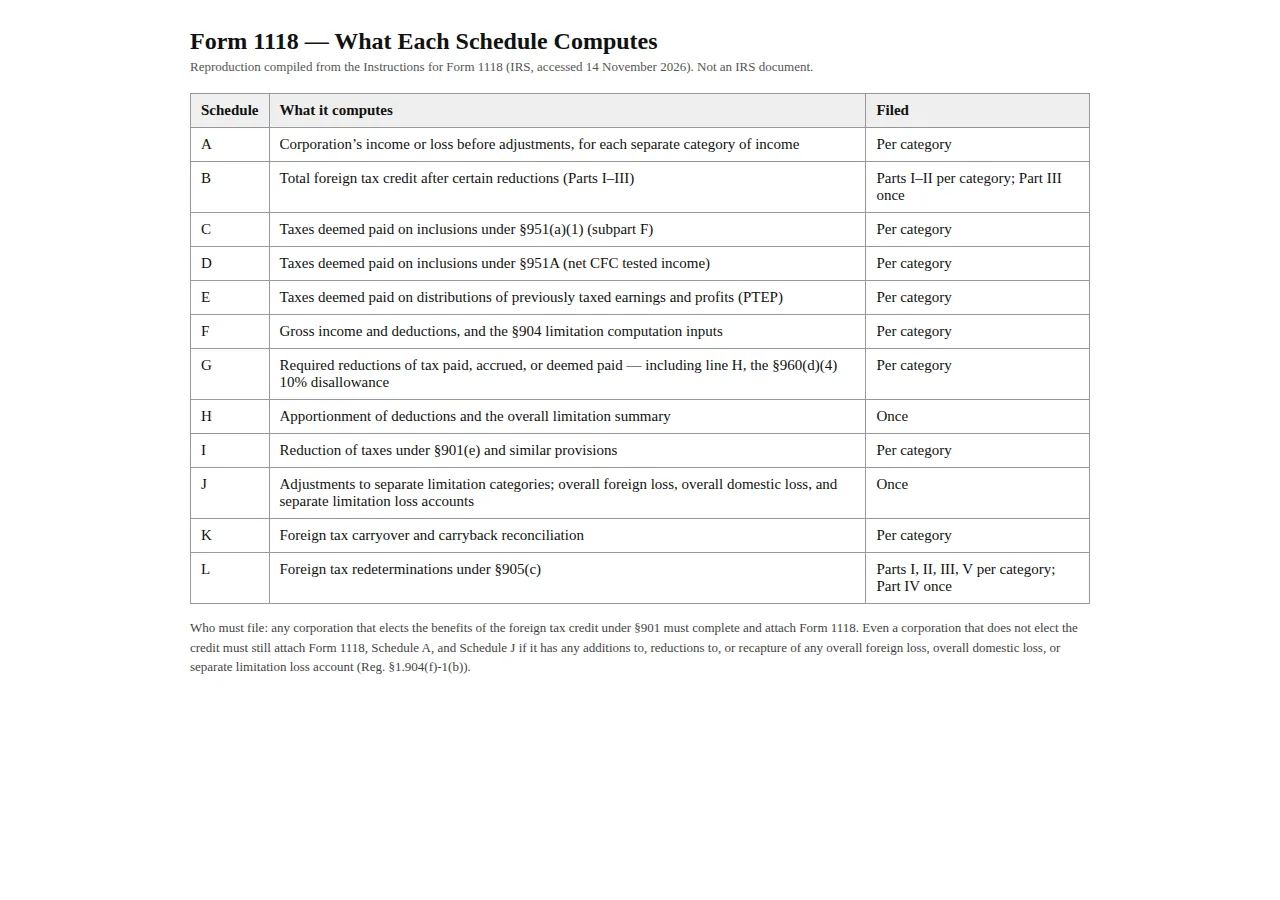
Schedule A: income or loss before adjustments. Schedule B: total credit after reductions. Schedules C, D, and E: taxes deemed paid on §951(a)(1) inclusions, §951A inclusions, and PTEP distributions. Schedule G: required reductions, incl. new line H (§960(d)(4)). Schedule J: loss accounts (overall foreign, overall domestic, separate limitation). Schedule K: carryover reconciliation. Schedule L: foreign tax redeterminations under §905(c).
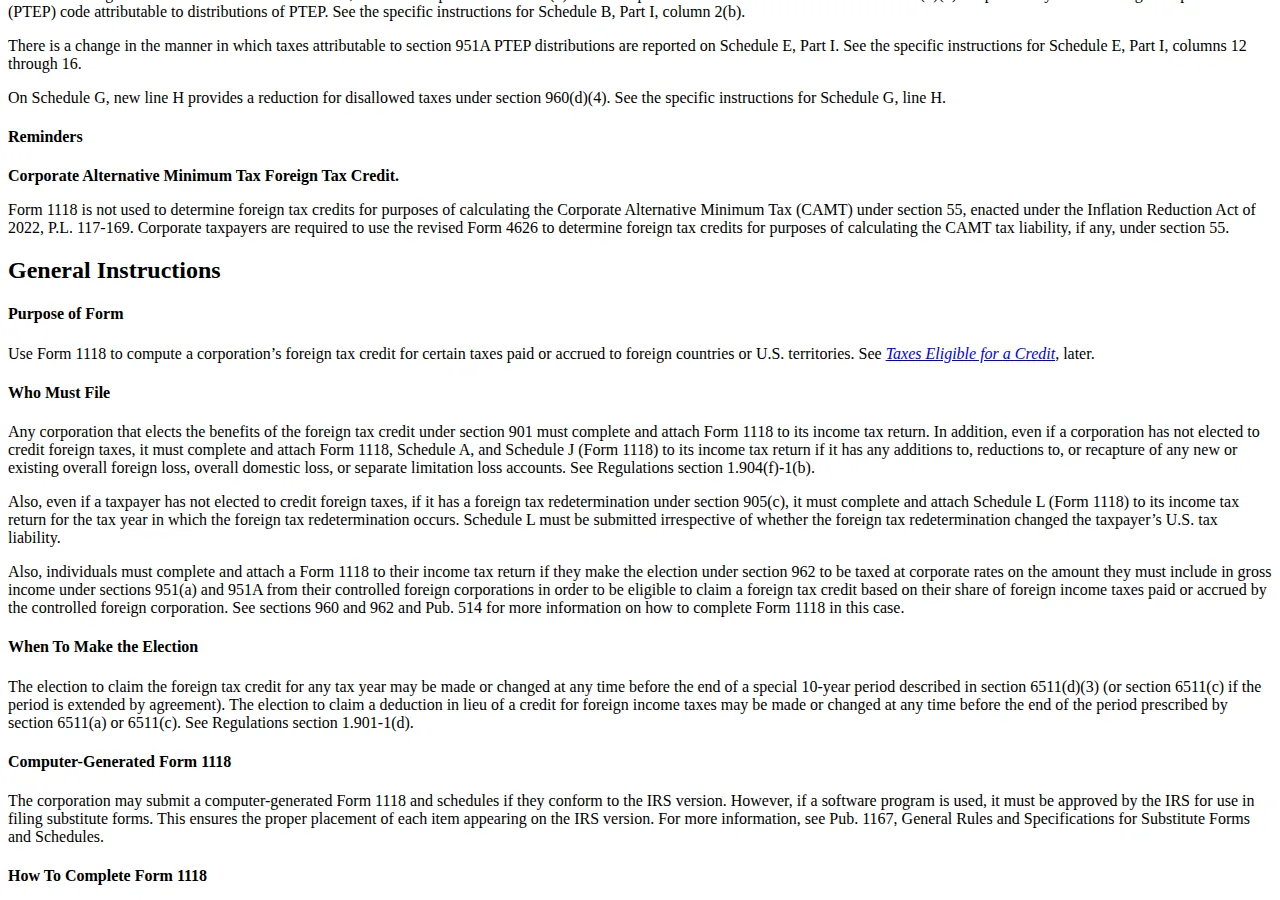
Any C-Corp electing the credit under §901 attaches Form 1118 to its return. Even without the election, a corporation with any change to an overall foreign loss, overall domestic loss, or separate limitation loss account must attach Form 1118, Schedule A, and Schedule J (Reg. §1.904(f)-1(b)), and must attach Schedule L for any year with a §905(c) redetermination, whether or not it changed the US tax liability.
Individuals file Form 1116, not Form 1118 — see IRS Form 1116 Foreign Tax Credit Playbook. The exception is an individual making the §962 election to be taxed at corporate rates on §951(a) and 951A inclusions. For the return itself, see IRS Form 1120S vs 1120 Corporate Tax Return Playbook; the tax estimator checks the pre-credit US tax feeding the limitation.
Worked examples: A1 to A7
All examples use the flat 21% rate (§11(b)).
— Example A1: the basic limitation. Entire TI $10,000,000 (an NOL carried into the year would shrink it); foreign-source TI $4,000,000 (general). US tax: 21% × $10,000,000 = $2,100,000. Foreign tax paid: $1,200,000 (30%). Limitation: $2,100,000 × ($4,000,000 / $10,000,000) = $840,000. Credit $840,000; excess $360,000 back 1 year, forward 10 (§904(c)). Residual US tax: $1,260,000. Total tax on the $4,000,000: $2,460,000, a 61.5% effective rate.
— Example A2: the baskets do not cross. Take A1, add $1,000,000 of foreign-source passive income with $150,000 of foreign tax (15%). Entire TI is now $11,000,000; US tax $2,310,000. General limit: $2,310,000 × ($4,000,000 / $11,000,000) = $840,000 — unchanged. Passive limit: $2,310,000 × ($1,000,000 / $11,000,000) = $210,000. Passive credit: the full $150,000. Total credit: $990,000. Passive unused limitation $60,000; general excess $360,000 — the $60,000 does not move.
— Example A3: carryback, then carryforward, then expiry. The A1 corporation's $360,000 excess is from 2024. In 2023 only $100,000 of unused limitation remains after other carrybacks. It carries back, absorbs $100,000, and refunds $100,000 of 2023 tax. The remaining $260,000 carries forward. In 2025 the limitation is $1,000,000 against $800,000 of foreign tax paid, leaving $200,000 of unused limitation, which the carryforward absorbs. The remaining $60,000 carries into 2026. Earliest-year-first; anything still unused after 2034 expires worthless.
— Example A4: the net CFC tested income basket, 2026 law. Tested income $2,000,000; QBAI $5,000,000; deemed tangible return 10% × $5,000,000 = $500,000; net CFC tested income $1,500,000. §250 deduction: 40% × $1,500,000 = $600,000; taxable $900,000; US tax at 21% = $189,000. Tested foreign income taxes: $300,000. Inclusion percentage: $1,500,000 / $2,000,000 = 75%. Deemed-paid credit (§960(d)): 90% × 75% × $300,000 = $202,500. Basket limitation (entire TI $5,900,000, US tax $1,239,000): $1,239,000 × ($900,000 / $5,900,000) = $189,000. Credit allowed: $189,000. The $13,500 excess is lost — §904(c) does not apply to this basket.
— Example A5: overall foreign loss recapture. 2024: foreign gross income $500,000, deductions $900,000 — an overall foreign loss of $400,000 sheltering $400,000 of US-source income. In 2025, foreign-source TI $600,000; entire TI $2,000,000; US tax $420,000. §904(f)(1) recharacterises the lesser of the remaining loss ($400,000) or 50% of foreign-source TI ($300,000) as US-source income, so foreign-source TI for the limitation is $300,000. Limit: $420,000 × ($300,000 / $2,000,000) = $63,000 (without recapture: $126,000). Foreign taxes paid: $90,000 (15%); credit $63,000; excess $27,000 carries back or forward. Remaining loss: $100,000. On a disposition of predominantly foreign-use property, §904(f)(3) substitutes 100% for 50%.
— Example A6: Section 901(m) covered asset acquisition. A qualified stock purchase with a §338(a) election is a covered asset acquisition under §901(m)(2)(A). A plant's basis: $2,000,000 before, $5,000,000 after — difference $3,000,000. Ten-year straight line allocates $300,000 to year one. Foreign income: $1,000,000; foreign tax at 25%: $250,000. Disqualified portion: $300,000 / $1,000,000 = 30%. Disallowed tax: 30% × $250,000 = $75,000. Creditable tax: $175,000. The $75,000 is not deductible either: §901(m)(6) bars §§275 and 78 for a disallowed tax.
— Example A7: FDII route against the CFC route. A corporation expects $2,000,000 of foreign-derived income. Route one, direct FDDEI: §250 deduction 33.34% × $2,000,000 = $666,800; taxable $1,333,200; US tax at 21% = $279,972; no foreign tax. Route two, the same $2,000,000 through a CFC as net CFC tested income, no QBAI offset: §250 deduction 40% × $2,000,000 = $800,000; taxable $1,200,000; US tax before credit $252,000. CFC foreign tax: $300,000 (15%); inclusion 100%; deemed-paid credit 90% × $300,000 = $270,000. Basket limit (entire TI $1,200,000): $252,000. Credit: $252,000; residual US tax zero. Total route two: $300,000. Route one costs $279,972 — cheaper by $20,028, with no $18,000 excess credit stranded. At a 10% foreign rate the answer flips: the CFC route totals $272,000 against $279,972 — cheaper by $7,972.
What changed for 2026
The One, Big, Beautiful Bill Act (Pub. L. 119-21, 4 July 2025) rewrote the three numbers driving the net CFC tested income basket, for taxable years beginning after 31 December 2025: §960(d)(1) deems paid 90% of the inclusion percentage times aggregate tested foreign income taxes (was 80%); §250(a)(1) allows a 40% deduction for net CFC tested income (was 50%) and 33.34% for foreign-derived deduction eligible income (was 37.5%). GILTI and FDII are renamed net CFC tested income and FDDEI.
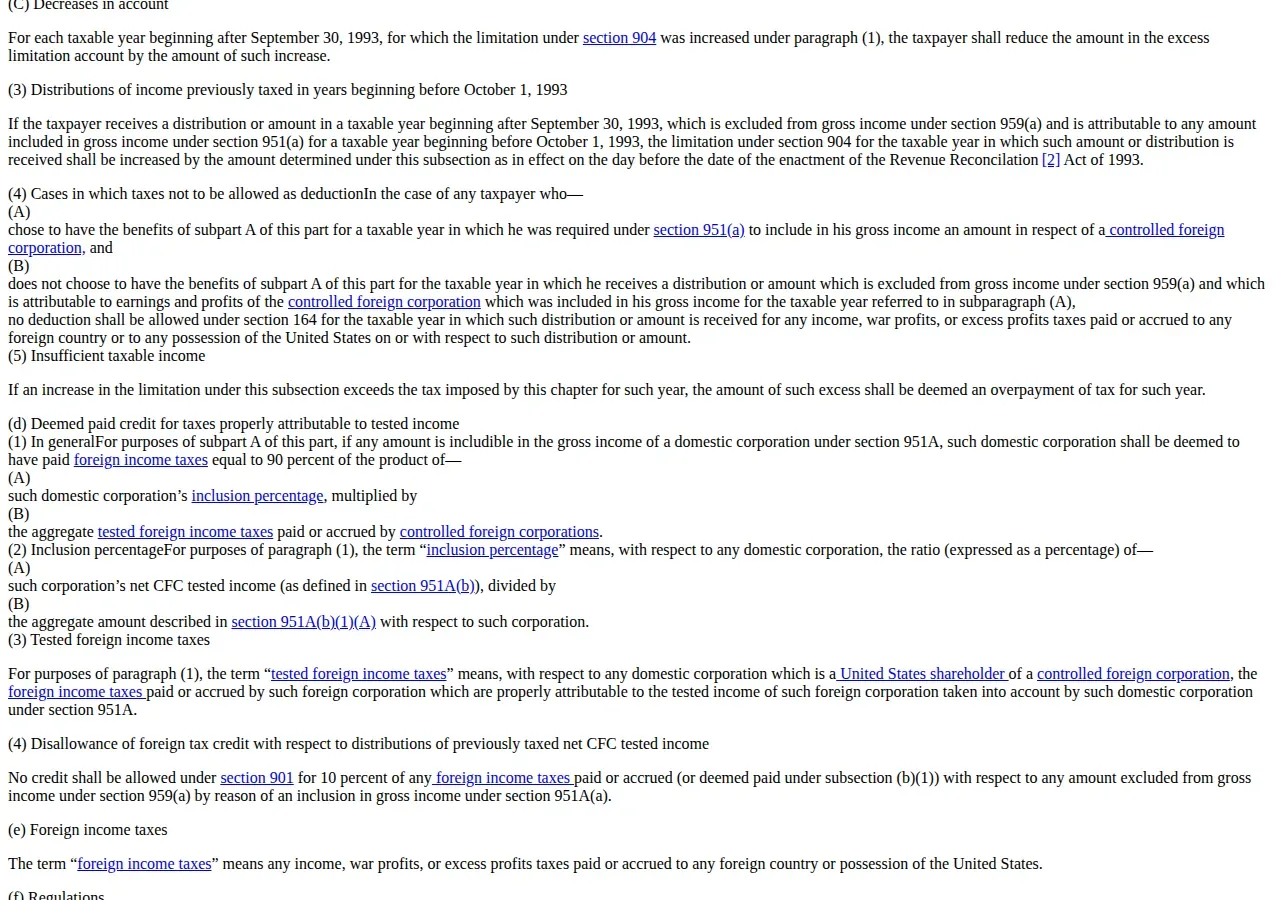
New §960(d)(4) disallows a credit under §901 for 10% of foreign income taxes paid, accrued, or deemed paid under §960(b)(1), on amounts excluded from gross income under §959(a) by reason of a §951A inclusion. The Form 1118 instructions (12/2025) flag it as new and add Schedule G, line H to report it; it applies to inclusions after 28 June 2025. Distributing previously taxed net CFC tested income in 2026 loses 10% of the credit on the tied taxes. A model on the old 80% and 50% figures understates the credit and overstates the deduction.
The execution sequence
- Choose credit or deduction for the year. Compare the §904 limitation against the foreign tax paid. If the limitation is zero, take the §164 deduction; otherwise take the credit and file Form 1118.
- Assign every dollar of foreign-source income to a basket. Use Schedule A; misassignment is the error the IRS finds first.
- Apportion deductions. Allocate interest, research, stewardship, and G&A between US and foreign source (Reg. §1.861-8); the numerator is taxable income, not gross income or GAAP book income.
- Compute the limitation per basket. US tax before credit × foreign-source TI / entire TI, per basket, with the §904(b) adjustments.
- Apply the deemed-paid rules. Schedule C (§951(a)), Schedule D (§951A at 90%), Schedule E (PTEP) — then reduce on Schedule G, including line H for the §960(d)(4) 10%.
- Run the loss accounts on Schedule J. Add, recapture at 50%, and carry the balances.
- Reconcile the carryover on Schedule K. Back one year first, then forward up to ten, in order. Diary the expiry year — 2034 for a 2024 excess.
- Check the CAMT separately. Compute the corporate alternative minimum tax credit on Form 4626.
Pre-filing checklist
- [x] Credit-versus-deduction election documented; §904 limitation computed first.
- [x] Every foreign tax supported by a receipt or assessment.
- [x] Basket assignment reviewed by a CPA against §954(c) and the look-through rules.
- [x] §250 deduction allocated to the §951A basket (§904(b)(5)); no interest or R&E allocated to it.
- [x] §901(m) analysis done for any acquisition in the last ten years.
- [x] Schedule J loss accounts reconciled to the prior-year return.
- [x] Schedule K queue aged, expiry year on the workpaper.
- [x] §905(c) redeterminations identified; Schedule L prepared.
- [x] CAMT credit computed on Form 4626, not assumed from Form 1118.
Who should NOT use this
Form 1118 is the wrong form for an individual with foreign wages, foreign dividends in a brokerage account, or a rental property abroad — that taxpayer files Form 1116. It is the wrong tool for a C-Corp whose only foreign income is a dividend from a specified 10-percent owned foreign corporation: §245A deducts the foreign-source portion and §904(b)(4) removes it from the limitation. It cannot claim a credit for foreign taxes on income the United States does not tax — §901(m) disallows the slice from a stepped-up basis, §901(j) the whole credit for listed countries. And it is not a substitute for a transfer-pricing study: if the foreign-source income figure is wrong, the limitation is wrong.
Founder & CEO Insight — Enow A. Jovial