IRS Form 1040 Schedule A: The Itemized Deductions Playbook
Schedule A is the form where a taxpayer proves the standard deduction is the wrong answer. For tax year 2026 the standard deduction is $16,100 for a single filer and $32,200 for a married couple filing jointly, under Rev. Proc. 2025-32. Every dollar above that line reduces taxable income; every dollar below it is worth nothing. The form has 18 lines and six deduction groups, each on its own statute, cap, and recordkeeping rule.
The choice is binary and annual — itemize or take the standard deduction, never both. A filer who itemized in 2025 for a $40,000 surgery may take the standard deduction in 2026.
Who this is for — and who should stop here
This guide is for a U.S. individual filer deciding whether to itemize for tax year 2026: a homeowner, a household with large medical bills, a high-tax-state resident, a donor, or a filer who suffered a disaster loss. It is not for a business — business expenses belong on Schedule C; see the Schedule C self-employed playbook — nor for a nonresident alien filing Form 1040-NR, who generally cannot claim the standard deduction.
Identifiers matter: your SSN or ITIN, your spouse's SSN, and a charity's EIN on Form 8283. An LLC, S-Corp, or C-Corp files its own return — the owner's Schedule A never carries the entity's expenses.
> [!FOUNDER]
> "Most people treat Schedule A as a form to fill in. I treat it as a negotiation with the standard deduction. The standard deduction is the government's opening offer — $16,100 for a single filer in 2026 — and Schedule A is your counter-offer. You win it with receipts, one line at a time, and you lose it the moment you claim a dollar you cannot prove."
> — Enow A. Jovial, Founder & Chief Executive Officer
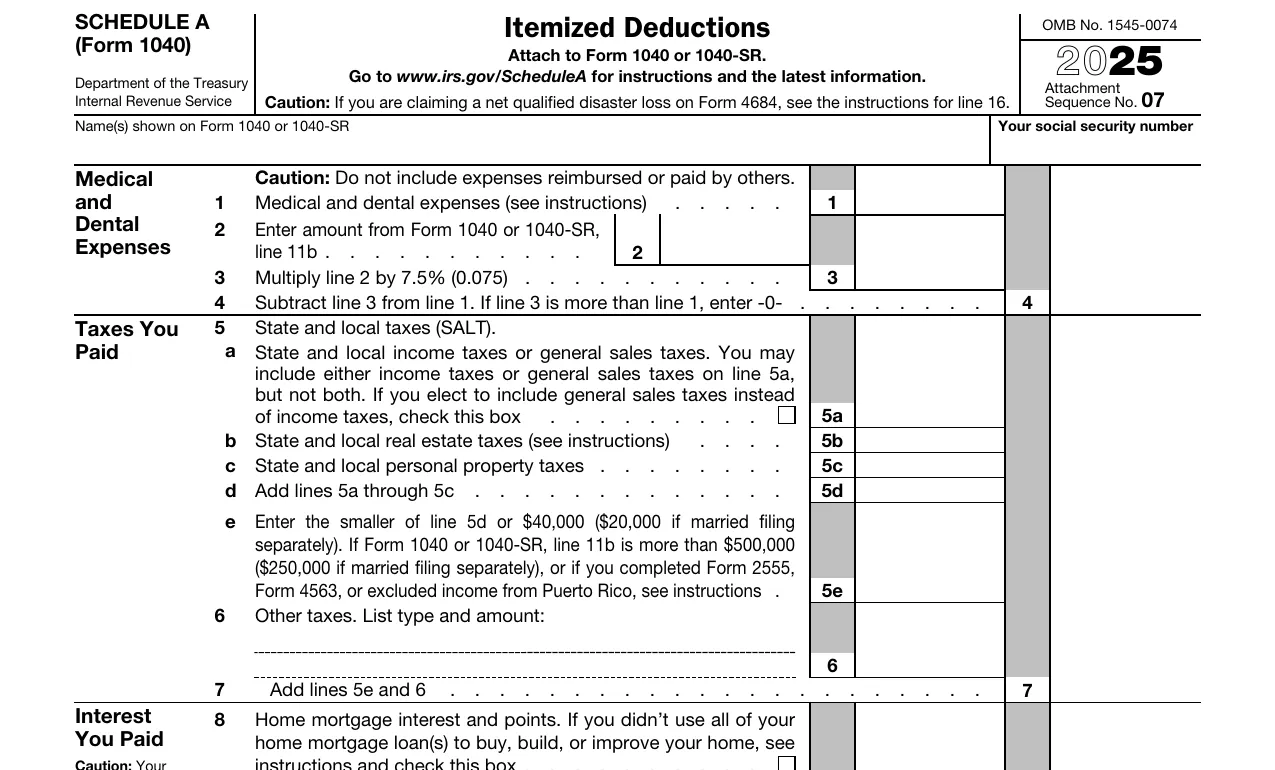
The form at a glance: all 18 lines
Six groups: medical and dental (1–4), taxes paid (5–7), interest paid (8–10), gifts to charity (11–14), casualty and theft losses (15), and other itemized deductions (16).
| Lines | Group | Statute | The cap that matters |
| :--- | :--- | :--- | :--- |
| 1–4 | Medical and dental | 26 U.S.C. § 213 | Only expenses above 7.5% of AGI count |
| 5–7 | Taxes paid (SALT) | 26 U.S.C. § 164 | $40,400 for 2026 ($20,200 MFS), MAGI phase-down |
| 8–10 | Interest paid | 26 U.S.C. § 163 | Mortgage interest on $750,000 of acquisition debt |
| 11–14 | Gifts to charity | 26 U.S.C. § 170 | 60% / 30% / 20% of contribution base, plus a 0.5% floor |
| 15 | Casualty and theft | 26 U.S.C. § 165 | $100 per casualty, then only above 10% of AGI; disaster only |
| 16 | Other itemized | 26 U.S.C. §§ 67, 165(d) | Miscellaneous deductions suspended; gambling losses at 90% |
Lines 1–4: medical and dental expenses, the 7.5% floor
Section 213(a) allows a deduction for medical care of the taxpayer, spouse, or dependent, "to the extent that such expenses exceed 7.5 percent of adjusted gross income." Line 1 is total medical expenses, line 2 is AGI (Form 1040, line 11b), line 3 is 7.5% of line 2, and line 4 is line 1 minus line 3 — zero if the floor is higher.
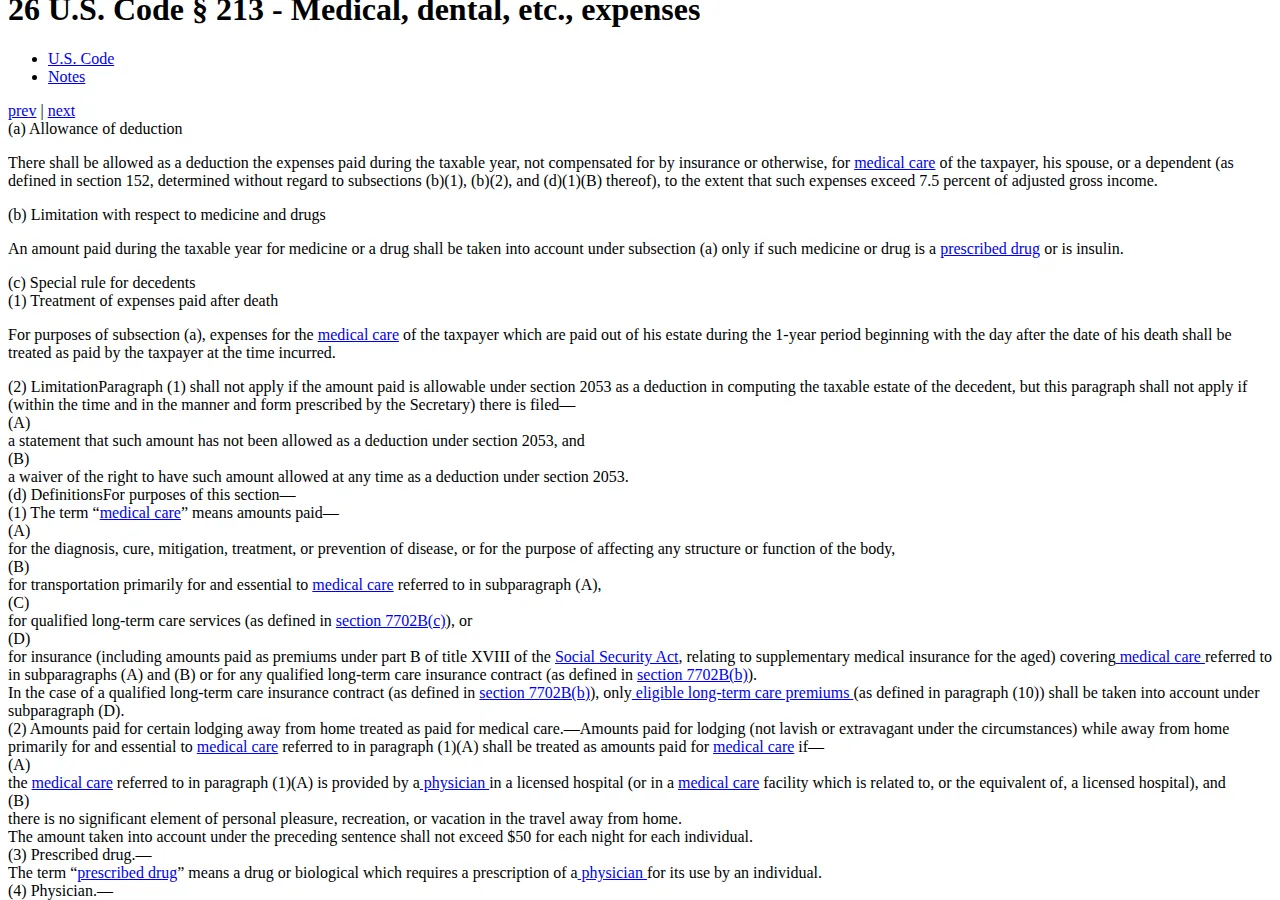
Deductible: payments to doctors, dentists, hospitals, and prescription drugs and insulin plus after-tax premiums and mileage to appointments. Not deductible: reimbursed expenses, cosmetic surgery, health club dues, and non-prescribed over-the-counter medicine.
Medical expenses are deductible in the year paid, not the year incurred. A filer past the 7.5% floor in December should pay January's planned procedure in December; a filer below the floor gains nothing by accelerating.
Worked example: the medical floor
A single filer with $120,000 AGI paid $14,000 in unreimbursed medical expenses in 2026: a $9,500 surgery, $3,000 in premiums, $1,500 in prescriptions.
$
\text{Floor} = 0.075 \times \$120{,}000 = \$9{,}000
$
$
\text{Line 4 deduction} = \$14{,}000 - \$9{,}000 = \$5{,}000
$
Only $5,000 reaches line 17. At $200,000 AGI the floor would be $15,000 and the whole $14,000 would produce zero — same bills, $5,000 of difference from income alone.
> [!KEY TAKEAWAY]
> The medical deduction is not a refund of medical spending. It is a deduction of the spending above 7.5% of AGI.
Lines 5–7: taxes you paid — the SALT cap
Line 5 covers state and local taxes: 5a is income taxes or general sales taxes (one or the other, never both), 5b is real estate taxes, 5c is personal property taxes, 5d adds them, 5e applies the cap. Line 6 is other taxes. The cap comes from § 164(b)(6) as rewritten by the One Big Beautiful Bill Act (P.L. 119-21): $40,000 for 2025, $40,400 for 2026, rising 1% a year through 2029, then $10,000 for tax years beginning after 2029 ($20,200 MFS in 2026).
Under § 164(b)(7)(B), the cap falls by 30% of modified AGI above $505,000 for 2026 ($252,500 MFS), never below $10,000: at $600,000 MAGI the cap is $11,900 (30% of the $95,000 excess is $28,500).
Federal income tax, FICA and SECA payroll taxes, estate and inheritance tax, homeowner association fees, and water, sewer, and trash service charges are all nondeductible on Schedule A. For the full SALT operation, see the SALT cap $40,000 OBBBA playbook.
Lines 8–10: interest you paid — the mortgage rules
Line 8 is home mortgage interest and points: 8a is interest reported on Form 1098, 8b is interest not reported on Form 1098, 8c is points not reported on Form 1098, 8e totals them. Line 9 is investment interest, deductible only up to net investment income. Line 10 totals the group.
Under § 163(h)(3), interest is deductible only on acquisition debt — debt to buy, build, or substantially improve a first or second home — and only on the first $750,000 of that debt for loans taken out after December 15, 2017 ($375,000 MFS). Debt from on or before December 15, 2017 is grandfathered at $1,000,000 ($500,000 MFS). Home equity debt is not deductible at all for tax years after 2017, regardless of what the money was spent on.
The limit applies to the debt, so the deductible fraction is the limit divided by the average balance. A filer with an $800,000 acquisition loan from 2022 paying $48,000 of interest at 6% deducts $45,000 ($48,000 × $750,000 / $800,000); the remaining $3,000 is permanently nondeductible.
> [!TIP]
> Points on a purchase mortgage are deductible in the year paid. Points on a refinance must be spread over the life of the loan — $6,000 on a 30-year refinance yields $200 a year, not $6,000.
Lines 11–14: gifts to charity — three caps and a new floor
Line 11 is cash gifts, line 12 noncash gifts, line 13 carryover, line 14 totals them. Section 170 runs on contribution base — roughly AGI without net operating loss (NOL) carrybacks — and three percentage caps. Cash gifts to public charities: up to 60% of contribution base (§ 170(b)(2)(G)). Appreciated property to public charities: 30%. Capital gain property to a private foundation: 20% (§ 170(b)(1)(D)). Amounts above a cap carry forward for up to five years (line 13).
A new floor applies for tax years beginning after December 31, 2025: contributions are allowed only above 0.5% of contribution base. A filer with a $200,000 contribution base and $6,000 of cash gifts deducts $5,000: the first $1,000 — 0.5% of $200,000 — is absorbed by the floor, and the 60% cap of $120,000 does not bind. A $400 gift from a filer with a $100,000 contribution base sits below the $500 floor and produces no deduction.
Substantiation is strict: any single gift of $250 or more requires a written acknowledgment from the charity before the return is filed; noncash gifts above $500 require Form 8283, and above $5,000 a qualified appraisal. A gift that buys a benefit is deductible only above the benefit's value.
Line 15: casualty and theft losses — disaster only
Line 15 takes the amount from Form 4684, line 18: casualty and theft losses from a federally declared disaster. The gate is § 165(h)(5): for tax years after 2017, a personal casualty loss is deductible only if attributable to a federally declared disaster (or, under the OBBBA amendment, a state declared disaster). A house fire, burst pipe, or stolen car outside a declared disaster produces no Schedule A deduction.
Two floors apply: $100 per casualty under § 165(h)(1) ($500 for qualified disaster-related losses), and the net loss only above 10% of AGI under § 165(h)(2). A $30,000 uninsured flood loss for a filer with $120,000 AGI yields $17,900: $30,000 minus $100, minus 10% of AGI ($12,000).
Line 16: other itemized deductions — what is left
Line 16 is the smallest line on the form. The miscellaneous itemized deductions that once lived here — unreimbursed employee expenses, tax preparation fees, investment advisory fees, union dues, hobby expenses — are gone. The Tax Cuts and Jobs Act suspended them for 2018–2025 under § 67(g); the One Big Beautiful Bill Act, § 70110, struck the 2026 end date, and the provision now sits at § 67(h): "no miscellaneous itemized deduction shall be allowed for any taxable year beginning after December 31, 2017." The suspension is permanent, except for educator expenses under § 67(b)(13).
What remains on line 16: gambling losses, federal estate tax on income in respect of a decedent, bond premium, and the educator expense. Gambling losses carry their own OBBBA change: under § 165(d), the amount allowed is 90% of wagering losses, only to the extent of wagering gains. A gambler who won and lost $20,000 deducts $18,000 — the $2,000 difference is a real tax cost of breaking even.
> [!WARNING]
> Claiming a suspended miscellaneous deduction is the fastest way to turn Schedule A into an audit flag: unreimbursed employee expenses, tax preparation fees, and investment management fees are not deductible for any tax year beginning after 2017.
Line 17, line 18, and the decision that matters
Line 17 adds lines 4–16 and carries the total to Form 1040, line 12e. Line 18 elects to itemize even below the standard deduction — usually wrong, but right when a spouse files separately and the other spouse itemizes, because § 63(c)(6)(A) then denies the standard deduction.
| Situation | Itemize | Take the standard deduction | Authority |
| :--- | :--- | :--- | :--- |
| Single, 2026 itemized $30,300 vs standard $16,100 | Yes — $14,200 extra | No | Rev. Proc. 2025-32, § .14 |
| Single, 2026 itemized $9,000 vs standard $16,100 | No | Yes — $7,100 more | Rev. Proc. 2025-32, § .14 |
| MFJ, 2026 itemized $32,500 vs standard $32,200 | Marginal — $300 extra | Usually yes | Rev. Proc. 2025-32, § .14 |
| MFS, spouse itemizes | Must itemize | Not available | 26 U.S.C. § 63(c)(6)(A) |
Worked example: the break-even
A single filer in 2026 has $9,800 of mortgage interest, $12,000 of SALT, $3,500 of cash gifts, and the $5,000 medical amount from the earlier example. Itemized total: $30,300; standard deduction: $16,100.
$
\text{Excess over standard} = \$30{,}300 - \$16{,}100 = \$14{,}200
$
$
\text{Tax saved at a 22\% marginal rate} = \$14{,}200 \times 0.22 = \$3{,}124
$
Itemizing is worth $3,124. Without the mortgage and medical amounts, the total would be $15,500 — $600 short — and itemizing would cost $132. Check your own break-even with the Self-Employed Tax & Quarterly Estimator. A filer $600 short should find $600 of legitimate deductions before year-end.
The 2026 haircut: section 68 trims the top bracket
The OBBBA replaced the old Pease limitation with a new § 68: itemized deductions fall by 2/37 of the lesser of the itemized total or taxable income above the 37% bracket threshold, capping the marginal value of a deduction at 35% instead of 37%. A filer with $50,000 of itemized deductions and $100,000 of income above the 37% threshold loses $2,702.70. The haircut applies after every other limitation and does not touch the standard deduction.
Risk layer: the five mistakes that cost money
First, the SALT cap as $10,000 — the 2026 cap is $40,400. Second, deducting home equity interest — nondeductible since 2018. Third, forgetting the medical floor and adding the full bill to line 17. Fourth, charitable gifts without the written acknowledgment — the IRS disallows the entire gift. Fifth, filing Schedule A when the standard deduction is larger; the IRS does not correct that error in the filer's favor. The defense is a receipt, a statement, or a contemporaneous log for every dollar.
Cross-border context: where Schedule A stops
A U.S. citizen abroad files the same Schedule A — excluded foreign earned income under § 911 is not part of AGI, which lowers the floors, but deductions allocable to it are disallowed. A nonresident alien files Form 1040-NR and generally cannot claim the standard deduction, and a filer claiming the foreign tax credit cannot also deduct the same taxes on Schedule A.
Filing checklist: Schedule A, tax year 2026
1. Pull Form 1040, line 11b (AGI) first — every floor on the form is computed from it.
2. Gather medical receipts and premium statements; subtract reimbursements before totaling line 1.
3. Multiply AGI by 7.5% for line 3; enter line 1 minus line 3 on line 4, or zero.
4. Total state income, real estate, and personal property taxes on 5d; cap at $40,400 ($20,200 MFS) on 5e; apply the MAGI phase-down above $505,000 ($252,500 MFS).
5. Pull Form 1098; confirm acquisition debt within the $750,000 limit ($1,000,000 if grandfathered pre-December 15, 2017).
6. List charitable gifts with acknowledgments for every gift of $250 or more; attach Form 8283 above $500 noncash; apply the 0.5% floor.
7. For a casualty loss, confirm a disaster declaration, file Form 4684, subtract $100 per casualty, then 10% of AGI.
8. Add lines 4–16 on line 17; compare with the 2026 standard deduction ($16,100 single, $32,200 MFJ, $24,150 head of household); itemize only if line 17 is larger.
9. If in the 37% bracket, apply the § 68 haircut: reduce line 17 by 2/37 of the lesser of the itemized total or taxable income above the 37% threshold.
10. Keep every receipt, 1098, acknowledgment letter, and Form 4684 for at least three years.
Interest and dividends feed the itemized-versus-standard decision: the Schedule B interest and dividends playbook prices the $1,500 trigger, qualified dividends, and the FBAR questions in Part III.