The departure gate nobody warns you about
An alien leaving the United States cannot simply board the plane. Before departure, the Internal Revenue Service can require a certificate of compliance — the sailing permit — obtained by filing Form 1040-C, U.S. Departing Alien Income Tax Return, or the shorter Form 2063, at a local IRS Taxpayer Assistance Center. No permit, no clean exit: the certificate proves the tax on U.S. income has been settled, bonded, or shown not to be in jeopardy. This playbook covers the filing operation: who must get the permit, which form applies, the 30-day window, the tax computation in Groups I, II, and III, and the termination assessment that turns a routine departure into an immediate demand for payment.
This guide is for the nonresident alien employee, the resident alien founder, and the green card holder relocating abroad — and for the CPA who must get the client on the plane without a missed deadline. The departure tax is not a separate tax: it is the ordinary income tax for the year of departure, computed early on income received or reasonably expected through the departure date, and paid at the Taxpayer Assistance Center before the flight. If the question is whether you are a resident alien at all, start with our Form 8840 closer connection exception playbook, and if a U.S. real property sale is part of the departure, the Form 8288 FIRPTA withholding tax return playbook covers the buyer's 15 percent withholding at closing.
Who must file, and who is excused
The rule is broad: if you are an alien, do not leave the United States or its territories without a certificate of compliance, unless you meet an exception. The certificate is not a final determination of liability — if more tax is later found due, you pay it. The permit clears the departure, not the account.
The exceptions are narrow and specific, and each one has a trap:
| Exception | Who qualifies | The trap |
|---|---|---|
| Diplomatic and international-organization personnel | A foreign-government representative holding a diplomatic passport, household members, an accompanying servant, or an employee of an international organization or foreign government whose official pay is exempt from U.S. tax and who has no other U.S. source income | A signed waiver of nonimmigrant privileges kills the exception — you must get a certificate |
| Students, trainees, and exchange visitors | A student, industrial trainee, or exchange visitor — or spouse or child — holding an F-1, F-2, H-3, H-4, J-1, J-2, or Q visa | Only four U.S. income types are permitted: study allowances, services or accommodations incident to the study, authorized employment income, and deposit interest not effectively connected with a U.S. trade or business |
| Vocational students | A student, or spouse or child, holding an M-1 or M-2 visa | Only authorized employment income or deposit interest not effectively connected with a U.S. trade or business |
Form 2063 vs Form 1040-C: the fork
Two forms can produce the permit, and the choice is a test, not a preference. File the shorter Form 2063 only if you filed all required returns, paid all tax due, and either have no taxable income for the year of departure and the preceding year, or are a resident alien whose departure the Area Director has ruled will not hinder collection. Everyone else files Form 1040-C.
| Test | Form 2063 | Form 1040-C |
|---|---|---|
| All required returns filed and tax paid | Required | Required for the permit in any case |
| Taxable income in the year of departure or the preceding year | None, or the Area Director has ruled the departure does not hinder collection | Any amount; the form computes the tax |
| What the form does | A short statement that no tax is due or collection is not hindered | A full return: income, deductions, credits, and the tax for the year to date |
| Joint return | Not applicable | Nonresident aliens cannot file a joint return; resident aliens can |
If you do not qualify for Form 2063, you must file Form 1040-C: an original and one copy for the tax year in which you plan to leave, reporting all income received or reasonably expected through the departure date.
The math: Groups I, II, and III
Form 1040-C sorts the filer into groups, and the group decides which lines compute the tax: Groups I or II use lines 16 through 23, Group III uses lines 24 and 25, and a nonresident alien in both Groups II and III uses lines 16 through 25. A resident alien under 26 U.S.C. 7701(b) uses the Form 1040 adjustments; a nonresident alien taxes income effectively connected with a U.S. trade or business — ECI — under the nonresident rules, while income not effectively connected — FDAP such as dividends, interest, and royalties — is taxed at the flat 30 percent rate unless a treaty lowers it.
The departure return is a stub-year computation: income from January 1 through the departure date, taxed as though that period were the whole year.
Take a concrete case. A nonresident alien software engineer on an H-1B visa departs on June 30, 2026, after six months of U.S. work: salary through June 30 is 96,000 dollars, with 14,400 dollars withheld, and no other U.S. income. On Form 1040-C the engineer reports the 96,000 dollars and computes a stub-year tax of 12,800 dollars. The 14,400 dollars withheld covers it, so nothing is due at the appointment — and the 1,600 dollar overpayment is not refunded at departure but claimed on the final Form 1040-NR, with the 1040-C payment credited against the final liability.
Now change one fact: the engineer also received 40,000 dollars of U.S. dividends, FDAP income taxed at 30 percent with no treaty reduction. The additional tax is 12,000 dollars, and the departure computation becomes 12,800 dollars plus 12,000 dollars, or 24,800 dollars, against 14,400 dollars withheld — 10,400 dollars due at the appointment, payable in certified funds. That is the departure gate doing its job: the dividend tax that would otherwise be collected after the filer is gone is collected before the plane leaves. Run the same numbers for your own departure through our tax estimator before the appointment, so the figure on the form is not a surprise.
Founder & CEO Insight — Enow A. Jovial
The 30-day window and the Taxpayer Assistance Center
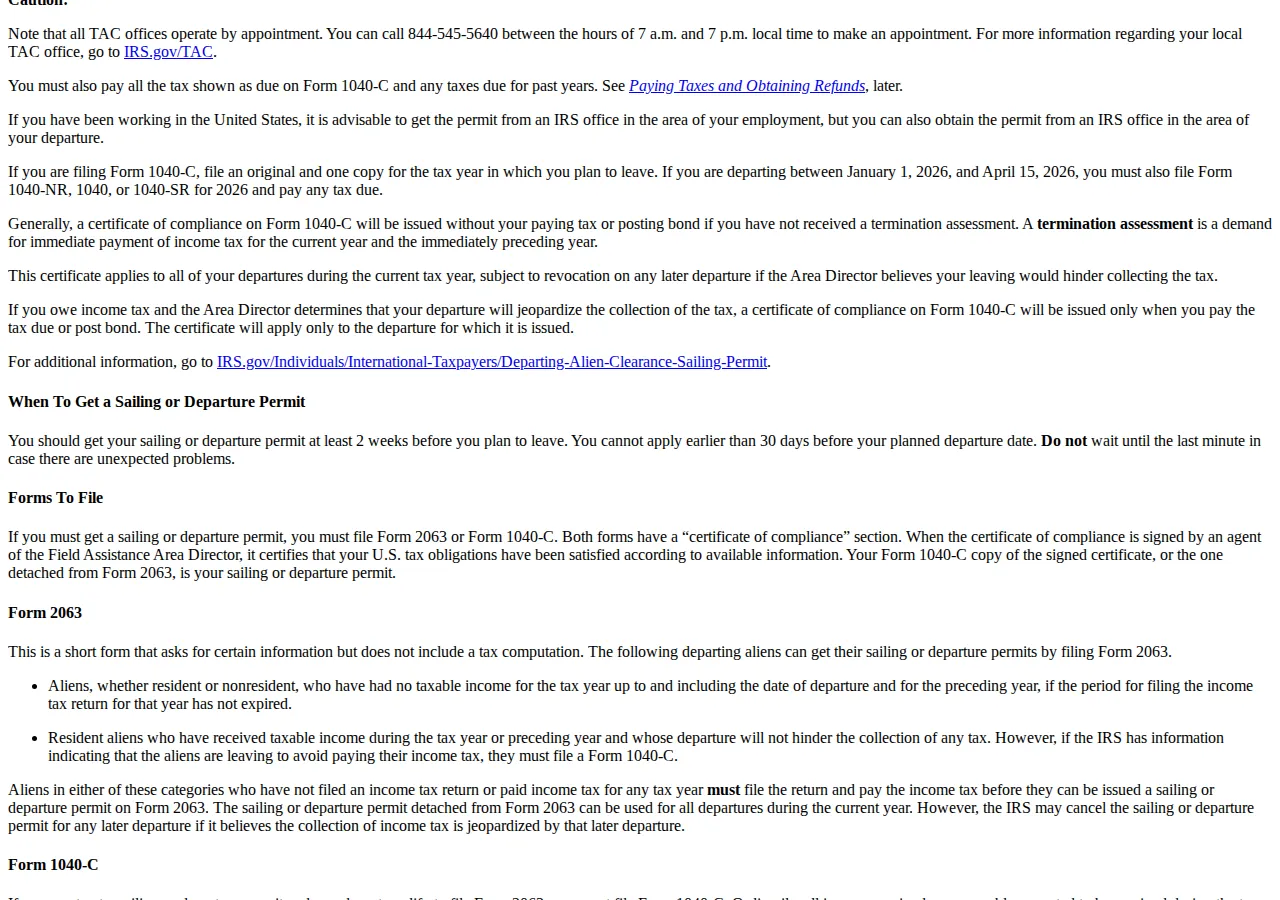
The timing is a window, not a single date: get the permit at least 2 weeks before you plan to leave, and no earlier than 30 days before departure. The appointment is at a local IRS Taxpayer Assistance Center, all of which operate by appointment only — call 844-545-5640 between 7 a.m. and 7 p.m. local time, well before the window opens; services are limited and not every office offers them.
Bring the file that proves the return: a valid passport with your alien registration card (green card) or visa, with your SSN or ITIN and EIN where the return uses them; copies of your U.S. income tax returns filed for the past 2 years, or for the shorter period you were in the United States; receipts for taxes paid on those returns; bank records and canceled checks proving your deductions, business expenses, and dependents; an employer statement of wages paid and tax withheld for the current year — or, if self-employed, an income and expense statement to the departure date; and proof of estimated-tax payments for the past year and the current year.
Pay, bond, or return: the three ways out
Except when a bond is furnished, or the IRS is satisfied that your departure does not jeopardize collection, you must pay all tax shown as due on Form 1040-C at filing, plus any taxes due for past years. An overpayment means no tax to pay at filing — but no refund at departure either; the refund waits for the final return.
The three routes out of the appointment are:
- Pay. Bring the payment in certified funds — a cashier's check, a certified bank or postal money order, or cash. Check the local Taxpayer Assistance Center for payment options.
- Bond. If you have paid all taxes due for prior years, furnish a bond guaranteeing payment instead of paying the tax shown on Form 1040-C or the tax on the preceding year's return if the period for filing that return has not expired. The bond must equal the tax due plus interest to the date of payment as figured by the IRS.
- Return. If you show the IRS, to its satisfaction, that you intend to return and that your departure does not jeopardize collection, you can get the permit by filing Form 1040-C without paying the tax shown — provided you file all unfiled returns, pay all tax due on them, and report all income received and reasonably expected during the entire year of departure. The permit covers all departures during the current year, though the IRS may cancel it for a later departure if collection is jeopardized.
Generally, a certificate of compliance on Form 1040-C will be issued without your paying tax or posting bond if you have not received a termination assessment. That sentence is the hinge of the whole operation — and it is why the termination assessment matters.
The termination assessment: section 6851
Section 6851 of the Internal Revenue Code is the enforcement arm behind the permit. If the Secretary finds that a taxpayer designs quickly to depart from the United States or to remove property from the United States, or to conceal himself or his property, or to do any other act tending to prejudice or render wholly or partially ineffectual proceedings to collect the income tax for the current or the immediately preceding taxable year unless the proceeding is brought without delay, the Secretary shall immediately make a determination of tax for the current taxable year or the preceding taxable year, or both, and the tax shall become immediately due and payable.
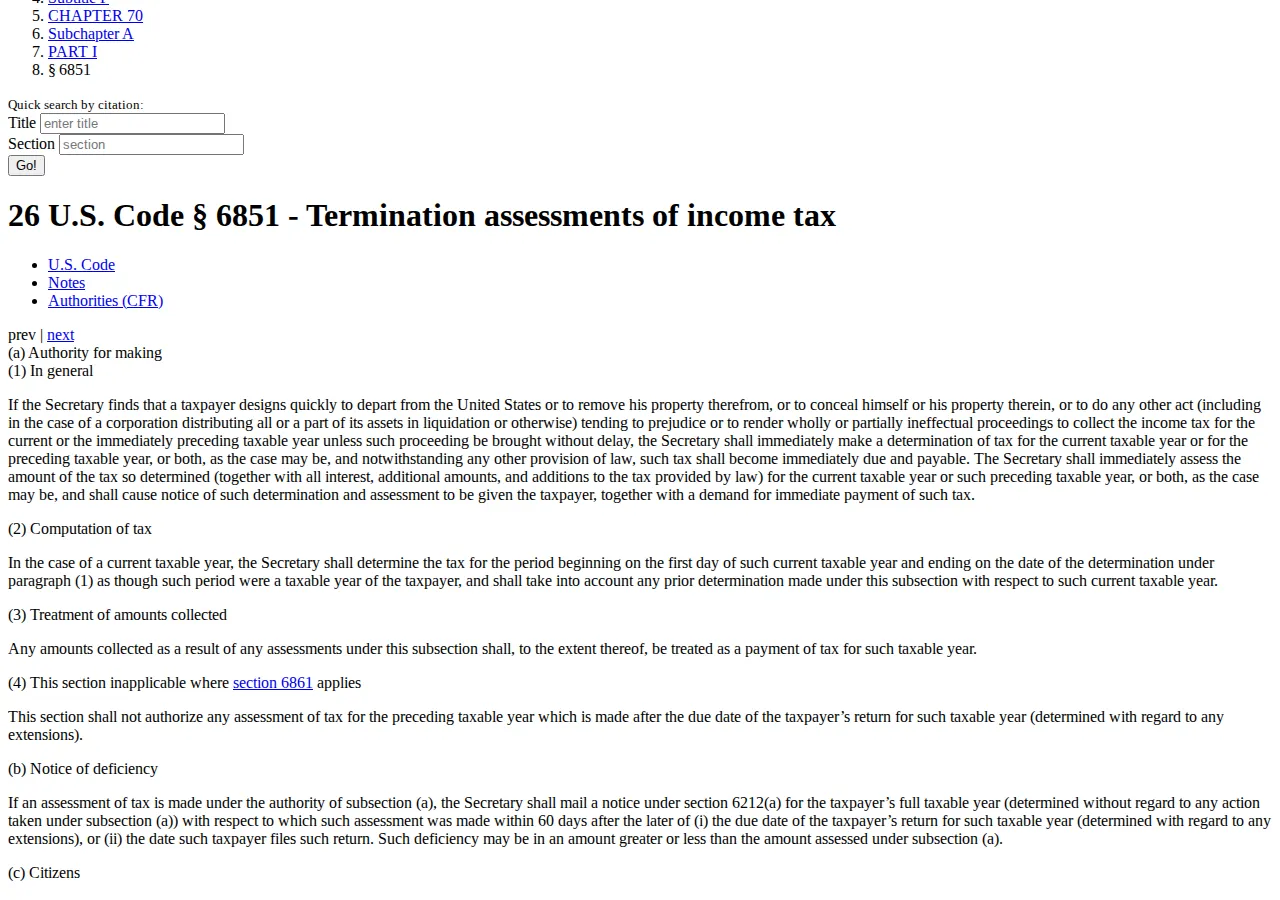
The computation is a stub year: the tax for the period from January 1 to the determination date, as though that period were a taxable year. A termination assessment is a demand for immediate payment for the current year and the immediately preceding year. Two limits protect the taxpayer: no assessment for the preceding year after that year's return due date, and a notice of deficiency for the full year within 60 days after the later of the return due date, with extensions, or the filing date.
In practice, the termination assessment is what happens when departure looks like flight rather than relocation: assets being moved, returns unfiled, the address already foreign. The filer who books the appointment 30 days out with two years of returns never meets section 6851. The filer who books a one-way ticket with unfiled returns and a wired-out bank account meets it at the gate — and the tax becomes due on the spot, not on April 15.
The departure checklist
- [x] Set the departure date and window. No earlier than 30 days before departure; the permit should be in hand at least 2 weeks before the flight.
- [x] Test the exceptions first. A single dollar of unauthorized U.S. income can break the student exception.
- [x] Choose the form. Form 2063 only if all returns are filed, all tax is paid, and there is no taxable income for the year of departure and the preceding year, or the Area Director has ruled collection is not hindered.
- [x] Book the Taxpayer Assistance Center appointment: call 844-545-5640, 7 a.m. to 7 p.m. local time, well before the window opens; confirm the office handles departing-alien permits.
- [x] Assemble the paper. Passport and visa or green card, two years of filed returns with payment receipts, employer wage statements or a self-employment income and expense statement to the departure date, and proof of estimated-tax payments.
- [x] Compute Groups I, II, and III. Report all income through the departure date; ECI under the nonresident rules, FDAP at 30 percent unless a treaty lowers it.
- [x] Decide pay, bond, or return. Certified funds at the appointment, a bond equal to tax plus interest, or the returning-resident route with all prior returns filed.
- [x] File the final return after the year ends. Form 1040, 1040-SR, or 1040-NR as the last-day status requires, with the 1040-C payment credited and any overpayment claimed there.
The sailing permit is a small form with a large consequence: the only paper between a relocation and a tax demand at the gate. The 30-day window, two years of returns, and certified payment are the price of a clean exit — the termination assessment is the price of skipping them.