IRS Form 1023: The 501(c)(3) Tax-Exemption Application Playbook
A food pantry incorporates in January and raises $80,000 in its first year. Its donors assume their gifts are tax-deductible. Incorporating as a nonprofit corporation under state law does not make an organisation exempt from federal income tax. Exemption under section 501(c)(3) is a separate federal status, and the only way to get the IRS to recognise it is Form 1023 — or the streamlined Form 1023-EZ if it qualifies. If the IRS approves, it issues a determination letter stating the organisation's exempt status and its qualification to receive tax-deductible charitable contributions.
What section 501(c)(3) actually requires
Section 501(c)(3) exempts corporations, community chests, funds, and foundations "organised and operated exclusively for religious, charitable, scientific, testing for public safety, literary, or educational purposes, or to foster national or international amateur sports competition, or for the prevention of cruelty to children or animals." Three further conditions sit in the same sentence: no part of the organisation's net earnings may inure to the benefit of any private shareholder or individual; no substantial part of its activities may be carrying on propaganda or attempting to influence legislation, except as provided in subsection (h); and the organisation must not participate in, or intervene in, any political campaign for or against any candidate for public office.
The organisational test asks whether the organising document limits purposes to exempt purposes and contains a dissolution clause dedicating assets to exempt purposes on dissolution. The operational test asks what the organisation actually does: its activities must be primarily in furtherance of its exempt purposes, and it must not operate for the benefit of private interests.
Section 508 adds the procedure. Under section 508(a), an organisation organised after October 9, 1969 is not treated as described in section 501(c)(3) unless it has given notice to the Secretary that it is applying for recognition — Form 1023 is that notice. Under section 508(b), an organisation that does not notify the Secretary that it is not a private foundation is presumed to be one. Section 508(c) excepts churches, their integrated auxiliaries, and conventions or associations of churches, and any non-private-foundation organisation whose gross receipts are normally not more than $5,000 in each taxable year.
Form 1023 vs Form 1023-EZ: the eligibility decision
Form 1023 is the full application: a long online form filed through Pay.gov, with narrative activity descriptions, financial statements, compensation schedules, and supporting documents. Form 1023-EZ is a three-page streamlined version for small organisations. The choice is a set of eligibility gates in the Form 1023-EZ Eligibility Worksheet, and the two gates that decide most cases are financial.
| Test | Form 1023-EZ | Full Form 1023 | Authority |
|---|---|---|---|
| Projected receipts | $50,000 or less, each of the next 3 years | Any amount | Form 1023-EZ Worksheet Q1 |
| Actual receipts | $50,000 or less, each of the past 3 years | Any amount | Form 1023-EZ Worksheet Q2 |
| Total assets | $250,000 or less | Any amount | Form 1023-EZ Worksheet Q3 |
| User fee | $275 | $600 | Rev. Proc. 2025-5, Appendix A |
| Filing | Online at Pay.gov | Online at Pay.gov | Instructions for Form 1023 |
| Determination letter | Same letter | Same letter | Instructions for Form 1023 |
The worksheet also disqualifies churches, schools, hospitals, supporting organisations under section 509(a)(3), organisations with a foreign address, previously revoked organisations, and organisations that took over a for-profit entity's assets. Any disqualifying answer means the full Form 1023, regardless of size. It also asks about unlisted securities and digital assets.
The money: fees, professional costs, and the cost of getting it wrong
The user fees are set by Rev. Proc. 2025-5, Appendix A: $275 for Form 1023-EZ and $600 for all other applications for recognition of exemption under section 501. The fee is paid through Pay.gov when the application is submitted. A wrong fee stalls the application.
The fee is the smallest line in the real budget — most organisations hire a CPA or an attorney, and the comparison that matters is the total cost of each path:
Take a food pantry projecting $60,000 of receipts and $40,000 of deductible donations. It files the full Form 1023 for $600 and pays a CPA $2,500: $3,100. If the application is denied for a defective dissolution clause and the organisation spends 4 months fixing it, with donations down $1,000 a month, the delay costs another $4,000. Had it projected $49,000, it would have filed the EZ form for $275 with $1,200 of review: $1,475. The $325 fee difference is trivial; the delay exposure is the real money. Run your own numbers through the Break-Even Analysis Calculator before choosing a path.
Worked example: two organisations, two filings
Hope Learning Center, Inc., a Delaware nonprofit formed March 15, 2026, runs after-school tutoring. Its board projects receipts of $180,000 in 2026, $240,000 in 2027, and $310,000 in 2028, and it holds $40,000 of donated computers and cash. It fails the EZ receipts gate in all three years, so it files the full Form 1023 for $600. Its articles state a charitable and educational purpose and include a dissolution clause dedicating assets to a named 501(c)(3) organisation. It obtains an employer identification number (EIN) on Form SS-4 and files Form 1023 on September 10, 2026 — within 27 months of the end of March 2026, so if approved, its exemption is effective from March 15, 2026.
Riverside Food Pantry, Inc., a Texas nonprofit formed June 2, 2026, distributes donated food. It projects $42,000 of receipts in each of its first three years and holds $18,000 of assets. It answers "No" to every disqualifying question on the EZ Worksheet, so it files Form 1023-EZ and pays $275. Its first-pass cost, with a $900 CPA review, is $1,175 — against Hope Learning Center's $3,100. Riverside files on November 5, 2026, also inside the 27-month window, so its exemption is also retroactive to its formation date.
The 27-month deadline and retroactive exemption
The Instructions for Form 1023 state the rule plainly: file within 27 months after the end of the month in which you were legally formed, and if the IRS approves, the effective date of your exempt status is your legal date of formation. File later and the effective date is the filing date. The 27 months run from the end of the formation month — an organisation formed March 15, 2026 has until June 30, 2028 to file and still get retroactive exemption.
An organisation formed March 15, 2026 that files on August 20, 2028 — two months past the June 30, 2028 deadline — loses retroactivity for March 2026 to August 2028. At $3,000 a month in donations over those 29 months, $87,000 of contributions were made to a taxable organisation. The filing date, not the approval date, counts.
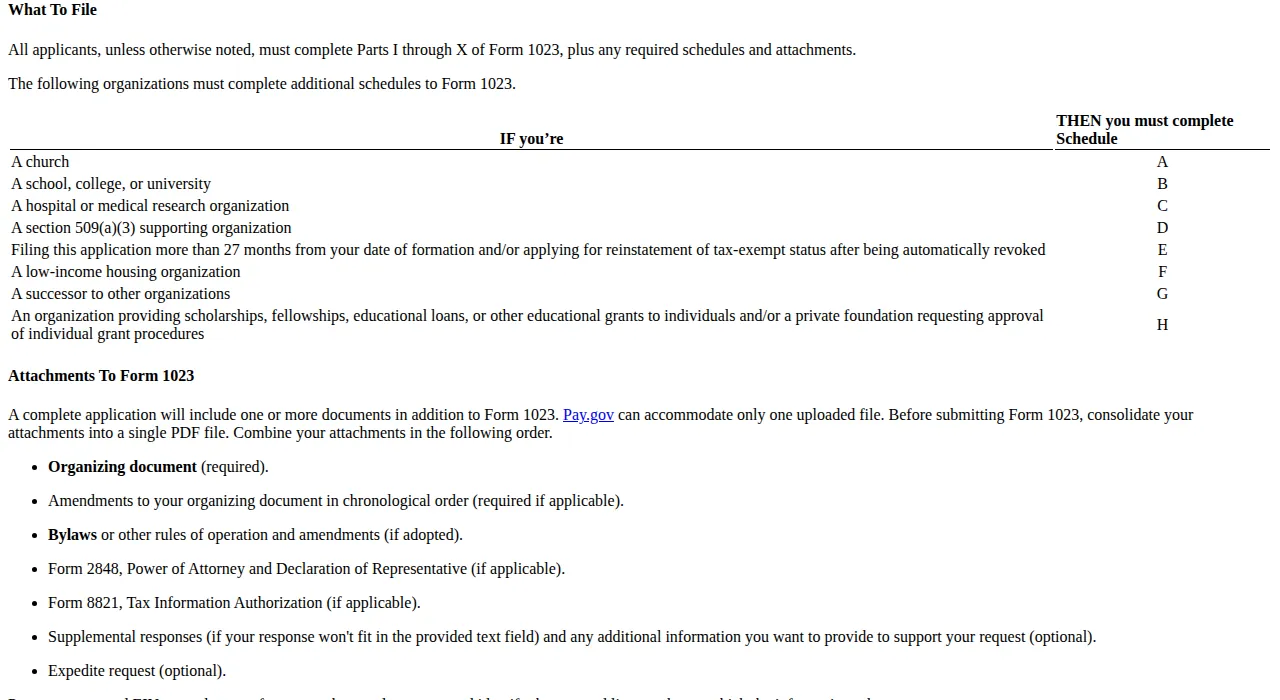
Relief exists but is not automatic. Schedule E of Form 1023 lets a late filer request an earlier effective date by showing it acted reasonably and in good faith and that relief will not prejudice the interests of the government. The IRS weighs whether the organisation filed before the IRS discovered the failure, intervening events, reliance on professional advice, and the difference in aggregate tax liability between retroactive exemption and taxable status. A founder who relied on a CPA's written advice has a far stronger case than one who simply forgot.
The application, step by step
- Incorporate under state law with articles stating an exempt purpose and a dissolution clause dedicating assets to exempt purposes.
- Obtain an employer identification number (EIN) on Form SS-4; the organisation must have its own 9-digit EIN before filing.
- Adopt bylaws, elect a board, and record the meeting minutes, including officer compensation.
- Complete the Form 1023-EZ Eligibility Worksheet honestly; any disqualifying answer means the full Form 1023.
- Draft narrative descriptions of past, present, and planned activities.
- Prepare financial statements and projections supporting the receipts figures.
- Attach the organising document, bylaws, and required schedules: A (churches), B (schools), C (hospitals), D (supporting organisations), E (late filing).
- Submit electronically through Pay.gov with the correct fee — $275 for 1023-EZ, $600 for Form 1023 — and keep the confirmation. Paper filing ended January 31, 2020.
- Answer any IRS information request promptly and completely.
- On approval, file the determination letter with permanent records, register with the state charity regulator, and calendar the first Form 990 filing — see the IRS Form 990 nonprofit filing playbook.
Who should NOT use this
Form 1023 is the wrong instrument for several organisations. A church, its integrated auxiliary, or a convention or association of churches is excepted from the notice requirement by section 508(c)(1)(A) and may operate as a 501(c)(3) organisation without applying at all. An organisation that is not a private foundation and whose gross receipts are normally not more than $5,000 a year is excepted by section 508(c)(1)(B). A social welfare organisation, a business league, or a chamber of commerce belongs under section 501(c)(4) or (c)(6), not (c)(3), and should not file Form 1023. Founders who want to lobby without limit or endorse candidates should not file Form 1023 at all.
501(c)(3) vs 501(c)(4) vs 501(c)(6): choosing the right subsection
| Feature | 501(c)(3) charitable | 501(c)(4) social welfare | 501(c)(6) business league | Authority |
|---|---|---|---|---|
| Purpose | Religious, charitable, scientific, educational, literary, testing for public safety, amateur sports, prevention of cruelty | Promotion of social welfare; civic leagues | Business leagues, chambers of commerce, boards of trade | 26 U.S.C. § 501(c)(3), (c)(4), (c)(6) |
| Donor deduction under § 170 | Yes, contributions are deductible | No, generally not deductible | No | 26 U.S.C. § 170; § 501(c)(3) |
| Lobbying | No substantial part of activities; § 501(h) election available | Permitted, within social welfare purpose | Permitted | 26 U.S.C. § 501(c)(3), (h) |
| Political campaign intervention | Absolutely prohibited | Permitted within limits | Permitted within limits | 26 U.S.C. § 501(c)(3) |
A community organisation that wants to endorse local candidates should organise as a (c)(4) and accept that donations are not deductible. The donor-advised fund vs private foundation playbook covers the related choice inside the (c)(3) world, between public charity and private foundation status.
If the IRS says no: denial, protest, and declaratory judgment
A denial does not arrive as a single letter. Under Rev. Proc. 2025-5, section 9, the IRS first issues a proposed adverse determination letter, which the organisation may protest. EO Determinations reviews the protest, which may then go to the Independent Office of Appeals. If no protest is submitted, the IRS issues a final adverse determination letter.
If administrative remedies are exhausted without a favourable determination, section 7428 gives the organisation a declaratory judgment remedy in court: it may petition the United States Tax Court, a United States District Court, or the United States Court of Federal Claims for a declaration of its status. Rev. Proc. 2025-5, section 10, sets the timing gate: a petition may not be filed earlier than 270 days after the organisation sought the determination, and the Service must have had a reasonable time to act on any appeal or protest.
Keeping the exemption once you have it
The determination letter is not permanent by default. Under section 6033(j), if an organisation fails to file an annual return or notice for three consecutive years, its exempt status is considered revoked on the date set for filing the third annual return. Reinstatement needs a new Form 1023 under Rev. Proc. 2014-11, retroactive only on reasonable cause. The annual filing duty is covered in full in the IRS Form 990 nonprofit filing playbook.
Execution checklist
- [x] Articles state an exempt purpose and include a dissolution clause
- [x] EIN obtained on Form SS-4 and entered on the application
- [x] Bylaws adopted, board elected, minutes recorded
- [x] EZ Eligibility Worksheet completed before choosing the form
- [x] Activity narratives drafted
- [x] Financial statements and budget prepared
- [x] Required schedules attached (A, B, C, D, or E as applicable)
- [x] User fee paid via Pay.gov; confirmation retained
- [x] 27-month deadline diarised; Schedule E prepared if filing late
- [x] Determination letter filed; first Form 990 diarised
Founder & CEO Insight — Enow A. Jovial
The decision in advance
Form 1023 is a filing, not a formality. The organisation that files inside 27 months, with a dissolution clause that satisfies the organisational test, activities that satisfy the operational test, and a receipts projection that honestly places it on the right side of the $50,000 gate, gets a determination letter effective from its formation date. The organisation that files late, or files the EZ form it does not qualify for, gets a proposed adverse determination letter and a protest.