The meter is the decision
Three vendors sell the same promise — capture a lead, score it, nurture it, hand it to sales — and charge for it three ways. HubSpot charges per seat plus per marketing contact, so the bill grows with the database. Salesforce charges per organisation for Account Engagement, the product still widely called Pardot, so the bill grows in edition jumps while the contact allowance sits flat at 10,000. Adobe publishes no price for Marketo Engage: four editions, and the number arrives after a sales conversation. Pick the wrong meter and the same 10,000 contacts cost 1,390 dollars a month on one platform and 2,750 on another. Rates below are from the vendors' pricing pages, November 21, 2026.
The three rate cards
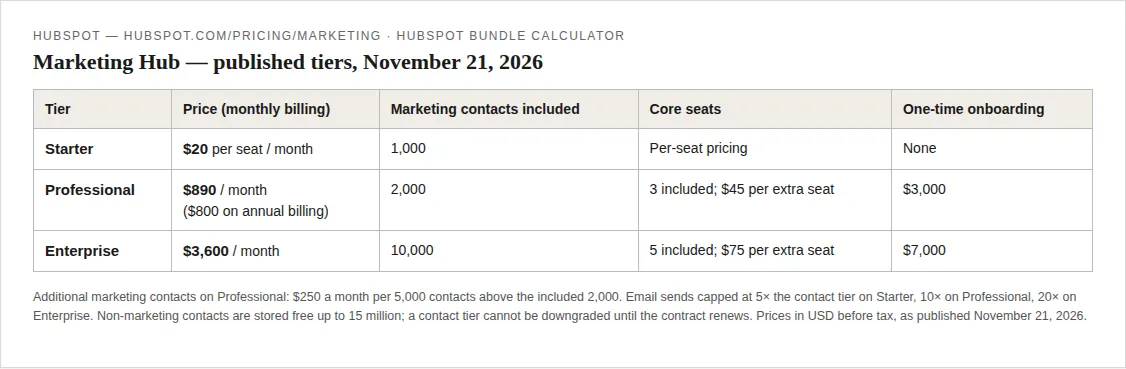
HubSpot Marketing Hub prices by marketing contacts — the contacts you can email and advertise to — plus seats. Starter is 20 dollars per seat a month, includes 1,000 contacts, and caps email sends at 5 times the contact tier. Professional is 890 dollars a month, 800 on annual billing, includes 2,000 contacts and 3 core seats, plus a mandatory 3,000 dollar onboarding fee. Enterprise is 3,600 a month, includes 10,000 contacts and 5 seats, plus a 7,000 dollar onboarding fee. Extra seats cost 45 dollars a month on Professional and 75 on Enterprise. Non-marketing contacts are stored free up to 15 million but cannot receive marketing email or ads.
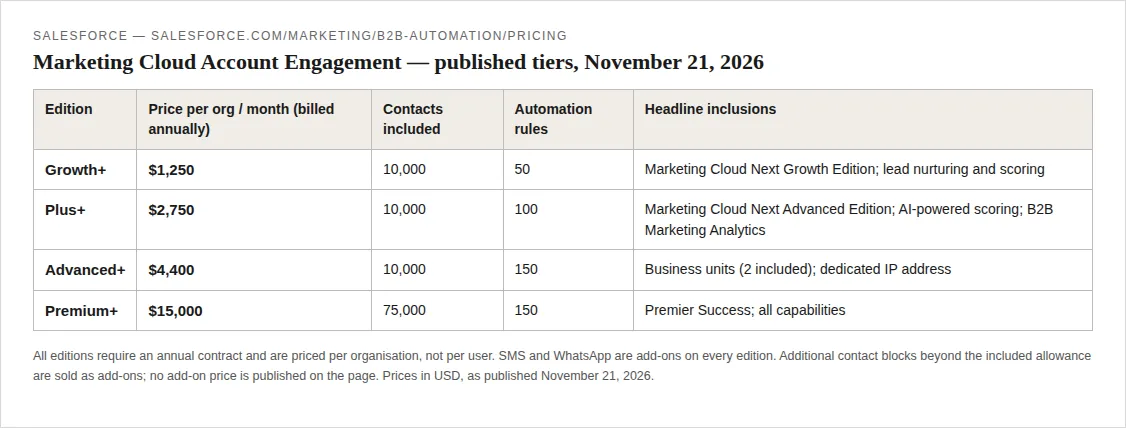
Account Engagement prices per organisation, not per user, and every edition requires an annual contract. Growth+ is 1,250 dollars a month with lead nurturing and scoring. Plus+ is 2,750 and adds AI-powered scoring and B2B Marketing Analytics. Advanced+ is 4,400 and adds business units and a dedicated IP address. Premium+ is 15,000 with Premier Success and every capability. Contacts: 10,000 on the first three editions, 75,000 on Premium+. Automation rules cap at 50 on Growth+, 100 on Plus+, 150 above. Forms, form handlers, and landing pages cap at 50 each on Growth+ and are unlimited above. SMS, WhatsApp, Advanced Dynamic Content, Advanced Email Analytics, and Custom Object Integration are all add-ons; the last three cost 400 dollars a month each.
Marketo Engage is sold in four editions — Growth, Select, Prime, and Ultimate — and Adobe publishes no dollar price for any of them; every edition shows a Get pricing button. Growth includes 10 users and 20,000 API calls a day; Select, Prime, and Ultimate each include 25 users and 50,000 API calls a day. Prime adds Target Account Management, Predictive Audiences, and Advanced Journey Analytics; Ultimate adds Marketo Measure multi-touch attribution. The quote is driven chiefly by marketing-database size — the count of contacts under management — plus edition, add-ons, and contract length. No free tier or self-serve trial exists; evaluation starts with a demo and a sales conversation. For the CRM side of this stack, see HubSpot vs Salesforce vs Pipedrive.
The modeling rules
All prices are US dollars before tax, as published November 21, 2026. Monthly billing is the basis; where annual billing changes the number, both figures are shown. One seat means one full-access marketer; view-only seats on HubSpot are free and Pardot is priced per organisation. Each workload assumes the team emails the full stated contact count monthly. HubSpot contact blocks cost 250 dollars per 5,000 contacts, the published Professional increment, applied to Enterprise too and flagged wherever it appears. Pardot totals are floors wherever an add-on price is unpublished. Marketo carries no total anywhere: printing one would require inventing a quote.
W1: the 1,000-contact startup
One marketer, 1,000 contacts, basic nurture and forms. HubSpot Starter: one seat at 20 dollars, contacts inside the included 1,000, email sends capped at 5,000 a month. Pardot Growth+: 1,250 dollars a month, with 9,000 of its 10,000 included contacts unused. Marketo: no published price — a quote-only platform for a 1,000-contact database means paying for a sales process before paying for software.
Pardot costs 62.5 times HubSpot here, and the gap is pure over-provisioning: the smallest Pardot edition is built for 10,000 contacts, so a 1,000-contact team buys 9,000 contacts it cannot use. Annualised: 240 dollars against 15,000, a 14,760 dollar gap for the same nurture job. The only honest reason to pick Pardot here is native Salesforce sync, if the company already runs Sales Cloud.
W2: the 10,000-contact growth team
Three marketers, 10,000 contacts, full automation plus lead scoring plus analytics. HubSpot Professional: 890 dollars base plus contact blocks — 10,000 minus the included 2,000 leaves 8,000, which is two blocks of 5,000 at 250 dollars each. On annual billing the base is 800, so the monthly total is 1,300. Email sends at this tier run 10 times the contact tier, or 100,000 a month. First year on monthly billing adds the 3,000 dollar onboarding fee. Pardot has two honest answers: Growth+ at 1,250 dollars covers 10,000 contacts exactly with basic scoring, but the analytics this workload assumes — B2B Marketing Analytics and AI-powered scoring — arrive only on Plus+ at 2,750 dollars. Marketo remains quote-only.
HubSpot at 1,390 dollars sits 140 above Pardot Growth+ and 1,360 below Pardot Plus+: the 140 gap buys the analytics Growth+ withholds, and the 1,360 gap is the price of Salesforce-native reporting. First-year totals: HubSpot 19,680 dollars including onboarding, Pardot Growth+ 15,000, Pardot Plus+ 33,000.
W3: the 50,000-contact enterprise
Five marketers, 50,000 contacts, multiple business units, attribution reporting. HubSpot Enterprise: 3,600 dollars base plus 40,000 contacts above the included 10,000 — eight blocks of 5,000 at 250 dollars each — for 5,600 a month. Email sends at this tier run 20 times the contact tier, or 1,000,000 a month. First year adds the 7,000 dollar onboarding fee, for 74,200 dollars. Pardot Advanced+ is 4,400 a month as a floor and includes 10,000 contacts; the remaining 40,000 need contact-block add-ons whose price Salesforce does not publish, so no honest total exists for Advanced+ at this size. Premium+ at 15,000 dollars a month includes 75,000 contacts and covers 50,000 outright. Marketo here is Prime or Ultimate territory, still quote-only.
HubSpot at 5,600 dollars is 1,200 above the Pardot Advanced+ floor — before the unpublished contact blocks — and 9,400 below Premium+. Annualised: HubSpot 67,200 dollars, Advanced+ floor 52,800 plus unknown add-ons, Premium+ 180,000. Past 10,001 contacts Pardot's published price stops being a total; the buyer negotiates blind, which is itself a cost. Run the same arithmetic on your own stack with the ROI calculator before signing.
The breakeven lines
First, cost per contact. At W1, HubSpot charges 2 cents per contact and Pardot charges 1.25 dollars per used contact — 62.5 times as much — though Pardot's cost per included contact is 12.5 cents. At W2, HubSpot Professional costs 13.9 cents per contact against 27.5 cents on Pardot Plus+ and 12.5 cents on Growth+. At W3, HubSpot Enterprise costs 11.2 cents against 30 cents on Premium+.
Second, the Pardot flat-rate illusion: the price does not move from 1 contact to 10,000, which makes it look cheap at W2 and ruinous at W1. The break-even against HubSpot Professional sits at roughly 7,000 contacts on monthly billing, since 890 plus one 250 dollar block covers up to 7,000 contacts.
Third, the onboarding drag: HubSpot's 3,000 dollar Professional onboarding equals 2.2 months of the W2 subscription, and the 7,000 dollar Enterprise fee equals 1.25 months of the W3 subscription. Both are one-time, so they vanish from year-two math — but they decide the first-year ranking at W2, where HubSpot's first year costs 4,680 dollars more than Pardot Growth+.
The decision table
| Decision dimension | HubSpot | Pardot / Account Engagement | Marketo Engage | Authority |
|---|---|---|---|---|
| At 1,000 contacts | 20 dollars | 1,250 dollars | Quote-only | Vendor pages, 2026 |
| At 10,000 contacts | 1,390 dollars | 1,250 floor; 2,750 with analytics | Quote-only | Vendor pages, 2026 |
| At 50,000 contacts | 5,600 dollars | 4,400 floor; 15,000 all-in | Quote-only | Vendor pages, 2026 |
| Contact ceiling | 250 dollars per 5,000 contacts | 10,000 included; add-on price unpublished | Database-size quote | Vendor pages, 2026 |
| Automation ceiling | Simple automation on Starter; workflows on Pro and Enterprise | 50 / 100 / 150 rules by edition | 20,000–50,000 API calls a day | Vendor pages, 2026 |
| Onboarding fee | 3,000 dollars Pro; 7,000 Enterprise | Not stated; Success plans are add-ons | Implementation quoted | Vendor pages, 2026 |
| Contract | Monthly or annual | Annual contract required | Annual contract, sales-led | Vendor pages, 2026 |
Founder & CEO Insight — Enow A. Jovial
Who should not use which
Do not buy Pardot Growth+ for a 1,000-contact list: 1,250 dollars a month buys 10,000 contacts the team will not use. Do not buy HubSpot Starter expecting real automation: it offers simple automation only — the workflow automation this guide prices starts on Professional. Do not buy Marketo without a trained administrator: Growth caps the team at 10 users and 20,000 API calls a day, and the platform assumes an operator who lives in it. Do not choose Pardot Plus+ for analytics alone without Salesforce Sales Cloud: B2B Marketing Analytics reports on Salesforce data, and without the CRM underneath, the 1,500 dollar jump from Growth+ buys empty dashboards. Do not put 50,000 contacts on HubSpot Enterprise without budgeting the contact blocks: the 3,600 dollar headline is 5,600 the moment the database crosses 10,000. For the email-only version of this comparison, see HubSpot vs Mailchimp.
The costs the rate card hides
Migration is the largest hidden cost, priced in weeks rather than dollars. All three platforms import contacts by CSV and API, so the database moves; the automation does not. HubSpot workflows, Pardot engagement programs and automation rules, and Marketo smart campaigns are rebuilt by hand, and scoring models are rebuilt twice — once as rules, once as thresholds — because no vendor exports a scoring model another can read. A team migrating 10,000 contacts with fifty nurture emails should budget two to four weeks of a marketer's time plus a parallel-run month on both platforms: 1,250 to 2,750 dollars of overlap at W2 prices.
Lock-in runs through the CRM, not the email tool. Pardot's value is native Salesforce sync, so leaving it means rebuilding the reporting the CRM team already uses. Marketo's lock-in is operational depth — workspaces, partitions, custom objects, and Marketo Measure attribution — which only pays off after months of learning. HubSpot's lock-in is the CRM itself: contacts, workflows, attribution history, and 15 million free non-marketing contacts in one database. Implementation follows the same pattern: HubSpot sells onboarding at a fixed 3,000 or 7,000 dollars, Salesforce sells Success plans as add-ons with no published price, and Marketo sells implementation through partners with no published price.
Execution checklist
- [x] Count mailable contacts first: export the 90-day emailed list, not the CRM total.
- [x] Price the contact blocks: on HubSpot, add 250 dollars per 5,000 contacts above the included tier.
- [x] Get the Pardot add-on quote in writing: contact-block pricing above 10,000 contacts is unpublished.
- [x] Get the Marketo quote before the demo ends: a written range before the second call keeps the process honest.
- [x] Add onboarding to year one: 3,000 dollars on HubSpot Professional, 7,000 on Enterprise, unknown on Pardot and Marketo until quoted.
- [x] Check the automation ceiling: 50 rules on Pardot Growth+, workflows on HubSpot Professional (simple automation only on Starter), 20,000 API calls a day on Marketo Growth.
- [x] Budget a parallel-run month: one extra month on the old platform plus rebuild time for scoring and nurture programs.
- [x] Re-price every quarter: HubSpot repriced Starter in 2026 and Salesforce rebadged Pardot into Account Engagement+ editions the same year.
The verdict is a map, not a winner. At 1,000 contacts HubSpot costs 20 dollars and Pardot costs 1,250. At 10,000 contacts HubSpot costs 1,390 and Pardot costs 1,250 without analytics or 2,750 with them. At 50,000 contacts HubSpot costs 5,600 and Pardot costs 4,400 plus an unpublished add-on, or 15,000 all-in. Marketo costs a sales conversation at every size. Choose by the meter that matches the database, and never sign a platform whose total you cannot reproduce from its own page.