Three answers to the same question
Every site needs to know where its visitors come from and what they do. GA4, Plausible, and Matomo answer that question with three different bargains. GA4 is free and takes your data to Google’s servers in exchange for limits on how much you can keep and how precisely you can query it. Plausible is a small monthly fee for a dashboard that collects no cookies and no personal data, hosted in the EU. Matomo is free software you can host yourself, or a hosted Cloud priced by hits, and in both forms the database is yours. The choice is not which tool is best in the abstract. It is which meter, which limit, and which ownership term fits the traffic you have.
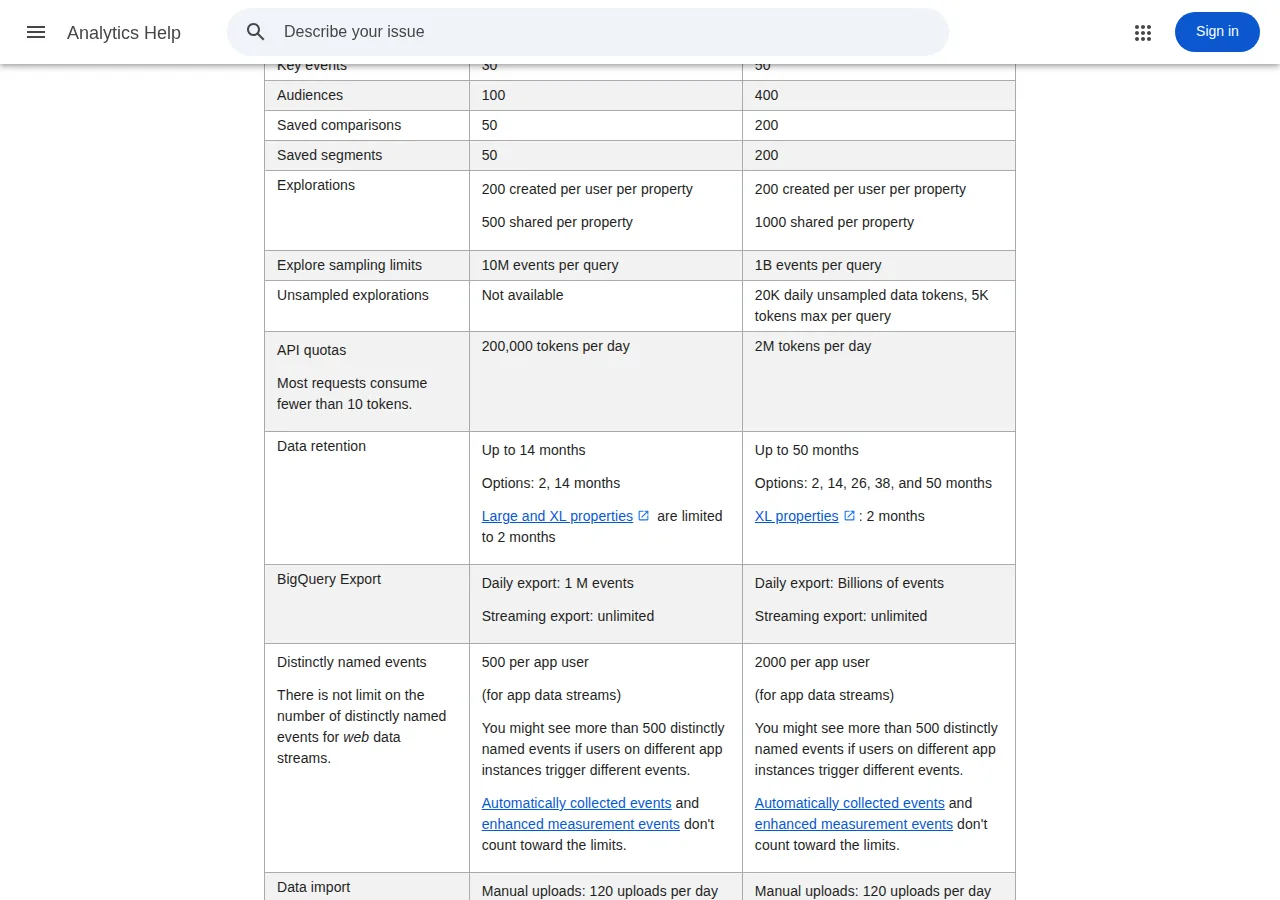
GA4 is event-based: a page view, a scroll, a click, a video play, a form submission, and a purchase are all events with parameters, instead of the page-view and session hits Universal Analytics counted. The standard property is free, including the BigQuery export that once required the paid tier. The price is paid in limits. Google’s own configuration limits page sets 30 key events per property, 50 event-scoped custom dimensions, 100 audiences, data retention of up to 14 months, explorations sampled above 10 million events per query, and a BigQuery daily export capped at 1 million events. The Analytics 360 tier raises every one — up to 50 months of retention, sampling only above 1 billion events per query, unsampled explorations, 2 million API tokens a day against 200,000 on standard, and billions of events a day to BigQuery — but Google publishes no list price for it.
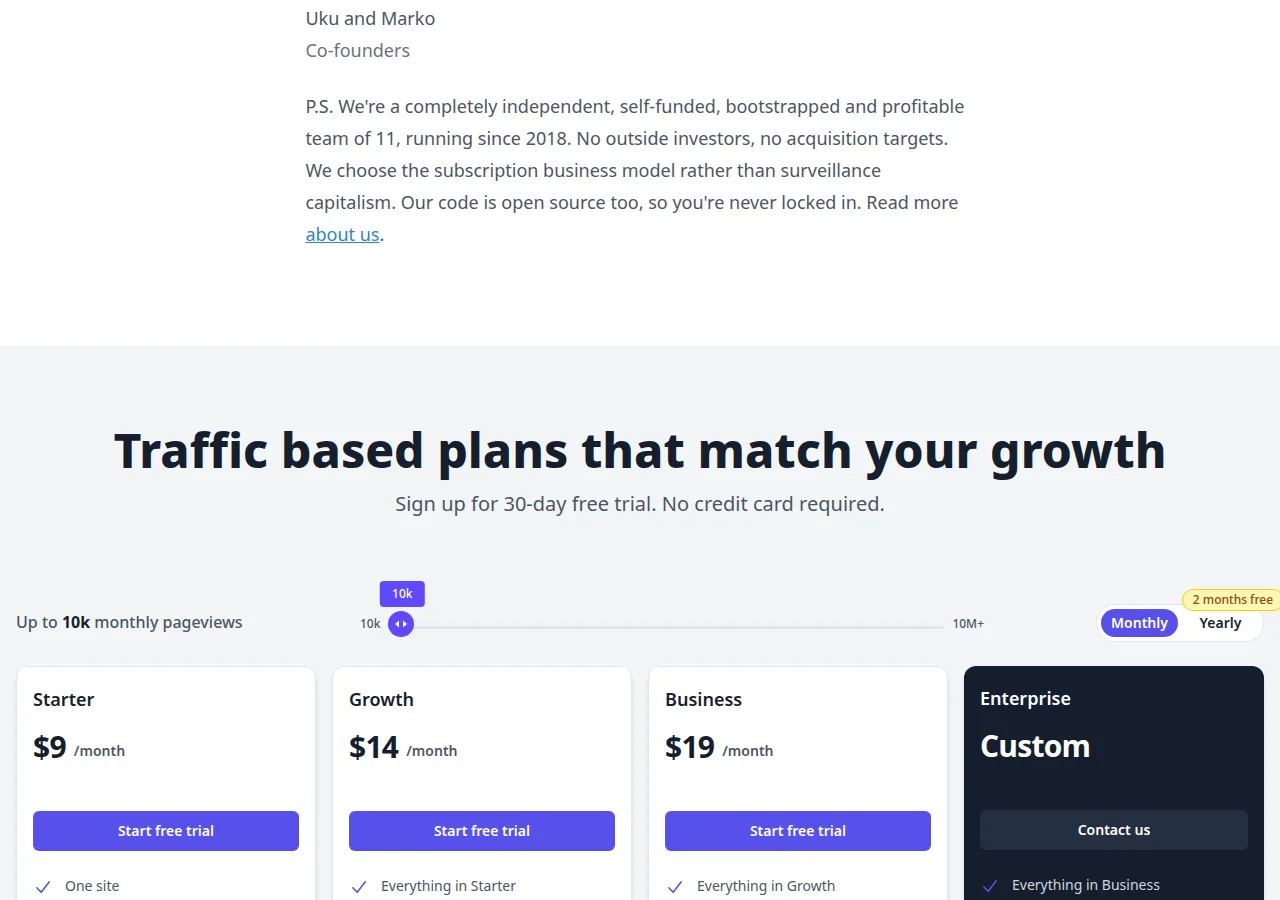
Plausible is the opposite shape: a lightweight script, a single-screen dashboard, and a price that follows monthly pageviews. Its own site states the position plainly — no cookies, no personal data, open source, hosted in the EU, and no need for cookie banners or GDPR consent for its standard tracking. There is no free hosted plan, only a 30-day trial with no card. The pricing widget shows Starter at $9 a month and Growth at $14 a month for up to 10,000 monthly pageviews, with two months free on yearly billing. Starter covers one site with three years of retention, goals, custom events, and a Google Analytics import. Growth covers three sites and three members with shared links and embedded dashboards. Business covers ten sites and ten members with five years of retention, custom properties, the Stats API, ecommerce revenue attribution, funnels, and user journeys.
Matomo is the only one of the three that lets you own the database. The On-Premise Community edition is free software under the GPL with unlimited users and unlimited hits; you pay for the server, the patching, and your time. Matomo Cloud is the hosted edition, priced by monthly hits, with the data hosted in Europe and every feature included. The pricing page shows $29 a month at 50,000 hits on the USD display; its own price data lists the same tier at €22. Prices are shown by visitor location, so this article does its math in euros, with the dollar equivalent in parentheses. The entry tier allows 30 websites, 30 team members, 100 segments, and 150 goals, with raw data kept 24 months and report data forever, and no sampling.
What each one costs at 10,000, 100,000 and 1,000,000 pageviews
The table below is monthly billing at the tier that covers the volume. Plausible prices are in dollars from its own pricing widget; Matomo prices are in euros from its own pricing page, with the dollar equivalent from the same page’s price data. GA4 is $0 at every volume.
| Monthly pageviews | GA4 standard | Plausible Starter | Matomo Cloud |
|---|---|---|---|
| 10,000 | $0 | $9 | €22 (~$26, 50,000-hit floor) |
| 100,000 | $0 | $19 | €38 (~$42) |
| 1,000,000 | $0 | $69 | €172 (~$204) |
Three readings follow. First, cost per 1,000 pageviews falls as volume rises for both paid tools, but Matomo stays roughly two to three times Plausible’s price at the same volume:
Second, annual billing is two months free on both, or ten times the monthly price: Plausible Starter costs $90, $190, and $690 a year; Matomo Cloud costs €264, €456, and €2,064. Third, the feature that costs money on Plausible is not traffic but analysis: funnels, user journeys, custom properties, and the Stats API need the Business plan — at 100,000 pageviews $39 a month against Starter’s $19, a $20 premium, or 105% more:
The meter is the product
The three tools do not count the same thing, and that is where bills surprise people. Plausible bills pageviews plus custom events in fixed tiers with no overage fees: two months in a row over the limit brings an upgrade prompt, and the dashboard locks a week later if the site does not upgrade, while data collection continues. There is no surprise invoice. Matomo Cloud bills hits — any tracked request: a pageview, an event, a download, an outlink, a site search, or a content impression. A content site with 1 million pageviews and one tracked event per pageview consumes 2 million hits and lands on the 2-million-hit tier at €334 a month, not the 1-million-hit tier at €172 — a 94% increase from one event per page:
GA4 bills nothing; its meter is the configuration limits. A site with 1 million pageviews a month and three events per pageview sends 3 million events a day, and the BigQuery daily export caps at 1 million — the export covers one-third of the day’s data. Explorations sample above 10 million events per query, so a quarterly exploration across 90 days of that traffic samples before answering. It is the design: the free tier is generous at the volume most sites have and exacting where Google wants the 360 conversation to start. The 360 conversation starts at a reported $50,000 a year — a reported figure, since Google publishes no price and the quote comes through Google or a Sales Partner.
The decision rule follows. A marketing site that counts pageviews gets the most predictable bill from Plausible. An event-heavy product with downloads, searches, and outlinks must size Matomo on hits, not pageviews, and read the quote at the hit tier the volume actually lands on. A site that needs Google Ads linkage, Search Console integration, and a BigQuery export at low volume gets GA4’s $0 price until the retention and sampling limits bite — at 14 months and 10 million events per query, roughly where the site is big enough to justify paying for analytics at all.
Consent, cookies, and who owns the data
The privacy difference is not a marketing claim. It is a difference in what is collected, where it is stored, and who can be compelled to hand it over.
| Dimension | GA4 | Plausible | Matomo |
|---|---|---|---|
| What is collected | Events with parameters, user properties, Google Signals | Pageviews, goals, custom events; no cookies, no personal data, no persistent identifiers | Pageviews, events, downloads, searches; configurable cookies; full raw data |
| Cookie banner | Needed in the EU unless consent mode is configured | Not needed for Plausible’s own tracking | Depends on configuration; GDPR Manager included |
| Where data lives | Google servers | EU-hosted, European-owned | Cloud hosted in Europe; On-Premise on your own server |
| Who owns the data | Google holds the data; export via API and BigQuery | Plausible holds the data; export via Stats API on Business | 100% data ownership; the database is yours |
| Retention | Up to 14 months (50 on 360) | 3 years Starter, 5 years Business | Raw data 24 months, report data forever |
| Sampling | Explorations sampled above 10M events/query | None | None |
| Authority | Google Analytics Help, answer/12229528 | plausible.io | matomo.org/pricing, matomo.org/gdpr |
Two cautions belong here. First, Plausible’s no-banner claim covers its own script. A page that also loads ads, embedded video, or a chat widget may still need consent for those scripts. Second, Matomo’s 100% data ownership is real on both editions, but ownership and operation differ: Cloud is hosted by Matomo in Europe, and On-Premise is operated by you, including the patching. That is the price of owning the server — the patch is your job, on your schedule, and the exposure window is yours too.
Who should not pick each one
Do not pick GA4 if the business cannot accept its data on Google’s servers, or if the reporting horizon is longer than 14 months with no BigQuery export from day one. A founder who discovers in month 15 that the first year’s explorations are gone has lost the baseline, and no upgrade restores it. Do not pick Plausible if the team needs more than ten sites on one account, or if funnels and revenue attribution are core and the budget only covers Starter — the features that justify the switch live on Business, and a Starter subscription that cannot answer the funnel question is a dashboard. Do not pick Matomo Cloud if the site is event-heavy and the budget was sized on pageviews: the hit meter moves the site up a tier before the pageview count does, and the 94% jump from the 1-million-hit tier to the 2-million-hit tier is the predictable version of that surprise. Do not pick Matomo On-Premise if nobody owns patching, because a free edition that is never patched is not free — it is an unmonitored server with your visitor data on it.
Run the switch
- Dual-tag for one full reporting cycle: run the new tool alongside GA4 for 30 days, so the baseline is measured twice and the new numbers can be checked against the old ones.
- Import the GA4 history first: Plausible and Matomo both offer a GA data importer. Run the import before the old property’s retention expires.
- Size the tier on hits, not pageviews, for Matomo: count pageviews plus events, downloads, outlinks, and searches for the busiest month of the last year, and buy the hit tier above it.
- Size Plausible on the busiest month, not the average: two consecutive months over the limit trigger the upgrade prompt and the dashboard lock a week later, so the tier must cover the peak, not the mean.
- Decide the consent position in writing: record whether the site relies on Plausible’s cookieless tracking, Matomo’s GDPR Manager, or GA4 consent mode, and keep the other scripts in the same decision.
- Set the retention clock on day one: enable the BigQuery export on GA4, confirm 24-month raw retention on Matomo Cloud, and note the 3-year or 5-year retention on Plausible.
- Rebuild the three reports the business actually reads: traffic sources, the signup funnel, and the revenue report. If a report cannot be rebuilt, the migration is not finished.
- Remove the old tag only after the new baseline is verified: compare one week of sessions, sources, and conversions across both tools and record the variance.
- [x] Dual-tagged for 30 days, baseline measured twice.
- [x] GA4 history imported before retention expires.
- [x] Tier sized on the busiest month, not the average.
- [x] Consent position recorded in writing for every script.
- [x] Retention and export confirmed on day one.
- [x] The three business reports rebuilt, variance recorded.
Failure modes
Most analytics migrations fail on the meter, not the dashboard. The hit-meter surprise: a Matomo buyer who sized on pageviews discovers the event volume a month into the contract. The sampling surprise: a GA4 team that built quarterly reporting on explorations discovers the 10-million-event threshold in the quarter that matters. The retention loss: a team that migrates in month 15 without an import loses the first year’s explorations permanently. The 360 quote shock: a team that outgrows the free tier discovers the upgrade is a quote-only annual contract reported at $50,000 a year, with no list price to anchor negotiation. The feature-tier gap: a Plausible Starter subscriber who needs funnels discovers they live on Business, at more than double the Starter price. The unpatched server: a Matomo On-Premise install that nobody patches is an unmonitored server holding visitor data, and the exposure window lasts until someone owns patching. Each is preventable by sizing the tier on the real meter and confirming the limit before the migration, not after.
Founder & CEO Insight — Enow A. Jovial
The operation is a sequence: dual-tag for a month, import the history, size the tier on the real meter, record the consent position, confirm retention on day one, rebuild the three reports, and only then remove the old tag. The self-hosting comparison that covers the free analytics stack is our self-hosting analytics guide, the product analytics trio that prices the event-based alternative is our PostHog versus Mixpanel versus Amplitude guide, and the GDPR request operation that governs the data is our GDPR DSAR playbook. Before the next renewal, run the numbers through our pricing calculator to confirm the tier covers the busiest month at the volume you actually have.