Two founders, one company, a handshake split of 50/50. Six months later one founder has written the whole product and the other has stopped answering messages — and the absent founder still owns half the company. The split is the allocation of every future dollar the company will ever create. Figures as read on November 16, 2026.
The law that makes the split real
A split agreed over coffee is a promise. A split issued as stock under Delaware law is property.
DGCL § 151(a) lets a corporation issue one or more classes of stock, or series within a class, with par value or without, and with voting powers — full, limited, or none — and such designations, preferences and special rights as the certificate of incorporation states.
DGCL § 152(a) answers what a founder can pay for stock: cash, any tangible or intangible property, or any benefit to the corporation, or any combination thereof. Unpaid work, assigned IP, and cash are all lawful consideration. Section 152(d) protects the board's valuation: absent actual fraud, "the judgment of the directors as to the value of the consideration... shall be conclusive," and the stock "shall be deemed to be fully paid and nonassessable stock upon receipt by the corporation of such consideration."
DGCL § 202 keeps a split from becoming a hostage situation. Section 202(a) provides that a written restriction on transfer, if permitted and "noted conspicuously on the certificate" or in the § 151(f) notice for uncertificated shares, "may be enforced against the holder" — and an unnoted restriction, "even though permitted by this section, is ineffective except against a person with actual knowledge of the restriction." Section 202(b) lets the restriction sit in the certificate, the bylaws, or an agreement among holders, but it does not bind securities issued before it was adopted unless their holders agreed or voted for it. Section 202(c) permits a right of first refusal, a buy-sell obligation, a consent requirement, a forced or automatic sale, and a ban on transfer to designated persons that is not manifestly unreasonable.
Three ways to divide the pie
| Method | How the split is set | Adjusts when contributions change? | Best when | Authority |
|---|---|---|---|---|
| Equal split | Same % each | No | Equal inputs | DGCL § 151(a) |
| Contribution-weighted | Fixed % from valued inputs | No | Known inputs | DGCL § 152(a), (d) |
| Slicing Pie (dynamic) | Recomputed from unpaid FMV | Yes | Unfolding inputs | Slicing Pie Framework; DGCL § 152(a) |
The equal split is the default because it is fast and feels fair. On 10,000,000 authorised shares:
ext{Each founder (2 founders)} =
rac{10{,}000{,}000}{2} = 5{,}000{,}000 ext{ shares} = 50%
It is honest only when the inputs are equal. The moment one founder writes the code and funds the first six months while the other contributes an idea part-time, 50/50 transfers value from the working founder to the absent one — and it will be renegotiated later, under pressure.
The contribution-weighted split prices the inputs on day one — A: $180,000 work plus $50,000 cash; B: $120,000 work; C: $60,000 work plus $25,000 cash:
ext{A} = $180{,}000 + $50{,}000 = $230{,}000
ext{B} = $120{,}000 + $0 = $120{,}000
ext{C} = $60{,}000 + $25{,}000 = $85{,}000
ext{Total} = $230{,}000 + $120{,}000 + $85{,}000 = $435{,}000
ext{A share} =
rac{$230{,}000}{$435{,}000} = 52.87%
ext{B share} =
rac{$120{,}000}{$435{,}000} = 27.59%
ext{C share} =
rac{$85{,}000}{$435{,}000} = 19.54%
The method is only as good as the valuations. Unpaid work is valued at its market rate, not at a rate invented to justify a percentage. Assigned IP is valued by the board under § 152(d), conclusive absent actual fraud — record the valuation in the board minutes.
Slicing Pie: the split that moves with the work
Mike Moyer's Slicing Pie model starts from a different premise: nobody knows on day one what each founder will contribute, so a fixed split is a guess dressed as a decision. Slicing Pie holds that "everything in business is quantifiable in terms of fair market values" and unpaid contributions are "bets" on the company's future. The Allocation Framework divides equity "based on the relative unpaid fair market value of their contributions," and the model "self-adjusts as things happen so it's always fair," ending "when the business has enough cash to pay everyone from revenue or Series A investment."
The worked example uses raw fair market values — A: 400 hours at $150 per hour plus $20,000 cash; B: 300 hours at $120 per hour, no cash:
ext{A unpaid salary} = 400 imes $150 = $60{,}000
ext{A total} = $60{,}000 + $20{,}000 = $80{,}000
ext{B unpaid salary} = 300 imes $120 = $36{,}000
ext{B total} = $36{,}000 + $0 = $36{,}000
ext{Pie} = $80{,}000 + $36{,}000 = $116{,}000
ext{A share} =
rac{$80{,}000}{$116{,}000} = 68.97%
ext{B share} =
rac{$36{,}000}{$116{,}000} = 31.03%
Six months later B has added $24,000 of unpaid work, A nothing. The pie re-computes:
ext{B total now} = $36{,}000 + $24{,}000 = $60{,}000
ext{Pie now} = $80{,}000 + $60{,}000 = $140{,}000
ext{A share now} =
rac{$80{,}000}{$140{,}000} = 57.14%
ext{B share now} =
rac{$60{,}000}{$140{,}000} = 42.86%
That movement is the point: under a fixed split B's extra $24,000 would have bought nothing; under Slicing Pie it buys 11.83 percentage points. Moyer is explicit that vesting does not fix a bad split: "Time-based vesting schedules don't solve this problem because they assume the original split was fair to begin with." Two cautions: the Learn page states no numeric multiplier for cash versus time, so this playbook applies none. And the model needs a ledger — every contribution logged with its fair market value and date — or the re-computation becomes an argument. Our cap table management and dilution playbook covers the ledger discipline that keeps a dynamic split auditable.
Vesting: the schedule that earns the split
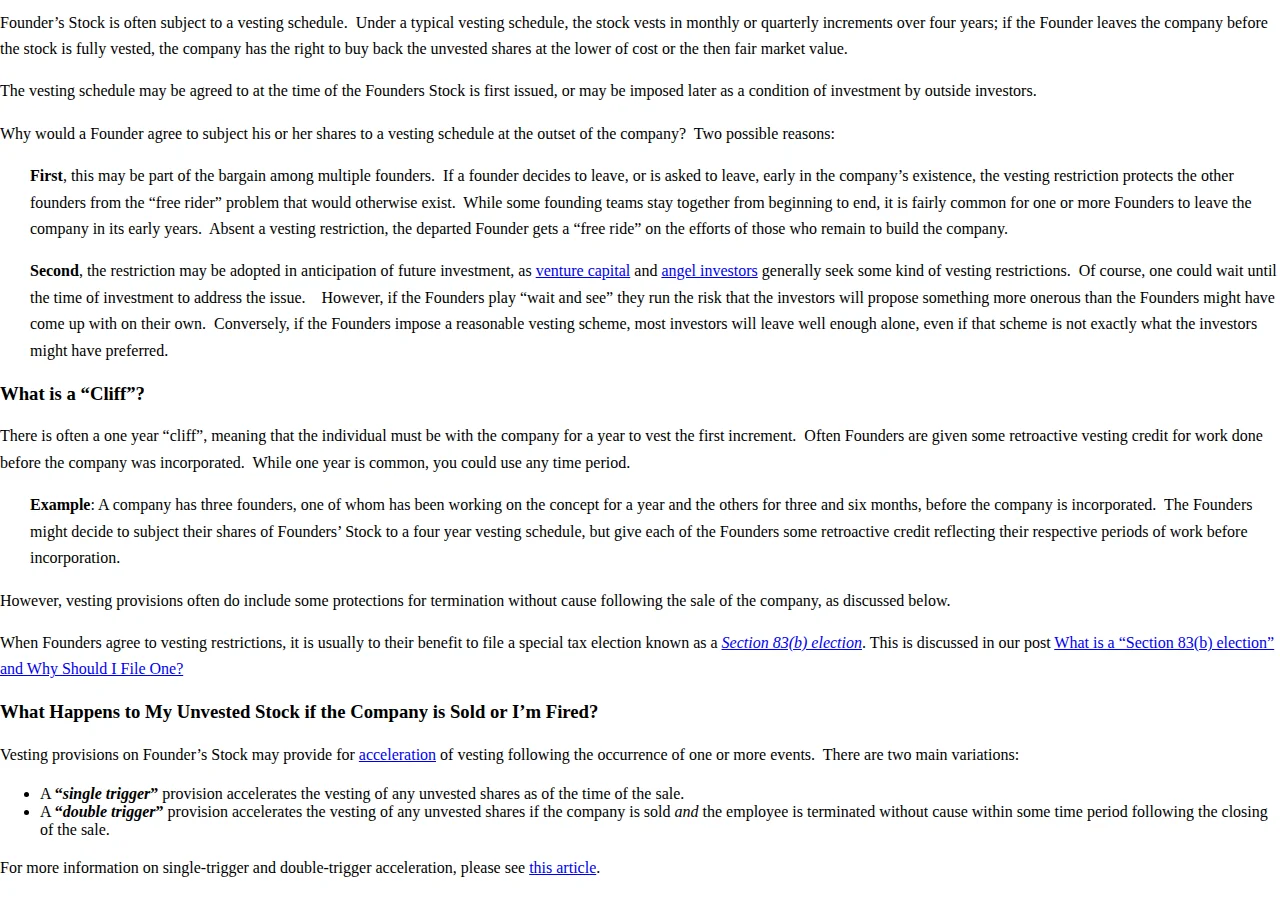
A split without vesting hands a departing founder the full reward for work they never did. The standard schedule, as Cooley GO states it, is that "the stock vests in monthly or quarterly increments over four years," with "a one year 'cliff'," and founders are often given retroactive credit for pre-incorporation work. Without a vesting restriction, a departed founder gets a "free ride," and investors "generally seek some kind of vesting restrictions" before they invest.
On a 4,000,000-share grant:
ext{Monthly vesting after the cliff} =
rac{4{,}000{,}000}{48} = 83{,}333.33 ext{ shares per month}
A founder leaving at month 18 has vested the cliff plus six monthly increments:
Acceleration decides what happens to the unvested shares when the company is sold. Single-trigger "accelerates the vesting of any unvested shares as of the time of the sale." Double-trigger accelerates them "if the company is sold and the employee is terminated without cause within some time period following the closing of the sale." Investors dislike single-trigger because an acquirer wants the founders to stay; double-trigger is the structure most financing documents land on.
Departure: the buyback math
When a founder leaves, the company buys back the unvested shares at "the lower of cost or the then fair market value." On the month-18 founder, issued at $0.0001 per share and now worth $0.40 per share:
ext{Buyback at cost} = 2{,}500{,}000 imes $0.0001 = $250
ext{Buyback at fair market value} = 2{,}500{,}000 imes $0.40 = $1{,}000{,}000
ext{Buyback price (lower of cost or FMV)} = $250
The $999,750 gap is why the "lower of" formulation exists: it returns the shares at the price the founder paid, not a million dollars for shares that never vested. The vested 1,500,000 shares stay with the founder unless a separate restriction requires a sale — § 202(c) permits clauses that "obligate the holder of the restricted securities to sell or transfer" them or cause "automatic sale or transfer." The co-sale right runs the other way: Cooley GO's example is two founders at 40 percent each and one investor at 20 percent — if one founder finds a buyer for 10,000 shares, the other founder may sell 4,000 and the investor 2,000, "so the first founder could sell only 4,000 shares." The right of first refusal is the third control: the company and the other founders get the first opportunity to buy shares a founder proposes to sell.
Issuing new shares dilutes every holder the same way: the founder above owns 40 percent of 10,000,000 shares, and a 2,500,000-share issuance leaves them at 32.00 percent. The split, the vesting schedule, and the cap table are one decision, not three — and our LLC operating agreement breakdown is worth reading before choosing an LLC instead of a Delaware C-Corp, since the operating agreement is where an LLC team writes the same restrictions § 202 provides for corporations.
The tax: IRC § 83 and the 83(b) decision
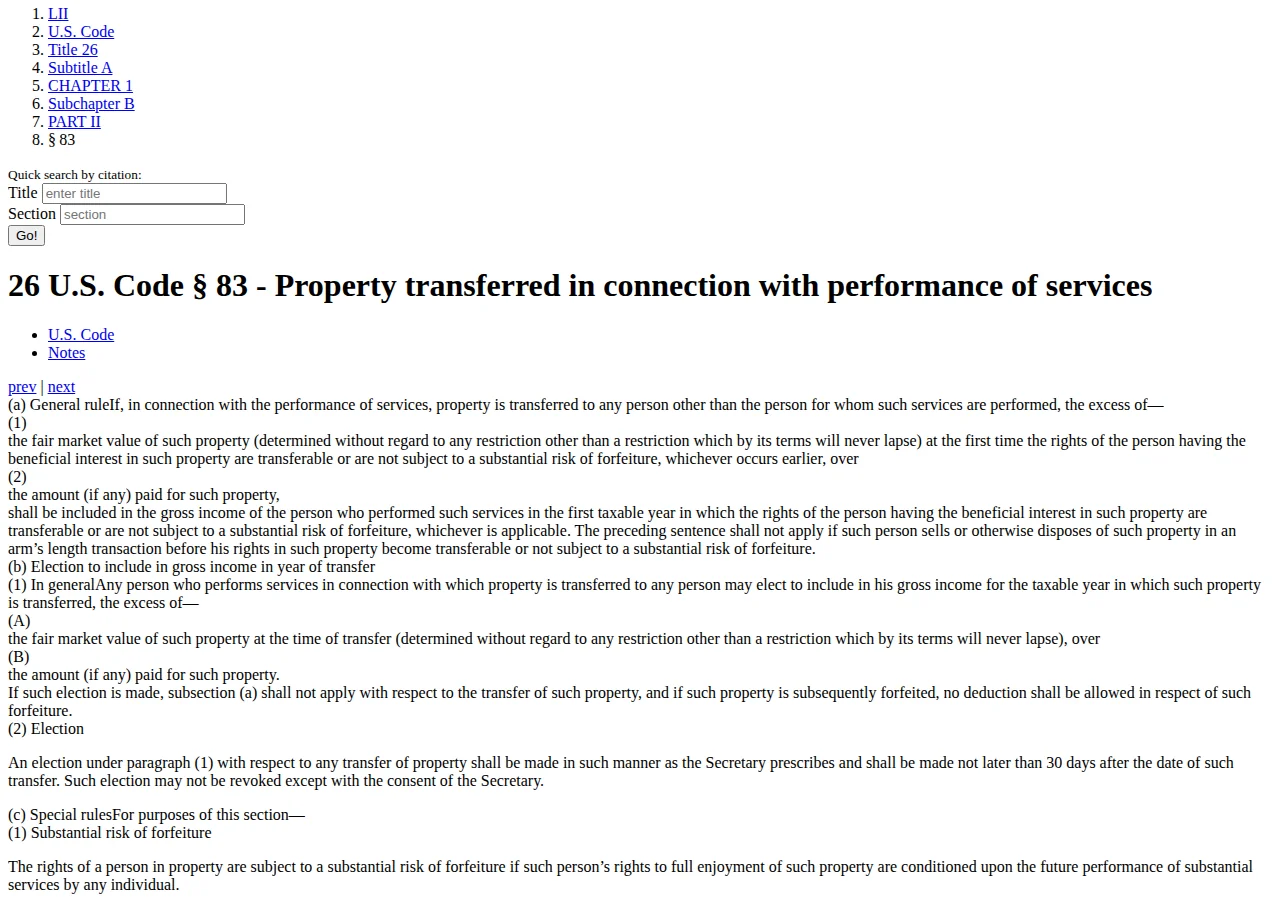
IRC § 83 decides when the tax arrives. Section 83(a) taxes the excess of fair market value over the amount paid, measured "at the first time the rights... are transferable or are not subject to a substantial risk of forfeiture, whichever occurs earlier." Section 83(c)(1) defines that risk: rights are subject to it "if such person's rights to full enjoyment of such property are conditioned upon the future performance of substantial services by any individual." A vesting schedule is such a condition, so unvested founder stock is still at risk.
Section 83(b) offers the alternative: a founder "may elect to include in his gross income for the taxable year in which such property is transferred" the excess of fair market value at transfer over the amount paid. The election "shall be made not later than 30 days after the date of such transfer" and "may not be revoked except with the consent of the Secretary." The price: "if such property is subsequently forfeited, no deduction shall be allowed in respect of such forfeiture."
On the month-18 example:
ext{Value at grant} = 4{,}000{,}000 imes $0.0001 = $400
ext{Amount paid} = 4{,}000{,}000 imes $0.0001 = $400
ext{Income with 83(b) election} = $400 - $400 = $0
Without the election, the shares are taxed as they vest — at the month-12 cliff, at a $0.40 fair market value:
ext{Value at cliff} = 1{,}000{,}000 imes $0.40 = $400{,}000
ext{Amount paid for those shares} = 1{,}000{,}000 imes $0.0001 = $100
ext{Ordinary income at cliff (no election)} = $400{,}000 - $100 = $399{,}900
The founder who skipped the election owes tax on $399,900 in the vesting year, on shares they cannot sell. The filing mechanics are covered in full in our Delaware C-Corp founder stock vesting and 83(b) election playbook; run your own grant through our tax estimator before the 30 days run out — the election cannot be filed late.
Founder & CEO Insight — Enow A. Jovial
Who should NOT use this
A solo founder does not need a split — they need a vesting schedule before investors ask for one. A team that has already raised a priced round should not re-open the split: the cap table and the board's authority now govern. A team incorporating as an LLC should not copy this playbook's stock mechanics — LLCs issue membership interests under an operating agreement, not shares under DGCL §§ 151 and 152. And a team that cannot agree on the market value of each founder's contribution should not adopt Slicing Pie: founders who will not price each other's work will fight over the ledger.
Execution checklist
- [x] Step 1: List every contribution: cash, hours at market rate, IP, customers — each with a dollar value and a date, signed by all founders.
- [x] Step 2: Choose the method and write down why: equal if the inputs are equal, weighted if they are known, Slicing Pie if they are unfolding. Record the reasoning in the board minutes.
- [x] Step 3: Authorise the shares and set the classes: board resolution under § 152 fixing shares and consideration; certificate stating classes and rights under § 151(a).
- [x] Step 4: Put every founder on the same vesting schedule: four years, one-year cliff, monthly vesting, retroactive credit for pre-incorporation work, acceleration agreed before the first investor asks.
- [x] Step 5: Write the departure rules before anyone wants to leave: buyback at lower of cost or FMV, right of first refusal, co-sale, § 202 restrictions noted on the certificates or the § 151(f) notice.
- [x] Step 6: File the 83(b) election inside 30 days: one election per founder, proof of filing kept — CPA confirms the grant-date valuation first.