Texas LLC vs Florida LLC: Formation Fees, Franchise Tax, and the 3-Year Bill
Texas charges $300 to create an LLC and then, for most small businesses, nothing after. Florida charges $125 to create one, $138.75 every year after. Neither state taxes your personal income. The difference is the second bill: Texas replaces the annual report with a franchise tax that starts only above $2,650,000 of revenue; Florida replaces it with a flat annual report and a 5.5 percent corporate tax that bites only on a C-corp election.
The head-to-head: every state fee that repeats
| Item | Texas | Florida | Authority |
|---|---|---|---|
| Formation filing | $300 (Certificate of Formation, Form 205) | $125 ($100 + $25 agent fee) | TX SOS Fee Schedule (Form 806); Fla. Stat. § 605.0213 |
| Annual report to the Secretary of State | None — $0 | $138.75 every year, Jan 1–May 1 | TX SOS Fee Schedule; Fla. Stat. §§ 605.0212, 607.193 |
| Annual filing with the tax agency | Public Information Report, free, due May 15 | None (no franchise tax report) | TX Comptroller Pub. 98-806 |
| Late annual filing | $50 per late report | $400 late charge ($538.75 total) | TX Comptroller Pub. 98-806; Fla. Stat. § 607.193 |
Formation: one form in Texas, one form in Florida
Texas does not call the document Articles of Organization. You file a Certificate of Formation — Form 205 — with the Secretary of State; the $300 fee is the same online, by mail, or in person in Austin. The form names the LLC, its registered agent and office, management structure, governing persons, and purpose. Expedited service is priced on the same fee schedule: $50 for standard expedite, $500 for next-day, $750 for same-day, all per document.
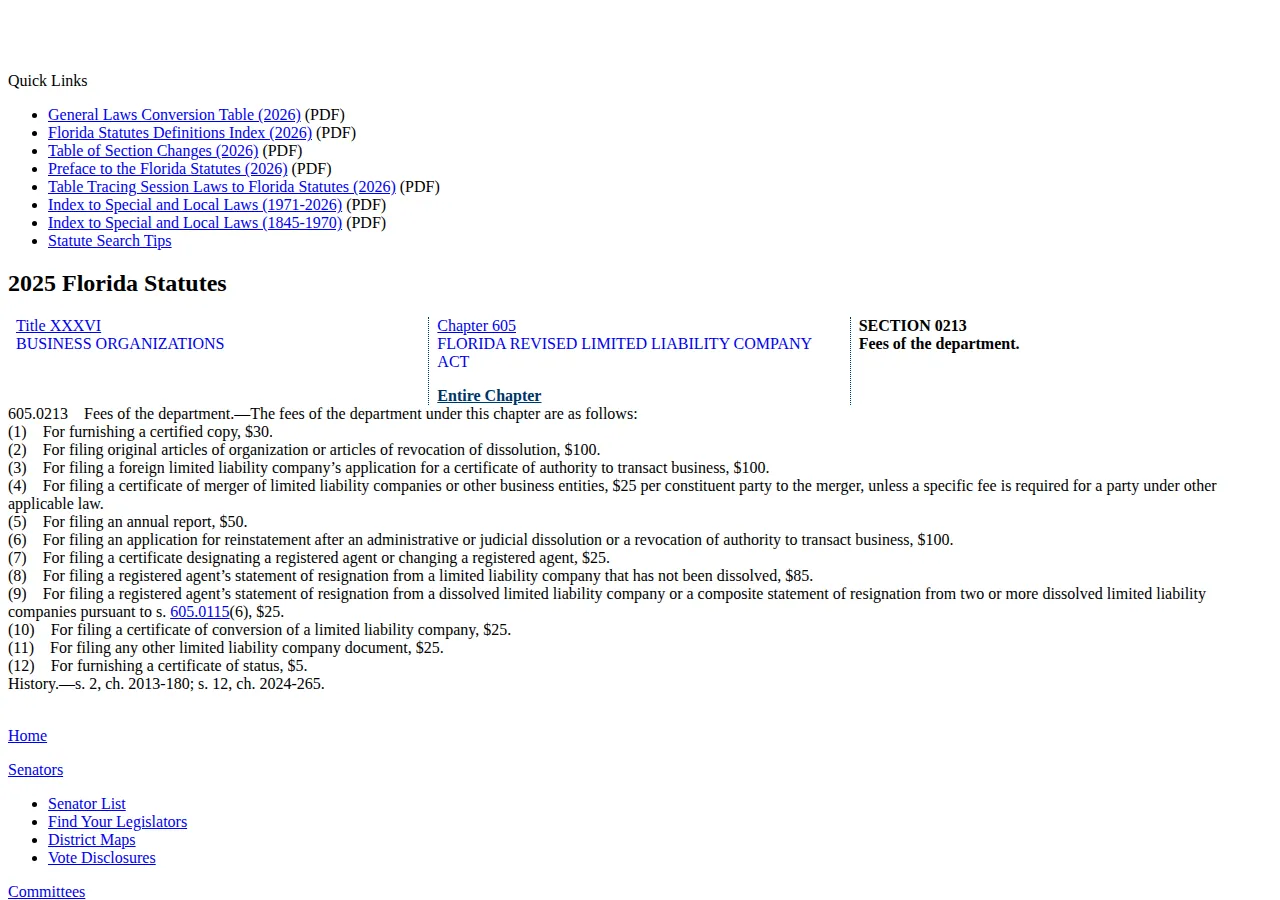
Florida files Articles of Organization through Sunbiz. The $125 is two charges: a $100 filing fee and a $25 fee to record the registered agent designation, both set by Fla. Stat. § 605.0213. The registered agent must sign the filing; Florida sells no expedited processing for online LLC filings.
The identity paperwork is federal, and the same in both states. The LLC gets an Employer Identification Number by filing Form SS-4 with the IRS — the LLC's own EIN, never the owner's Social Security Number, goes on the state filing, the bank account, and the tax return. A single-member LLC is a disregarded entity by default; a multi-member LLC is a partnership by default. Either can elect S-corp treatment on Form 2553 or C-corp treatment on Form 8832, and the CPA who keeps the books should make that election before the first return — the election changes what Florida charges, as shown below.
Our LLC formation tax guide covers the federal elections in full.
The recurring bill: May 15 in Texas, May 1 in Florida
Texas has no annual report to the Secretary of State — what it has instead is a May 15 deadline with the Comptroller of Public Accounts. Every taxable entity — LLCs included, single-member LLCs included — files a free Public Information Report (Form 05-102) every year, even when it owes no tax. Since 2024 reports, an entity at or below the threshold files no franchise tax report — but the information report is still mandatory. Miss May 15 and the Comptroller assesses a $50 penalty per late report, even on a $0 report.
Florida's deadline is May 1, a fortnight earlier, with a penalty eight times larger. The first annual report is due between January 1 and May 1 of the year after formation — form in 2026 and your first report lands in 2027 — and every year after in the same window, under Fla. Stat. § 605.0212. The $138.75 is $50 for the report plus an $88.75 supplemental corporate fee under § 607.193. File after May 1 and a $400 late charge turns the bill into $538.75 — no grace period, no first-time waiver. An LLC that never files cannot maintain or defend an action in a Florida court and faces administrative dissolution.
The Texas franchise tax: the math that decides it
The franchise tax is a privilege tax under Chapter 171 of the Texas Tax Code, imposed on every taxable entity formed or doing business in Texas. It is not an income tax. The tax base is taxable margin — the lowest of four computations: 70 percent of total revenue, total revenue minus cost of goods sold, total revenue minus compensation, or total revenue minus $1 million. Rates: 0.75 percent of margin for most businesses, 0.375 percent for retail or wholesale trade. Two thresholds keep small businesses out: revenue of $2,650,000 or less for 2026–2027 report years owes no tax, and a computed tax under $1,000 is not owed under § 171.002(d)(1). Businesses with $20 million or less in revenue may use the EZ computation instead: 0.331 percent of total revenue.
Example one — a services LLC, $4,000,000 of revenue, $1,200,000 of compensation (three people at $400,000 each, under the $480,000 cap), and no cost of goods sold:
The LLC pays $13,240 — EZ wins whenever margin exceeds 44.13 percent of revenue, because 0.331 ÷ 0.75 = 0.4413. A fat-margin services firm should run EZ first.
Example two — a wholesale distributor with $4,000,000 of revenue, $3,400,000 of cost of goods sold, and $500,000 of compensation:
The distributor pays $2,250 — the long form wins by $10,990, because the cost-of-goods deduction collapses the margin.
The break-even against Florida's flat $138.75 is the threshold. Below $2,650,000, Texas charges $0 and Florida charges $138.75. One dollar over the threshold, a services firm on EZ owes $2,650,000 × 0.331% = $8,771.50 — 63 times Florida's annual report. The only soft landing is a thin-margin wholesaler: $2,700,000 of revenue against $2,650,000 of cost of goods sold leaves a $50,000 margin, a $187.50 computed tax, and under the $1,000 rule, $0 owed — though the report still has to be filed. Run the tax estimator at your own revenue and margin before choosing a state on tax grounds — the answer flips on cost of goods sold, not the headline rate.
The Florida trap: elect C-corp and the 5.5 percent appears
Neither state taxes personal income, and both bans are constitutional: Texas voters wrote the ban into Article VIII, § 24-a in 2019, and Florida's Article VII, § 5 caps any tax on a natural person's income at the amount creditable against federal tax — effectively zero. A default pass-through LLC owes no state income tax in either state.
The trap is the C-corp election. An LLC that files Form 8832 and elects corporate taxation becomes subject to Florida's corporate income tax: 5.5 percent of net income above a $50,000 exemption, under Fla. Stat. §§ 220.11 and 220.14, reported on Form F-1120. On $200,000 of Florida net income:
The same entity in Texas owes franchise tax only — with $2,000,000 of revenue, under the threshold, that is $0. The C-corp election costs $8,250 a year in Florida and nothing extra in Texas at this size. An S-corp election avoids the Florida tax entirely — the income passes through to owners who pay no Florida personal income tax — but the election must be made deliberately, before the first return.
Series LLCs: Texas has had them since 2009; Florida just joined
A series LLC is one parent LLC with internal series — each with its own assets, members, and purpose — so a liability in one series stays in that series. Texas has authorized them since 2009 under Chapter 101, Subchapter M, §§ 101.601–101.636: a company agreement "may establish or provide for the establishment of one or more designated series of members, managers, membership interests, or assets." A 2021 amendment added protected and registered series, effective June 1, 2022, whose debts are enforceable only against that series' assets. The shield is not automatic: keep separate records per series, grant the series and its limited liability in the company agreement, and put express notice of the limitation in the certificate of formation. One $300 formation creates the parent; series are created by designation.
Florida is the new entrant. Until June 30, 2026, Florida law allowed no domestic series LLC at all, and an investor who wanted compartments formed a separate LLC per asset. That changed on July 1, 2026, when Chapter 2025-162 took effect: Fla. Stat. § 605.2201 now lets an LLC establish a protected series with the consent of all members, by filing a designation with the department. Any guide written before July 2026 that says Florida has no series LLC is out of date.
Four rental properties as four separate Florida LLCs cost $500 to form and $555 a year — $1,610 over three years. Four separate Texas LLCs cost $1,200 to form and $0 a year. One Texas series LLC costs $300 to form the parent. Florida's new protected series offers the same from July 1, 2026 — one $125 formation, one $138.75 annual report — but the per-series designation fee and whether each series files its own report were not published in the sources checked.
Registered agents: the same rule, the same price, different penalties
Both states require a registered agent with a street address in the state, continuously maintained. Texas states it in Tex. Bus. Orgs. Code § 5.201: each filing entity "shall designate and continuously maintain in this state" a registered agent and a registered office. The agent must be a Texas resident or a Texas-authorized organization, must have consented in writing or electronically (Form 401-A), and the office cannot be solely a mailbox. Florida's § 605.0113 is the same shape: a Florida-resident agent, a Florida street address, a written acceptance, and a duty to forward process to the LLC.
Lose the agent and the state can end the entity: involuntary termination in Texas, administrative dissolution in Florida. Changing the agent costs $25 in Florida; Texas Form 401 is $15 per filing guides — confirm before filing.
Hiring the role costs the same in either state, so it cancels out of the comparison — but the vendor spread is the largest line item after formation. Northwest Registered Agent charges $125 a year flat, free in the first year with its $39 formation package; LegalZoom charges $249 a year and bundles the agent into no formation tier. Over five years of agent-only service that is $625 against $1,245, a $620 gap for the same statutory job. Our LegalZoom vs Bizee vs Northwest pricing playbook prices all three vendors across five years.
Who should pick which
Pick Texas if revenue stays under $2,650,000 — $0 a year against Florida's $138.75 — or if you run a multi-property portfolio and want the mature series LLC statute. Pick Florida if you value the $175 cheaper formation, you operate in Florida and want the simplest annual compliance — one report, one fee, no Comptroller filing — or your revenue will pass $2,650,000 with a fat services margin, where the franchise tax starts near $8,800 and Florida's $138.75 wins.
Founder & CEO Insight — Enow A. Jovial
Form the LLC in one pass
- Step 1 — Pick the state on revenue, not the filing fee. Under $2,650,000 and staying there: Texas. Over it with a services margin: Florida. Multi-property: a Texas series, or a Florida protected series.
- Step 2 — Reserve the name only if you need it. Texas Form 501, $40, holds the name 120 days; Florida needs no paid reservation for an online filing.
- Step 3 — Name the registered agent and get consent. Texas requires it in writing or electronically (Form 401-A); Florida requires the agent's signature on the Articles.
- Step 4 — File the formation document. Texas Form 205, $300; Florida Articles, $125. File the EIN application (Form SS-4) the same week — the LLC's own EIN, never the owner's SSN.
- Step 5 — Adopt the company agreement and make the tax election. Operating agreement, member ledger, Form 2553 S-corp or Form 8832 C-corp election if wanted — before the first return.
- Step 6 — Calendar the recurring deadline on day one. Texas: Public Information Report every May 15. Florida: annual report every January 1 to May 1.
- [x] Formation filed and fee paid: Texas Form 205 ($300) or Florida Articles ($125).
- [x] EIN obtained on Form SS-4 under the LLC's name.
- [x] Registered agent consented and on record.
- [x] Company agreement signed and tax election filed, if any.
- [x] May deadline calendared: May 15 (Texas) or May 1 (Florida).