Fifty hosts, 500 gigabytes of logs a month, ten engineers who need the full platform, and 100,000 real-user sessions. Dynatrace prices that estate at 3,225 dollars a month, Datadog at 2,465 dollars, New Relic at 1,061 dollars. Dynatrace bills the host by the memory in it. Datadog bills the host, then bills the log twice: once to ingest it, once to make it searchable. New Relic bills the data and the seat, and charges nothing for the host at all.
The three meters, in one table
| Vendor | What you pay for | Headline rate | The meter that surprises |
|---|---|---|---|
| Dynatrace | Host units of 8 GiB, plus Grail ingest | 58 dollars a month per 8 GiB host, full-stack | A 32 GiB host is four units: 232 dollars a month |
| Datadog | APM hosts, log ingest, log indexing | 31 dollars a month per APM host, Pro | Indexing at 1.70 dollars per million events, 15-day retention |
| New Relic | Data ingested, plus user seats | 0.40 dollars per GB beyond the free 100 GB | Full-platform users at 99 dollars each after the first |
All three rates come from the vendors' own pricing pages as read on November 20, 2026: dynatrace.com/pricing, datadoghq.com/pricing, and newrelic.com/pricing.
Dynatrace: the host is measured in memory
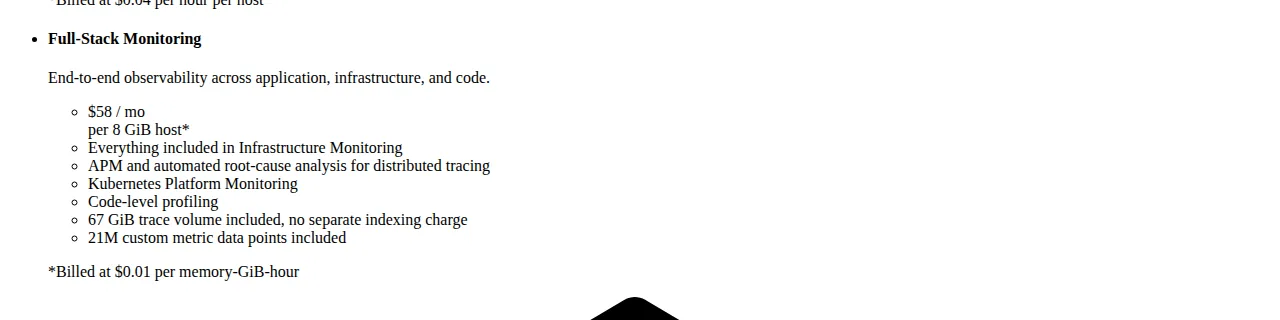
Dynatrace sells four host tiers, and the unit is never "one server." Foundation and Discovery is 7 dollars a month per host and covers host health, topology, and operating-system services. Infrastructure Monitoring is 29 dollars a month per host and adds process, disk, memory, and network analysis. Full-Stack Monitoring — the tier with application performance monitoring and automated root-cause analysis — is 58 dollars a month per 8 GiB host. A host with 32 GiB of RAM is four billable units, so full-stack monitoring on that one machine costs 232 dollars a month, not 58.
At fifty hosts averaging 8 GiB, the full-stack line is 2,900 dollars a month. At fifty hosts averaging 32 GiB, it is 11,600 dollars — the same fifty machines, four times the bill. Kubernetes workloads priced through OpenTelemetry instrumentation are 5 dollars a month per container — the escape hatch for container-dense estates, where forty containers cost 200 dollars a month against 232 on a 32 GiB host meter.
The data layer is Grail: ingest and process at 0.20 dollars per GiB, retain at 0.0007 dollars per GiB-day, queries included. Five hundred gigabytes of ingest is 100 dollars a month; retaining it for 35 days adds 12.25 dollars. Dynatrace includes 67 GiB of trace volume per full-stack host and 21 million custom metric data points, so a typical estate never sees a separate trace or metric line.
Real User Monitoring is 2.25 dollars per 1,000 sessions, session replay is 0.0045 dollars per session, and Synthetic Monitoring is 4.50 dollars per 1,000 synthetic actions. Application Security is 13 dollars a month per 8 GiB host, and compliance monitoring is 5 dollars a month per host. Davis AI — the automated root-cause engine — is included in Full-Stack Monitoring, which is why the 58-dollar unit costs nearly twice Datadog's 31-dollar APM host: the analysis is in the price, not on top of it.
Datadog: the host is cheap, the log is billed twice
APM Pro starts at 31 dollars per host per month on annual terms, APM Enterprise at 40 dollars, or 47 dollars on demand. Infrastructure Monitoring Pro is 15 dollars per host per month and Enterprise is 23 dollars. The APM host includes Universal Service Monitoring, which costs 9 dollars per host as an add-on to infrastructure-only hosts. Data Streams Monitoring is available standalone at 15 dollars per host, Continuous Profiler at 19 dollars. Every APM host includes 150 GB of ingested spans, with additional spans at 0.10 dollars per GB.
Logs are where Datadog's meter turns expensive, because there are two of them. Ingestion is 0.10 dollars per GB on annual terms, 0.12 dollars on demand. Indexing — the step that makes logs searchable — is 1.27 dollars per million events at 7-day retention, 1.70 dollars at 15 days, and 2.50 dollars at 30 days. At one kilobyte per event, 100 gigabytes is 100 million events, so indexing costs 170 dollars against a 10-dollar ingestion line at 15-day retention. Index 10 percent and the line falls to 17 dollars, but the other 90 percent is not searchable unless archived or moved to Flex Logs.
Real User Monitoring splits three ways: Measure at 0.15 dollars per 1,000 sessions, Session Replay at 2 dollars, and Investigate at 3 dollars. Containers are 5 free per host license on Pro and 10 on Enterprise, with additional containers at 0.002 dollars per container per hour and prepaid containers at 1 dollar per container per month. Our Datadog vs Grafana Cloud vs New Relic observability pricing playbook prices the same vendor on a smaller workload and shows the same indexing trap at 100 gigabytes.
New Relic: the host is free, the seat is the bill
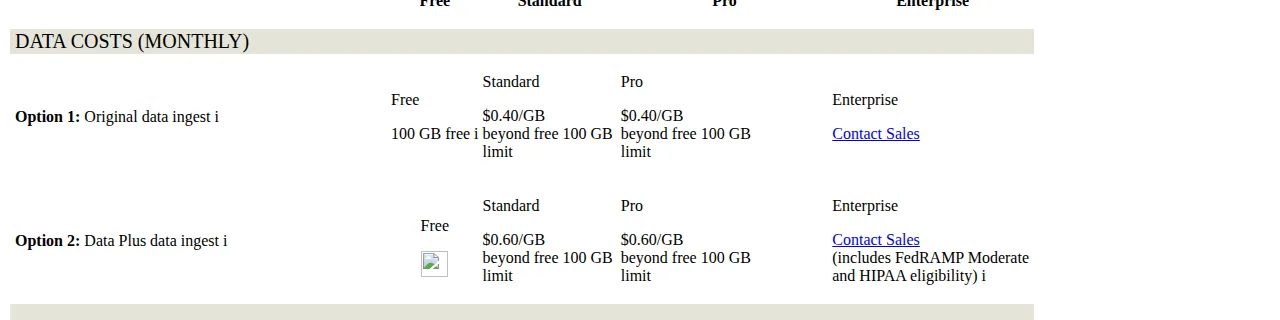
New Relic charges nothing per host. Its two meters are data and users. The free tier includes 100 GB of data ingest and 500 synthetic checks a month. Beyond that, the original data option is 0.40 dollars per GB, and Data Plus — which adds FedRAMP Moderate and HIPAA eligibility — is 0.60 dollars per GB. Five hundred gigabytes costs 160 dollars on the original option; two terabytes costs 760 dollars. There is no indexing meter, no retention meter, and no per-host charge on top.
The user meter is where the bill grows. Basic users are free. Core users cost 49 dollars each and add telemetry in the IDE, error tracking, and logs. Full platform users cost 10 dollars for the first user and 99 dollars for each additional user on the Standard edition with annual commitments. Ten full users cost 901 dollars a month; fifty cost 4,861 dollars. Additional synthetic checks beyond the free 500 cost 0.005 dollars each.
The formula shows the whole strategy in one line: New Relic is the cheapest vendor here until the seat count crosses a threshold, and then it is the most expensive. At ten users and 500 gigabytes the total is 1,061 dollars; at fifty users it is 5,621 dollars, and the data line is only 760 dollars of it. The lever is the headcount, not the telemetry volume.
The same estate, priced three ways
Three workloads, one set of rules: hosts are 8 GiB for the Dynatrace unit, logs are one kilobyte per event for the Datadog indexing line, RUM is on the Measure tier for Datadog, and New Relic users are full platform on Standard annual terms.
Workload 1 — fifty hosts, 500 GB of logs, ten full users, 100,000 RUM sessions:
Workload 2 — twenty hosts, 100 GB of logs, five full users, 50,000 RUM sessions:
New Relic's data line is zero at workload 2 because 100 GB falls inside the free tier — a small estate pays New Relic only for its seats.
Workload 3 — two hundred hosts, 2 TB of logs, fifty full users, one million RUM sessions:
New Relic wins all three workloads, but only because the seat count stays low relative to the host count. At workload 1 volumes, New Relic equals Datadog at 24.2 full users; at workload 3 volumes the crossover is 50.6 users, and the example estate sits just below it. Count your full-platform users before you sign, because the vendor that wins at ten seats loses at thirty.
The decision table
| Decision factor | Dynatrace | Datadog | New Relic | Authority |
|---|---|---|---|---|
| APM on 50 hosts | 2,900 dollars a month | 1,550 dollars a month | 0 dollars (no host charge) | Vendor pricing pages, Nov 20 2026 |
| 500 GB log line | 100 dollars ingest | 900 dollars ingest plus index | 160 dollars ingest | Vendor pricing pages, Nov 20 2026 |
| 10 full users | Included in host unit | No per-user charge | 901 dollars a month | New Relic pricing page |
| Root-cause analysis | Davis AI included | Watchdog available, add-on pricing | Applied Intelligence, edition-gated | Vendor product pages |
| Free tier | None published | None published | 100 GB ingest, 500 synthetic checks | New Relic pricing page |
| Best for | Regulated estates that want analysis included | Teams that index selectively | Small teams with many hosts, few seats | Editorial analysis of the three meters |
Who should not buy each one
Dynatrace is the wrong buy for a fleet of fat machines: at 32 GiB per host the unit quadruples and the 58-dollar headline becomes 232 dollars per machine. It is also the wrong buy for a team that wants a free tier to evaluate against production traffic — none is published. It is the right buy for a regulated estate, where Davis AI root-cause analysis and the 5-dollar compliance add-on are worth more than the premium.
Datadog is the wrong buy for a team that indexes everything: at one kilobyte per event the indexing line is seventeen times the ingestion line at 15-day retention. It is the right buy for a team that treats indexing as a budget decision — index 10 percent, archive the rest — and for teams already on Datadog infrastructure monitoring, where the APM host at 31 dollars replaces a 15-dollar infrastructure host plus a 9-dollar USM add-on for 7 dollars more.
New Relic is the wrong buy for a large engineering organisation: fifty full-platform users cost 4,861 dollars a month before a single gigabyte is ingested, and the per-seat meter grows with hiring while the other two vendors' meters do not. It is the right buy for a small team running a large estate — many hosts, few engineers, heavy telemetry. Our Sentry vs Datadog error tracking vs observability pricing playbook covers the error-tracking corner of the same decision for teams whose first problem is exceptions, not infrastructure.
Execution checklist
- [x] Step 1: Count the estate. List every host with its RAM in GiB, last month's log volume, the RUM session count, and the engineers who need full-platform access. The count is the whole decision.
- [x] Step 2: Price Dynatrace in host units. Divide total host RAM by 8 GiB, multiply by 58 dollars, add Grail ingest at 0.20 dollars per GiB and RUM at 2.25 dollars per 1,000 sessions.
- [x] Step 3: Price Datadog with indexing, not just ingestion. Multiply hosts by 31 dollars, add ingest at 0.10 dollars per GB, then indexing at 1.70 dollars per million events at 15-day retention — and decide what percentage of events you will actually index.
- [x] Step 4: Price New Relic on seats. Subtract the free 100 GB, multiply the rest by 0.40 dollars, then add 10 dollars plus 99 dollars per full user after the first.
- [x] Step 5: Trial on production-shaped traffic. Run the free tier or trial against a real week's telemetry, not a demo workload, and measure the host units, indexed events, and seats it actually consumes.
- [x] Step 6: Re-price quarterly. Host RAM grows with every hardware refresh, log volume with every service, headcount with every hire. A 50-host estate becomes a 200-host estate in a year of growth.
Founder & CEO Insight — Enow A. Jovial