A Delaware series LLC is one master LLC holding several businesses behind internal walls. Each series can own property, sign contracts, hold its own bank account, and — if the statute's conditions are met — keep its debts away from the other series. Delaware allows this in two forms, and choosing the wrong one is the most common expensive mistake in the structure: a protected series costs nothing to create and proves nothing to a lender, while a registered series costs $70 to file and $100 a year but carries its own public record. Figures as read on November 16, 2026, from the Delaware Code at delcode.delaware.gov.
The statute: two series under one chapter
Delaware amended its LLC Act in August 2019 and split the old single series concept in two: § 18-215 governs protected series, § 18-218 governs registered series. Use protected series when the walls are for your own bookkeeping and tax separation, and registered series when a bank, a counterparty, or a court will need to verify the series exists without taking your word for it.
| Attribute | Protected series (§ 18-215) | Registered series (§ 18-218) | Authority |
|---|---|---|---|
| Created by | LLC agreement alone | Certificate of registered series filed with the Secretary of State | 6 Del. C. §§ 18-215(a), 18-218(a), (d) |
| Filing fee | $0 | $70 per series | 6 Del. C. § 18-1105(a)(3) |
| Annual tax | $0 (covered by the master LLC $400) | $100 per registered series | 6 Del. C. § 18-1107(b) |
| Public record | None | Yes — certificate on file, own good standing | 6 Del. C. § 18-218(a); § 18-1107(h) |
| Name rule | No statutory name rule | Must begin with the master LLC name, distinguishable on the state records | 6 Del. C. § 18-218(e) |
| Can contract, hold title, sue and be sued in its own name | Yes | Yes | 6 Del. C. §§ 18-215(b)(1), 18-218(c) |
| May merge, convert, or consolidate on its own | No — only under §§ 18-219–18-221 | Yes, under § 18-221 | 6 Del. C. § 18-215(a) |
| Banking business | Excluded for both | Excluded for both | 6 Del. C. § 18-215(b)(1); 8 Del. C. § 126 |
The Delaware Registered Series vs. Protected Series LLC comparison covers the UCC Article 9 consequences; this playbook is the formation operation.
The three-part protected-series test
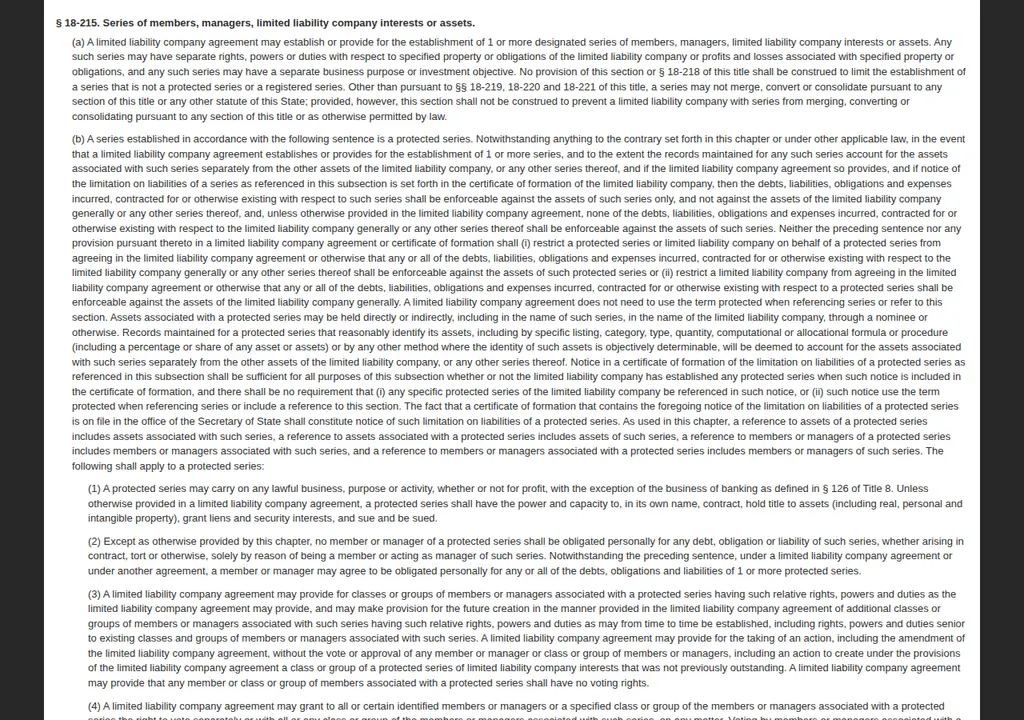
Section 18-215(b) grants protection only when three conditions are all true at once:
- The LLC agreement establishes the series. The agreement must establish the series and so provide that the series debts are enforceable against the series assets only. A certificate that mentions series while the operating agreement is silent on them fails this condition.
- The records account for the series assets separately. Records for the series must account for its assets separately from the LLC and every other series — by listing, category, quantity, or a formula such as a percentage or share. A single shared ledger with no series column is not separate records.
- Notice sits in the certificate of formation. Notice of the limitation on liabilities must be set forth in the certificate of formation. The notice is sufficient whether or not any specific series has been established when it is included, and it need not use the word "protected" or cite § 18-215. File it in the original certificate even with zero series — adding it later costs a $180 amendment, and a series created before the notice existed was never protected.
The same three conditions apply to a registered series under § 18-218(c), with the certificate of registered series added on top. The operating agreement is the load-bearing document in both forms, not the state filing.
The filing sequence, step by step
The formation itself is short; the sequencing is what matters.
- [x] Step 1: Decide protected, registered, or mixed before you draft. A structure may hold both kinds — decide per series, not per LLC.
- [x] Step 2: Reserve the name ($75) or file directly. Name reservation under § 18-103 costs $75 under § 18-1105(a)(1). The master name must contain a § 18-102 designation, and each registered series name must begin with the full master name, per § 18-218(e). Check the name first with the LLC and brand name availability search tool.
- [x] Step 3: File the certificate of formation ($70). Under § 18-201(a), the certificate sets forth the LLC name, the registered office and agent under § 18-104, plus any other matters the members determine to include. The series notice goes in "other matters": a sentence stating that the debts of any series shall be enforceable against the assets of that series only.
- [x] Step 4: Adopt the operating agreement with series provisions. This is the document § 18-215(b) actually tests. For each series: its name, members and managers, business purpose, capital accounts, profit and loss allocation, and the statement that its debts are enforceable against its assets only. Section 18-215(b)(3) allows the agreement to provide for future series — do so.
- [x] Step 5: File a certificate of registered series ($70 each) for each registered series. Under § 18-218(d)(1), the certificate sets forth the name of the LLC and the name of the registered series. File it before opening the series bank account and before the series signs anything.
- [x] Step 6: Obtain an EIN for each series. The IRS 2010 proposed regulations treat each series as a separate entity, and each can elect its own classification. Banks require a separate EIN per series account. Our EIN application playbook runs the four routes and the one-EIN-per-day limit that breaks a multi-series filing done in one sitting.
- [x] Step 7: Open separate accounts and separate books per series. One bank account per series, one ledger per series, contracts signed in the series name.
- [x] Step 8: Calendar June 1. The annual tax is due June 1 under § 18-1107(c); the Secretary of State mails a statement at least 60 days before, in care of the registered agent — one more reason that address must stay current.
The money: formation and five-year carry
For a master LLC holding three series:
The protected form saves $4,140 over five years against three standalone LLCs and $1,710 against the registered form. The saving is paid for in verifiability: a lender that cannot confirm a series exists from the state record will refuse the loan, demand a parent guarantee, or price the uncertainty — any one of which costs more than the $100 a year a registered series would have cost.
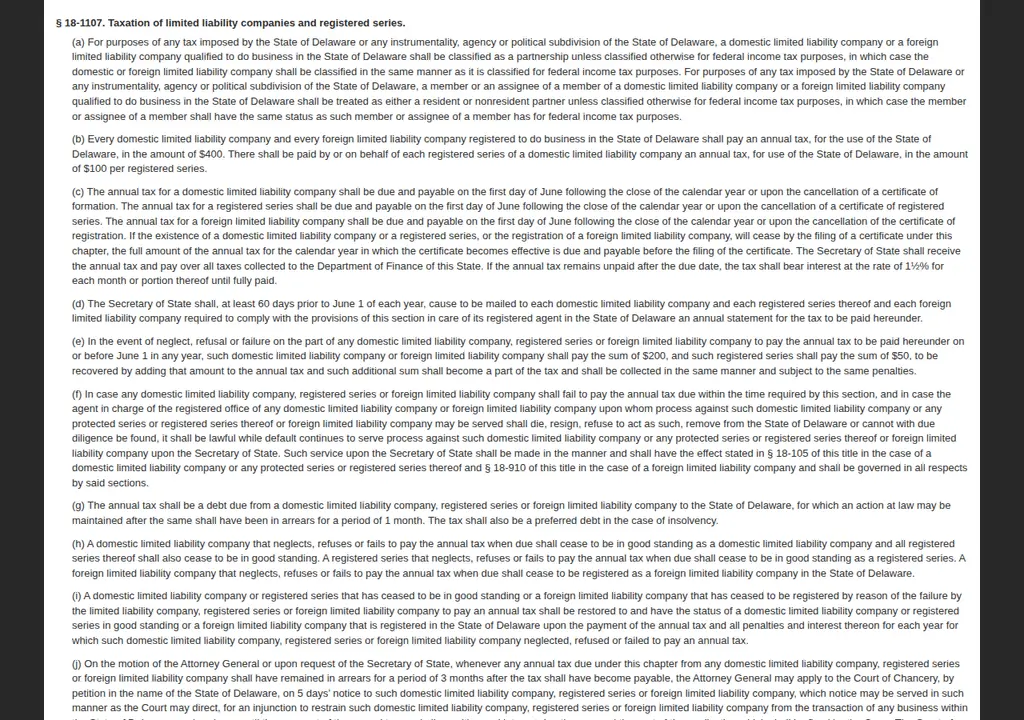
Late payment is steeper than the tax itself. Under § 18-1107(e), a domestic LLC that misses June 1 pays $200, each registered series $50, added to the tax; under § 18-1107(c) the unpaid tax bears interest at 1.5% per month. A master LLC with three registered series paying three months late owes:
The $31.50 of interest is the small part; the $350 penalty stings, and under § 18-1107(h) the LLC and any series that misses its tax ceases to be in good standing.
Registered series: what the extra $70 buys
Under § 18-218(d)(1) the certificate sets forth the LLC name and the registered series name. Under § 18-218(e), the series name must begin with the LLC name, including the § 18-102 designation, and be distinguishable on the Secretary of State's records.
What the $70 buys is three things the protected form cannot offer: a public organic record a lender's UCC search can confirm; its own good standing, which a protected series has none of; and the right to merge or consolidate with another registered series under § 18-221, which a protected series cannot do except by converting first under § 18-219.
Conversion runs both ways: § 18-219 converts protected to registered by filing a certificate of conversion and a certificate of registered series simultaneously; § 18-220 converts back the same way. If the LLC agreement is silent on authorization and does not prohibit conversion, members holding more than 50% of that series profit interests authorize it. Neither conversion winds up the series or dissolves the LLC. The practical use is the upgrade path: form protected while the structure is internal, convert when a lender asks for a public record. The conversion filing is $180 — budget the upgrade as a $180 decision, not a re-formation.
Tax: one LLC, several taxpayers
Delaware and federal treatment point in opposite directions. For Delaware purposes, § 18-1107(a) classifies a domestic LLC as a partnership unless it is classified otherwise federally, in which case Delaware follows the federal classification. Federally, the IRS 2010 proposed regulations treat each series as a separate entity, each able to elect its own classification. One Delaware filing can therefore contain three federal taxpayers — an S-Corp series running a business, a disregarded series holding one property, a C-Corp series holding investments — each with its own EIN, return, and books.
That flexibility is also the compliance trap: three returns, three sets of books, three EIN applications, and the one-EIN-per-day limit means a three-series formation cannot get all its EINs in one online session. Each series tax election is a separate decision with its own deadline. Our Form 8832 election guide runs the 75-day window and the Rev. Proc. 2009-41 relief; run it per series, not once for the structure.
Founder & CEO Insight — Enow A. Jovial
Who should not form a series LLC
The structure has sharp edges. A series may not carry on banking as defined in 8 Del. C. § 126, per § 18-215(b)(1) — a fintech that takes deposits is not a series candidate. A series LLC operating in a state that does not recognize series — and several still do not — may find its walls unenforceable where the business actually happens; foreign qualification there is a separate question for counsel. A single-asset business gains nothing from a series. And a structure whose series will each need outside financing should be registered from the start: a lender that discovers the series is protected mid-diligence will price the delay into the deal.
The LLC formation tax guide is the right starting point if any of those boundaries applies — a single clean LLC with the right tax election beats a three-series structure run as one commingled pool.
Execution checklist
- [x] Step 1: Choose the form per series — protected for internal walls, registered where a lender must verify existence from the state record.
- [x] Step 2: Reserve the master name ($75) — confirm availability first; registered series names must begin with the full master name.
- [x] Step 3: File the certificate of formation ($70) — name, registered office and agent under § 18-201, plus the series limitation notice.
- [x] Step 4: Adopt the operating agreement — series provisions, separate capital accounts, per-series profit and loss, and the § 18-215(b) enforceability statement.
- [x] Step 5: File certificates of registered series ($70 each) — before the series signs anything or opens an account.
- [x] Step 6: Obtain one EIN per series — plan around the one-per-day online limit; a three-series structure needs three sessions.
- [x] Step 7: Open one bank account and one ledger per series — the records condition is the protection; commingling ends it.
- [x] Step 8: Calendar June 1 every year — $400 for the master, $100 per registered series, $200/$50 late penalties plus 1.5% monthly interest, and loss of good standing.