The bill is the architecture
Every observability demo shows the same dashboards. Every invoice tells a different story. Datadog, Splunk and Elastic all ingest, index, retain and alert on logs, but they charge for those four acts with three different meters, and the meter decides the architecture. A team that buys Splunk Cloud Platform without an ingest budget meets the price after the contract is signed. This playbook prices W1 at 10 GB of logs a day, W2 at 100 GB a day and W3 at 1 TB a day on all three vendors, from list rates published on 20 November 2026, with all arithmetic shown.
Three vendors, three meters
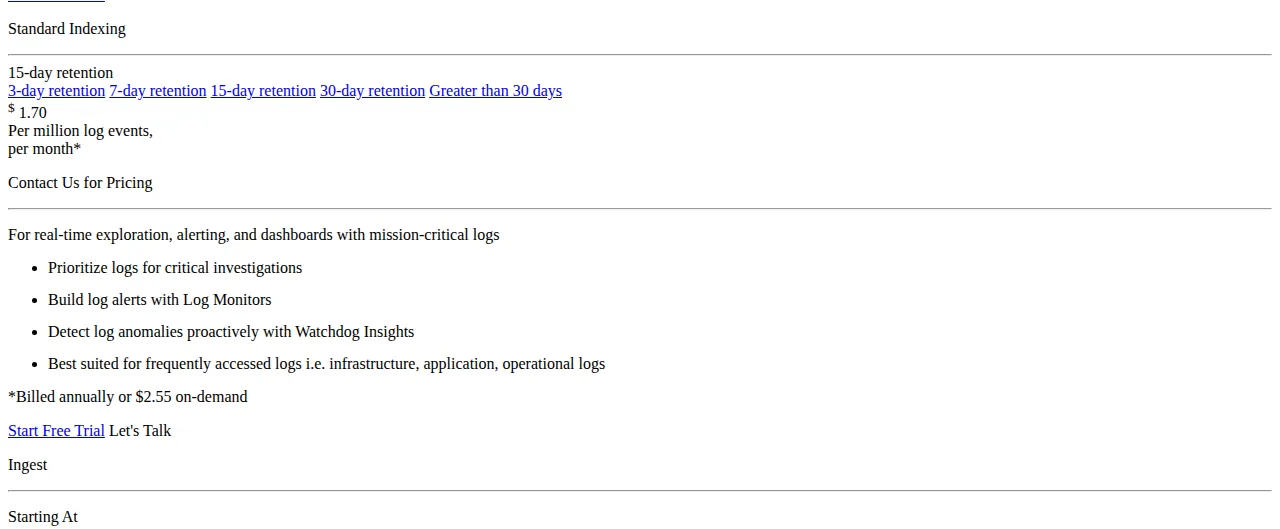
Datadog splits the log bill in two: ingest at $0.10 per GB, plus indexing per million events per month by retention tier, $1.70 at 15 days. You pay ingest on everything and index only what you search, so the index fraction is the strongest cost control in the estate. APM is $31 per host per month.
Splunk Observability Cloud charges $0.60 per GB per day, or $18.00 per GB of daily volume per month, with no separate index charge. Hosts: Infrastructure Monitoring $15 and APM $40 per host per month, Standard rates. Splunk Cloud Platform, the SIEM, is sold by quote only.
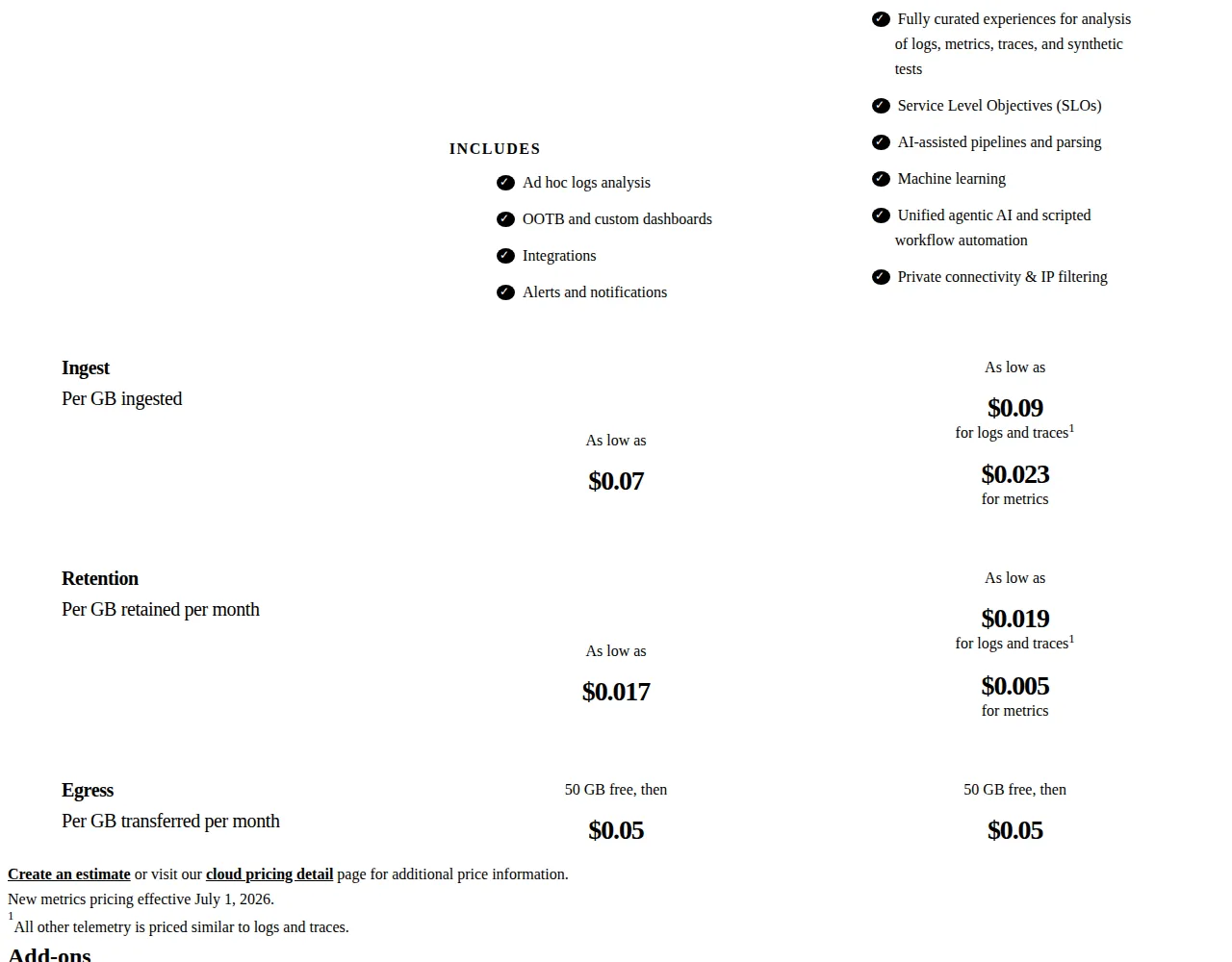
Elastic Cloud Serverless charges ingest plus retention, both per GB. On Complete, ingest is as low as $0.09 per GB and retention $0.019 per GB retained, with no per-host fee and APM included. The catch is as low as: Elastic publishes volume-tiered floors, so every Elastic total here is a floor.
| Meter | Datadog | Splunk Observability Cloud | Elastic Serverless Complete | Authority |
|---|---|---|---|---|
| Log ingest | $0.10 per GB | $0.60 per GB per day | $0.09 per GB, as low as | Vendor pricing, 20 Nov 2026 |
| Log indexing or retention | $1.70 per 1M events, 15-day | Included in the per-day rate | $0.019 per GB retained | Vendor pricing, 20 Nov 2026 |
| Host monitoring | $15 per host per month | $15 per host per month | Included, no per-host fee | Vendor pricing, 20 Nov 2026 |
| APM | $31 per host per month | $40 per host per month | Included in Complete | Vendor pricing, 20 Nov 2026 |
What each vendor publishes
Datadog publishes the fullest card. Ingest is $0.10 per GB, and the index ladder is $1.06, $1.27, $1.70 and $2.50 per million events per month for 3, 7, 15 and 30 days on annual billing. On demand, 15-day indexing rises to $2.55, a 50 percent premium. Escape hatches: Flex Logs at $0.05 per million events stored, Pipelines at $0.095 per ingested GB, Archive Search at $0.05 per GB scanned, forwarding to an external SIEM at $0.25 per GB.
Splunk publishes list rates only for Observability Cloud, all Standard rates. The bundle alternative: Essentials at $95 per host per month and Premier at $150, from 30 hosts. The page does not state the log allowance, so no edition total is built here.
Elastic publishes two serverless tiers. Logs Essentials: ingest as low as $0.07 per GB, retention as low as $0.017 per GB retained. Complete adds full-stack monitoring, SLOs and APM for as low as $0.09 per GB ingested and $0.019 retained, metrics at $0.023 and $0.005. Egress is 50 GB free, then $0.05 per GB.
For the wider comparison, our Datadog vs Grafana Cloud vs New Relic observability pricing playbook prices Datadog against two other vendors, and our Sentry vs Datadog error tracking vs observability pricing playbook covers the error-tracking side.
The shared assumptions
Three workloads, one set of rules. A month is 30 days. All rates are US list rates read on 20 November 2026, annual-commit. Retention is 15 days everywhere. The average log event is 1 KB, so 1 GB holds about 1,000,000 events; that conversion drives the Datadog index math. Datadog indexes 100 percent of ingested logs in the baseline. Splunk runs Logs plus Infrastructure Monitoring and APM on every host. Elastic runs Serverless Complete with APM included and no per-host fee. Retained volume at steady state is daily GB times 15 days.
| Workload | Logs per day | Logs per month | Hosts | Retention |
|---|---|---|---|---|
| W1 small | 10 GB | 300 GB | 10 | 15 days |
| W2 growing | 100 GB | 3,000 GB | 50 | 15 days |
| W3 large | 1 TB | 30,000 GB | 250 | 15 days |
W1: 10 GB a day
W1 is a small estate: ten hosts, 300 GB of logs a month, indexed in full at the 15-day rate.
At W1: Elastic $29.85 a month as a floor, Splunk $730.00, Datadog $1,000.00.
W2: 100 GB a day
W2 is the growing estate most buyers sign for: fifty hosts, 3,000 GB a month.
At W2: Elastic $298.50, Splunk $4,550.00, Datadog $7,700.00 a month; annualised $3,582.00, $54,600.00 and $92,400.00. The gap is $3,150.00 a month, almost all of it the index line.
W3: 1 TB a day
W3 is the large estate: 250 hosts, 30,000 GB a month, 1 TB a day. The meters scale linearly.
At W3: Elastic $2,985.00, Splunk $31,750.00, Datadog $65,500.00 a month; annualised $35,820.00, $381,000.00 and $786,000.00. The Datadog index line alone exceeds the entire Splunk bill.
The crossover table
| Workload | Datadog per month | Splunk per month | Elastic per month, floor | Cheapest on list |
|---|---|---|---|---|
| W1, 10 GB a day | $1,000.00 | $730.00 | $29.85 | Elastic |
| W2, 100 GB a day | $7,700.00 | $4,550.00 | $298.50 | Elastic |
| W3, 1 TB a day | $65,500.00 | $31,750.00 | $2,985.00 | Elastic |
The table ranks list price, not value. Elastic wins every row, widest where volume is highest: Elastic charges ingest once, Datadog charges ingest plus indexing. Splunk beats Datadog on every row, $18.00 against $54.00 per GB of daily volume per month at full 15-day indexing.
Four levers that move the bill
Four levers decide the real bill. The first is the Datadog index fraction, and it is the largest. Datadog logs cost $3.00 per GB of daily volume per month for ingest, plus $51.00 times the indexed fraction; Splunk logs cost a flat $18.00. Set the two equal and solve:
Index 29.4 percent or less at 15-day retention and Datadog logs match Splunk logs. At W2 with 10 percent indexed, Datadog logs fall to $810.00 a month and the total to $3,110.00, below Splunk at $4,550.00. Route debug logs to Flex storage or archive, and index only what your alerts and dashboards query.
The second lever is retention. Datadog 30-day indexing costs $2.50 per million events, so W2 logs rise to $7,800.00 a month and the total to $10,100.00. At 7 days and $1.27, W2 logs drop to $4,110.00.
The third lever is the Elastic realised rate. Elastic logs cost $30.00 times the realised ingest rate per GB of daily volume per month, plus $0.29 of retention; set that equal to Splunk at $18.00 and solve:
Elastic stays below Splunk logs until its realised rate rises above about $0.59 per GB. Get the tiered rate from the Elastic estimator at your real volume.
The fourth lever is the Splunk edition. From 30 hosts, Essentials at $95 per host per month and Premier at $150 replace the a la carte host lines, but the log allowance is unpublished, so the edition only wins if your quote states it in writing.
The SIEM fork
Elastic Security Serverless is the only SIEM here with published per-GB rates: Essentials at as low as $0.09 per GB ingested and $0.017 retained, Complete at $0.11 and $0.019. Those rates took effect on 1 November 2025. At W2, Elastic Security Complete costs $330.00 plus $28.50 of retention, $358.50 a month as a floor.
Splunk Enterprise Security has no published per-GB price. Splunk sells it by quote on activity-based, workload or ingest pricing. This guide prints no Splunk SIEM total.
Datadog Cloud SIEM is an add-on to Log Management, and the pricing page read for this guide did not state its unit plainly enough to build a total. What is verifiable is the forwarding cost: $0.25 per GB outbound per destination.
| SIEM path | Published per-GB rate | W2 SIEM line, per month | Authority |
|---|---|---|---|
| Elastic Security Complete | $0.11 ingest, $0.019 retention | $358.50, floor | Elastic pricing, 20 Nov 2026 |
| Splunk Enterprise Security | None published, quote only | Not printed | Splunk pricing, 20 Nov 2026 |
| Datadog Cloud SIEM | Unit not stated plainly | Not printed | Datadog pricing, 20 Nov 2026 |
For the error-tracking side, our Sentry vs Grafana vs Honeycomb observability pricing playbook prices three more vendors on the same per-GB discipline.
Operator boundaries
Each meter has its own failure mode, and it follows the telemetry path. OTel collectors batch spans into JSON payloads over HTTP, agents scrape host metrics over TCP, and the log pipeline parses each line before indexing — so a SaaS estate on AWS pays the meter on API calls, DNS lookups and SQL queries it never budgeted as logs. Datadog breaks on index-everything defaults: a service logging verbosely at 2 KB per event doubles the index line, because indexing is priced per event and ingest per GB. Splunk breaks on the per-day meter: a one-day spike to 300 GB bills as a 300 GB day. Elastic breaks on the tier boundary and the measurement point: ingest and retention are billed on the enriched size before compression, and crossing a volume tier changes the rate on the whole month.
Execution checklist
- Measure true daily ingest: take the p95 daily GB, not the average, because Splunk bills the day and Datadog indexes the event.
- Count the events per GB: sample 1,000 log lines and rerun the Datadog index line with your real event size.
- Set the index fraction before the contract: name the indexed services, and put the 29.4 percent crossover in the memo.
- Price the SIEM separately: take the Elastic Security floor or a written Splunk quote, and add the Datadog forwarding line if logs cross vendors.
- Get the Splunk quote in writing with the ingest model named: activity-based, workload or ingest, with the Cloud Flex terms.
- Run the Elastic estimator at your real volume: confirm the tiered rate against the $0.59 break-even, and budget the tier rate, not the floor.
- Re-run the totals every quarter: rerun the W1 to W3 arithmetic with fresh volumes and rates, and run the result through our ROI calculator before any renewal.
The decision
Buy the meter you can control. At 10 GB a day, verify the Elastic tier. At 100 GB a day, Splunk is the safe list-price buy; Datadog suits teams that will run an indexing policy. At 1 TB a day, the decision is an indexing policy plus a SIEM quote plus a forwarding map.
Founder & CEO Insight — Enow A. Jovial
The numbers here are list rates read on 20 November 2026, and every total shows its arithmetic. What should not differ is the method: name the meter, name the volume, name the retention, and make the vendor write the unit beside the price.