CrowdStrike, SentinelOne and Microsoft Defender sell the same promise — an agent on every endpoint that stops the breach before it becomes a filing — but they charge for it in three different currencies. CrowdStrike charges per device per month: Falcon Go is $7.99 a device a month, Falcon Pro is $14.99, and Falcon Enterprise is $19.99, all billed monthly on the vendor's own pricing page. SentinelOne charges per endpoint per year through a partner: Singularity Core is $69.99, Control is $79.99, Complete is $179.99 and Commercial is $229.99 a year, for 5 to 100 workstations. Microsoft Defender charges per user per month: Defender for Business is $3.00, Defender for Endpoint Plan 1 is $3.00, and Plan 2 is $5.20, on the October 2026 Microsoft price list. The billing unit decides the bill.
The reason detection speed is now a finance question, not only a security question, is a filing deadline. The SEC adopted rules on July 26, 2023 requiring public companies to disclose a material cybersecurity incident on Form 8-K, Item 1.05, within four business days of determining that the incident is material. The rule took effect on December 18, 2023. In the first year, 26 companies filed under Item 1.05, and in the first 100 days the average time from detection to disclosure was 5.45 business days. The clock runs from the materiality determination, not from detection — but a team that cannot answer "what ran, where, and how far did it get" within days cannot make a materiality determination at all. That is what an EDR platform sells: the timeline. Retention figures matter as much as the per-endpoint rates, because a 14-day window cannot answer a question asked on day 20.
The three meters, side by side
| Vendor | What you pay for | Entry EDR price | Ceiling that matters | Authority |
|---|---|---|---|---|
| CrowdStrike Falcon | Per device, per month | Go $7.99/device/mo; Enterprise $19.99/device/mo, billed monthly | Enterprise is the cheapest Falcon tier with EDR; Falcon Complete (managed detection) is quoted | crowdstrike.com/pricing, read Nov 20, 2026 |
| SentinelOne Singularity | Per endpoint, per year, via partner | Core $69.99/endpoint/yr; Complete $179.99/endpoint/yr | Prices shown for 5–100 workstations; partner's price controls | SentinelOne published list, checked Oct 24–30, 2026 |
| Microsoft Defender | Per user, per month | Business $3.00/user/mo; Endpoint Plan 2 $5.20/user/mo, annual term | One licence covers up to 5 devices; Business capped at 300 users | Microsoft October 2026 price list via o365hq and Redress Compliance, read Nov 20, 2026 |
CrowdStrike is the only one of the three that publishes its prices on its own page with a buy button. SentinelOne publishes list prices but sells only through authorised partners. Microsoft publishes list prices and also bundles the product into suites, so the standalone price is often not the price anyone pays.
CrowdStrike Falcon: the monthly meter, and the outage that priced the risk
Falcon is sold in tiers that climb by capability, not by seat count. Falcon Go, at $7.99 a device a month billed monthly, is next-generation antivirus — protection, not detection and response. Falcon Pro, at $14.99 a device a month billed monthly, adds the enhanced protection layer. Falcon Enterprise, at $19.99 a device a month billed monthly, is the cheapest Falcon tier that is actually EDR: full endpoint detection and response with threat hunting, DNS filtering and IP reputation. Falcon Complete, the managed detection and response service with 24/7 human analysts, is quoted by sales and does not appear on the price page at all. The page offers monthly or annual billing and a 15-day free trial.
The monthly-billed figures are the expensive way to buy Falcon. Independent reads of CrowdStrike's annual pricing put Falcon Enterprise at $184.99 a device a year, which is $15.42 a device a month — $4.57 a month less than the monthly-billed $19.99. At 250 endpoints:
\text{Falcon Enterprise, 250 endpoints, monthly billing} = $19.99 \times 250 \times 12 = $59{,}970\text{ per year}
\text{Falcon Enterprise, 250 endpoints, annual billing} = $184.99 \times 250 = $46{,}247.50\text{ per year}
Annual billing saves $13,722.50 a year at 250 endpoints, and the saving scales with the fleet. A buyer who signs the monthly price because it looks smaller has bought the most expensive version of the product. Go is not EDR at any price — comparing Go's $7.99 against Defender's $3.00 compares antivirus against EDR.
The risk CrowdStrike carries that the other two do not is concentration. On July 19, 2024, a faulty Falcon sensor content update — Channel File 291 — crashed about 8.5 million Windows devices worldwide, by Microsoft's estimate. CISA's alert that day recorded that the fault was a CrowdStrike content update, not malicious activity, and that the update had been reverted within hours — but many affected machines needed manual remediation in safe mode, and about 99% of Windows sensors were not back online until July 29. The outage is not a reason to reject Falcon: every kernel-level agent carries the same class of risk. It is a reason to price the operational cost of a bad update into the decision — a staged rollout ring for sensor updates and a tested recovery runbook. Our security incident response playbook covers the runbook: who declares the incident, who owns the timeline, and what gets written down while the systems are still down.
Founder & CEO Insight — Enow A. Jovial
SentinelOne Singularity: the annual meter, sold by a partner
SentinelOne's pricing page lists five packages, and four of them carry a printed price. Singularity Core is $69.99 an endpoint a year, Control is $79.99, Complete is $179.99, and Commercial is $229.99, all billed annually for 5 to 100 workstations. Singularity Enterprise is quoted. EDR starts at Complete: Core and Control are endpoint protection with AI detection and rollback, and Complete adds the XDR layer with autonomous response and JSON alert exports. Commercial adds identity security, managed threat hunting, and 90 days of data retention, against 14 days on Complete. Above 100 workstations the buyer gets a quote.
\text{Singularity Complete, 250 endpoints} = $179.99 \times 250 = $44{,}997.50\text{ per year}
\text{Singularity Commercial, 250 endpoints} = $229.99 \times 250 = $57{,}497.50\text{ per year}
Complete undercuts Falcon Enterprise on annual billing by $1,250 a year at 250 endpoints — a rounding error, not a reason to choose. The real difference is retention: Complete keeps 14 days of EDR data, Commercial keeps 90 days, and the jump costs $12,500 a year at 250 endpoints. A team that needs to answer "what ran here three weeks ago" must buy Commercial, and the honest comparison is Commercial at $57,497.50 against Falcon Enterprise, whose retention figure CrowdStrike does not publish on its pricing page. Do not assume a retention period a vendor has not printed.
Microsoft Defender: the bundled meter, and the five-device rule
Defender's prices look like a rounding error next to the other two, and that is the point — Microsoft sells EDR as a feature of a suite, not as a product. Defender for Business is $3.00 a user a month for organisations with up to 300 users, and it is included in Microsoft 365 Business Premium. Defender for Endpoint Plan 1 is $3.00 a user a month on an annual term and is included in Microsoft 365 E3; it is prevention only — antivirus, attack surface reduction, device control, web protection — with no EDR. Defender for Endpoint Plan 2 is $5.20 a user a month on an annual term, or $62.40 a user a year, and is included in Microsoft 365 E5; it adds full EDR, automated investigation and remediation, advanced hunting with KQL, live response, sandbox analysis, CVE scoring through the Microsoft Graph API, and six months of data retention. The Plan 2 add-on for Microsoft 365 E3 tenants is $3.00 a user a month.
Two licensing facts change the math. First, a Defender licence covers up to five devices per user, while CrowdStrike and SentinelOne charge per device. A 250-device fleet belonging to 125 users needs 125 Defender licences, not 250:
\text{Defender Plan 2, 125 users} = $5.20 \times 125 \times 12 = $7{,}800\text{ per year}
That is $7,800 a year for the same 250 devices that cost $15,600 at one device per user — and $38,447.50 a year less than SentinelOne Complete at list. Second, the suite math: Microsoft 365 E5 rose to $60 a user a month on July 1, 2026, and includes Plan 2. An organisation already on E5 pays $0 incremental for EDR. An organisation on E3 pays the $5.20 standalone rate, or the $3.00 add-on, to reach the same tier.
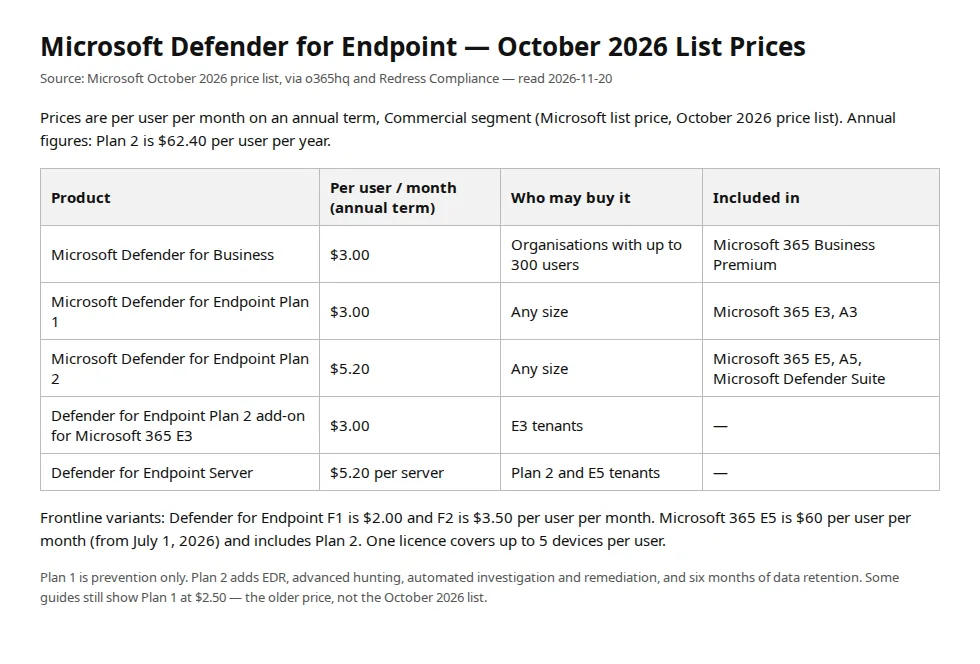
Defender's weakness is scope, not price. It is strongest inside the Microsoft stack — Windows, Microsoft 365, Entra ID — and thinner on Mac and Linux estates. A fleet that is half macOS buys the Windows discount and pays full price for the other half somewhere else. The ISO 27001 vs SOC 2 Type II enterprise procurement playbook covers how auditors treat the managed layer: a managed service is a control, and the auditor will ask for the provider's own SOC 2 report, not yours.
The decision: which meter matches how you are already licensed
| Buyer | Buy this | Skip this | Authority |
|---|---|---|---|
| Microsoft 365 E5 already deployed | Defender Plan 2 — $0 incremental | Any standalone EDR until the Mac/Linux gap is measured | Microsoft October 2026 price list |
| Microsoft 365 E3, Windows-heavy fleet | Defender Plan 2 add-on at $3.00/user/mo | Plan 1 — prevention without EDR cannot answer the Item 1.05 question | Microsoft October 2026 price list |
| Small business, up to 300 users, no E5 | Defender for Business at $3.00/user/mo | Falcon Go — antivirus at $7.99/device/mo is not EDR | Microsoft October 2026 price list |
| Mixed OS fleet, partner channel preferred | SentinelOne Complete at $179.99/endpoint/yr | Core and Control — no EDR at any price | SentinelOne published list, Oct 2026 |
| Enterprise fleet, monthly billing needed | Falcon Enterprise at $19.99/device/mo; switch to annual at renewal | Falcon Pro — enhanced protection is not full EDR | crowdstrike.com/pricing |
The annual totals at 250 endpoints, one device per user, are $15,600 for Defender Plan 2 standalone, $44,997.50 for SentinelOne Complete, and $46,247.50 for CrowdStrike Falcon Enterprise on annual billing — or $59,970 on monthly billing. The cheapest EDR is the one already inside a suite you own. The most expensive is the one bought monthly, on the wrong tier, with a retention window shorter than the investigation it must support.
Five steps before you sign
- Inventory the fleet by user, not by device. Export every endpoint with its assigned user and operating system. The Defender five-device rule only helps if you know the user count.
- Price the Microsoft you already own. List every Microsoft 365 licence in the tenant and mark which include Plan 1, Plan 2, or Defender for Business. An E5 tenant needs no EDR purchase at all.
- Get the partner quote in writing for SentinelOne, and the annual price for CrowdStrike. Ask for the per-endpoint price, the renewal price, the retention period, and whether managed detection is included. The list price is not the bill.
- Run a 30-day pilot on one update ring. Deploy the agent to a single department, push a sensor update, and time the recovery. The July 2024 outage is the test case: measure how your machines come back.
- Write the retention period into the order. Fourteen days, 90 days, or six months — whichever it is, put it in the contract, and confirm the price of extending it before the first incident, not during it.
- [x] Fleet counted by user and by device, with the OS split documented
- [x] Microsoft 365 licences mapped, with the included Defender tier marked
- [x] Standalone quotes received in writing, with renewal price and retention stated
- [x] Pilot ring deployed and a sensor update rolled back on schedule
- [x] SEC Item 1.05 response owner named, with the four-business-day clock rehearsed
The EDR market in 2026 is three billing units wearing the same product name. CrowdStrike charges per device per month and rewards annual billing with a $13,722.50 saving at 250 endpoints. SentinelOne charges per endpoint per year through a partner whose price controls. Microsoft charges per user per month and gives the product away inside a suite most enterprises already buy. Count the users, count the devices, count the licences you already own — and then buy the timeline, not the logo. The Sentry vs Rollbar vs Bugsnag error tracking pricing playbook covers the B2B SaaS half of the same discipline: what your applications report when the endpoint agent has nothing to say. Run the fleet math in our ROI calculator before the renewal meeting.