Three vendors sell the same promise — a message leaves one service and arrives at another — and charge for it in three different ways. Amazon SQS bills per request. CloudAMQP rents you a RabbitMQ or LavinMQ broker by the month, flat. Confluent Cloud meters Kafka by the hour, by the gigabyte moved, and by the gigabyte stored. This playbook prices the three at 10 million, 100 million and 1 billion messages a month, states each one's ordering and retention guarantees, and shows the arithmetic.
How each vendor charges
SQS has no instance, no cluster, no storage line. Every API action counts as a request, and each 64 KB chunk of a payload bills as one request. The first 1 million requests a month are free. After that, Standard runs $0.40 per million up to 100 billion, $0.30 to 200 billion, $0.24 above; FIFO $0.50, $0.40, $0.35 across the same tiers. Sourcing note: the AWS page renders those rate cells through JavaScript, so they do not appear in the fetched page HTML; they were corroborated across several independent pricing reads on 6 November 2026, while the tier structure and free tier are confirmed on the AWS page itself.
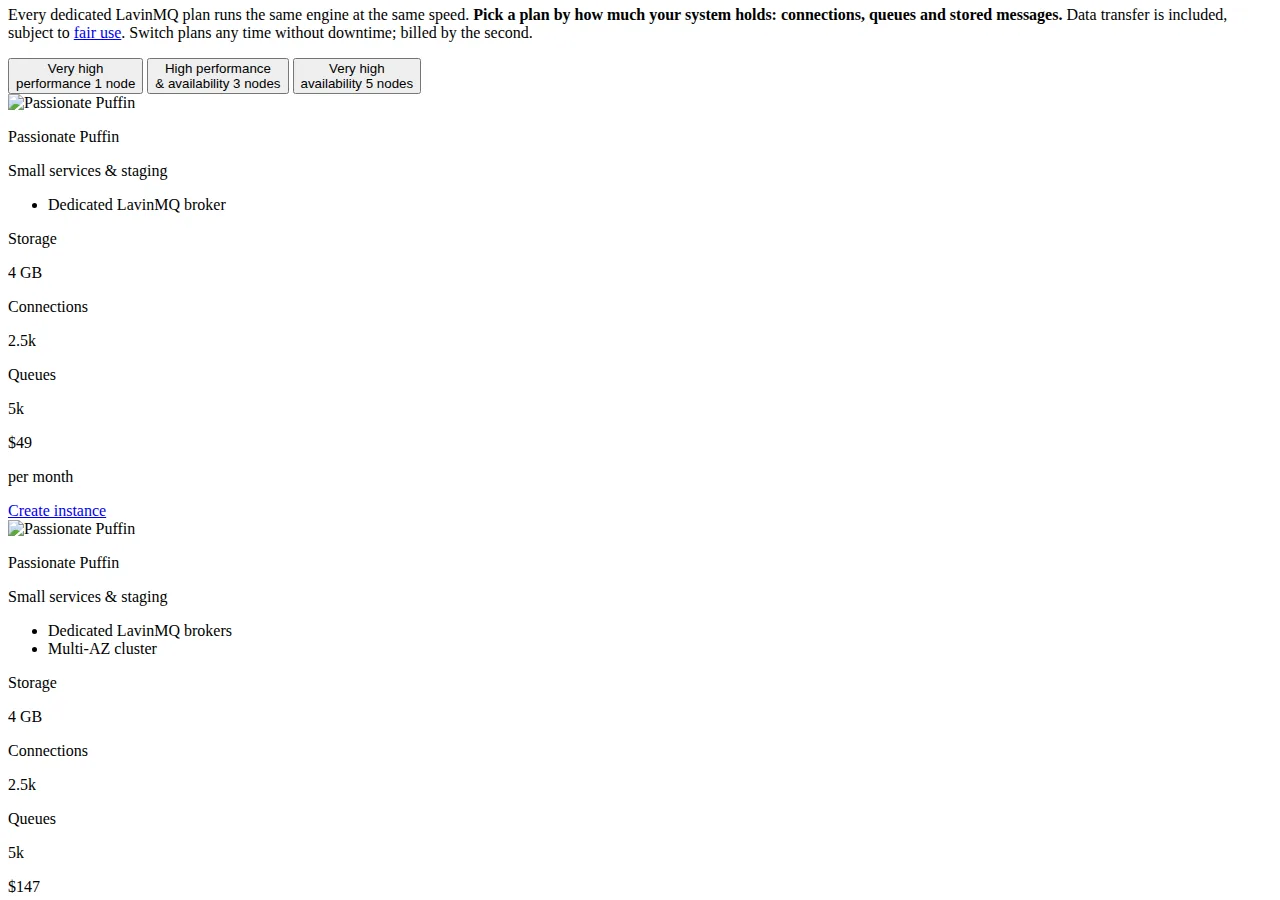
CloudAMQP charges a flat monthly rent per broker. The shared plans carry a message quota. Little Lemur is free (1M message quota, 100 queues, 10,000 queued messages, 20 connections). Tough Tiger is $19/month (10M quota, 1,000 queues, 100,000 queued messages, 100 connections). Dedicated RabbitMQ plans drop the quota: Big Bunny $99, Happy Hare $199, Awesome Ape $999, Heavy Hippo $1,999, Loud Lion $3,499, Raging Rhino $5,499 a month; three-node multi-AZ triples the smallest two to $297 and $597. Dedicated LavinMQ runs $49 to $2,999 by size; Passionate Puffin is $49 (4 GB, 2,500 connections, 5,000 queues). Extra storage is $0.35 per GB a month, and data transfer is included within a fair-use allowance of 30 percent of monthly spend.
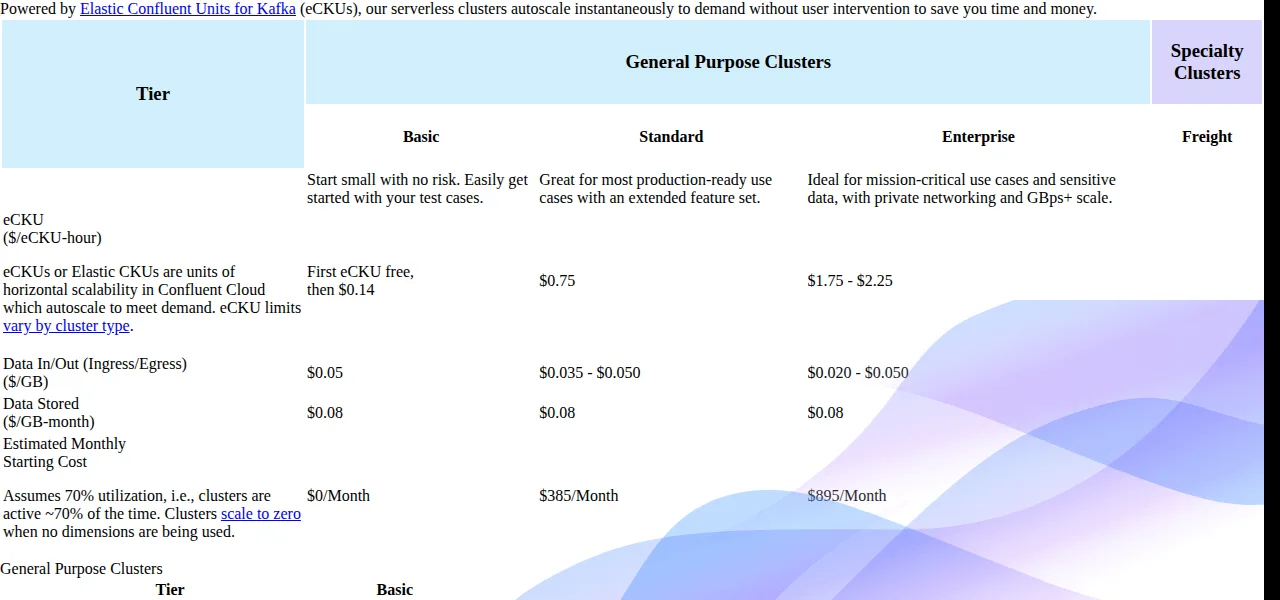
Confluent Cloud meters three things at once, starting with the eCKU, an Elastic Confluent Unit for Kafka that autoscales with demand. Basic gives you the first eCKU free and then charges $0.14 per eCKU-hour. Standard charges $0.75 per eCKU-hour. Enterprise charges $1.75 to $2.25. Freight, the logging and observability tier, charges $2.25 with a two-eCKU minimum. Data in and out costs $0.05 per GB on Basic, $0.035 to $0.050 on Standard, $0.020 to $0.050 on Enterprise, $0.014 to $0.030 on Freight. Stored data costs $0.08 per GB-month on Basic, Standard and Enterprise, $0.03 on Freight. Starting costs assume 70 percent utilization: $0 Basic, about $385 Standard, about $895 Enterprise, $2,300 Freight.
> [!KEY TAKEAWAY]
> SQS wins at low and medium volume because you pay only for requests. CloudAMQP wins above roughly 83 million messages a month, because a flat $99 broker stops growing while SQS keeps metering. Confluent never wins on raw queue price — its premium buys Kafka semantics, replay and stream processing.
The monthly cost math at 10M, 100M and 1B messages
A message through SQS normally costs three billable requests: send, receive, delete. Empty receives, retries and visibility-timeout changes add more, so treat the numbers below as a floor. Assume 1 KB messages, so the 64 KB chunk rule does not multiply anything.
$
\text{Monthly SQS cost} = (\text{messages} \times 3 - 1{,}000{,}000) \times \frac{\$0.40}{1{,}000{,}000}
$
Standard costs 29 times $0.40 ($11.60) at 10 million messages a month, 299 times $0.40 ($119.60) at 100 million, and 2,999 times $0.40 ($1,199.60) at 1 billion. FIFO adds a 25 percent premium at every step: $14.50, $149.50 and $1,499.50. Long polling and batching cut empty receives; every retry doubles the request count for that message.
CloudAMQP needs no formula. At 10 million messages a month, Tough Tiger at $19 covers the quota yet costs more than SQS at $11.60 — the premium for an AMQP broker. At 100 million messages, Tough Tiger no longer fits: its 10 million quota is spent in three days. Big Bunny at $99 undercuts SQS Standard at $119.60; the crossover where the SQS bill equals $99 solves to about 82.8 million messages a month. Above that, the flat broker is cheaper: at 1 billion messages, SQS costs $1,199.60 while Big Bunny costs $99, provided the broker keeps up.
Confluent needs a three-part calculation. Take a Standard cluster running one eCKU, 100 million 1 KB messages a month, and 100 GB retained.
$
\text{Confluent Standard} = (\$0.75 \times 730 \times 0.70) + (200 \text{ GB} \times \$0.035\text{--}\$0.050) + (100 \text{ GB} \times \$0.08)
$
The eCKU line at 70 percent utilization is $0.75 times 730 hours times 0.70, or $383.25 a month — reproducing Confluent's own published starting estimate of about $385. Data movement is 200 GB at $0.035 to $0.050, or $7.00 to $10.00. Storage is 100 GB at $0.08, or $8.00. Total: $398.25 to $401.25 a month. Always-on, the eCKU line alone is $547.50. Basic is cheaper on paper — first eCKU free, then $0.14 an hour — but caps storage at 5 TB, allows 1,500 partitions and carries a 99.5 percent SLA.
Headline pricing compared
| Item | Confluent Cloud (Standard) | CloudAMQP (Big Bunny) | AWS SQS (Standard) | Authority |
| --- | --- | --- | --- | --- |
| Cost at 100M messages a month | About $398 to $401 a month, 1 eCKU at 70 percent | $99 a month | $119.60 a month | Derived; see math blocks |
| Cost at 1B messages a month | $547.50 a month eCKU line alone, always on | $99 a month, if the broker keeps up | $1,199.60 a month | Derived; see math blocks |
Retention, ordering and delivery — the guarantees that decide the pick
SQS Standard gives at-least-once delivery with best-effort ordering, so your consumer must expect duplicates and make its work idempotent. FIFO queues give exactly-once processing and strict ordering within a message group, at the $0.50 rate. Retention runs 60 seconds to 14 days, default 4 days. There is no replay: once a message is deleted, it is gone.
CloudAMQP gives you RabbitMQ or LavinMQ semantics. Messages route through exchanges to queues with bindings, so one publish can fan out to many queues, which neither SQS nor plain Kafka does natively. Ordering holds within a single queue with one consumer, but competing consumers on the same queue break strict ordering. Persistent messages written to disk survive a broker restart; transient messages do not. Retention is bounded by storage and plan: Little Lemur caps queued messages at 10,000 and idle queue time at 28 days, Tough Tiger at 100,000 queued messages. Dead-letter exchanges route poison messages to a holding queue.
Confluent Cloud gives you Kafka semantics, and Kafka is a log before it is a queue. Every message is written to a partition and kept for the retention window, so a consumer group can rewind and replay history — the capability that justifies the premium. Ordering holds within a partition, so your partition key decides your ordering guarantee. Retention is effectively unlimited on Standard, Enterprise and Freight, bounded only by the $0.08 per GB-month storage meter; Basic caps storage at 5 TB. Keep 1 TB (1,024 GB) retained for a month and Standard or Enterprise charges $81.92, Freight $30.72. On CloudAMQP, extra storage is $0.35 a GB a month, so 100 GB extra is $35.00. On SQS there is no storage line at all, because retention tops out at 14 days. If you need replay, you pay Confluent's storage meter; if you need a message to wait a few days, all three do it; if you need a month, SQS cannot.
> [!WARNING]
> SQS retention tops out at 14 days and Confluent Basic caps storage at 5 TB. An outage longer than your retention window deletes work silently — messages expire, they do not raise an alarm. Set a CloudWatch alarm on ApproximateAgeOfOldestMessage for SQS and a storage alert on every Confluent topic.
Throughput ceilings — where the flat broker breaks
SQS Standard throughput is nearly unlimited: AWS documents no per-queue ceiling. FIFO is the constrained sibling at 300 messages a second without batching, or 3,000 a second with batching, per queue; high-throughput FIFO workloads split work across message groups. If your ordering need is global rather than per group, FIFO at 300 messages a second is a wall without high-throughput mode, which raises the ceiling to 70,000 messages a second.
CloudAMQP publishes burst figures rather than sustained guarantees: Big Bunny bursts to 10,000 messages a second, Happy Hare to 12,000. Throughput depends on broker, nodes, routing type, message size, consumers, publishers, persistence flags and datacenter. Treat the burst number as a ceiling illustration, not a committed rate: 10,000 messages a second sustained for a 30-day month is 25.92 billion messages, a volume no $99 broker is expected to carry with persistence on.
Confluent publishes throughput per tier: Basic 250 MBps in and 750 MBps out, Standard 1,920 in and 5,760 out, Enterprise 9,120 in and 27,360 out. Partition limits gate workload shape: 1,500 on Basic, 2,500 on Standard, 50,000 on Enterprise, 96,000 on Freight. Thousands of topics or tenants hit the partition ceiling long before the byte ceiling.
> [!FOUNDER]
> "The queue is the one piece of infrastructure nobody budgets for until it stops," says Enow A. Jovial, Founder and CEO. "Price the retention and the replay before you price the messages."
Who should NOT use this
Do not use SQS Standard where a duplicate breaks the business — payment capture, inventory decrement, anything charging a card needs exactly-once handling or an idempotency key. Do not use SQS FIFO above 300 ordered messages a second per queue without batching, or for messages that must survive longer than 14 days. SQS cannot replay, fan out, or route by content.
Do not use CloudAMQP shared plans in production: Little Lemur is a development sandbox, Tough Tiger a hobby tier, and a spike past the quota leaves messages unhandled. Do not use a single-node dedicated plan without a maintenance window — patching takes it down; multi-AZ costs three times the rent. RabbitMQ gives at-least-once delivery and per-queue ordering, not exactly-once semantics.
Do not use Confluent Cloud as a plain queue: at 100 million messages a month, Standard costs about four times the SQS bill and four times Big Bunny. Do not use Basic for a revenue workload: the 99.5 percent SLA allows over three and a half hours of downtime a month, and the 5 TB storage cap arrives exactly when the business grows. Do not use Freight for latency-sensitive serving.
Decision table — match the workload, not the brand
| Workload | Pick | Why this one wins | Authority |
| --- | --- | --- | --- |
| Side project, under 10M messages a month | SQS Standard or Little Lemur | SQS about $11.60 at 10M messages; Little Lemur free in quota | Vendor pricing pages |
| Background jobs, 10M to 80M messages a month | SQS Standard | Metered pricing stays under the $99 broker below the 82.8M crossover | Derived from vendor pricing pages |
| Background jobs, above 80M messages a month | CloudAMQP Big Bunny or Happy Hare | Flat $99 or $199 beats a meter that grows with every message | CloudAMQP plans page; derived crossover math |
| Ordered payments or ledger writes | SQS FIFO | Exactly-once processing and strict ordering per message group | AWS SQS pricing page and FAQs |
| Event sourcing, replay, stream processing | Confluent Standard or Enterprise | Kafka log semantics, consumer-group rewind, unlimited retention | Confluent Cloud pricing page |
The migration workflow
Skipping the measurement step is how teams migrate to a queue that costs more and holds less.
1. Measure real volume for two weeks: messages published and consumed, average payload size, peak messages per second.
2. Classify every queue: strict ordering, exactly-once handling, fanout, or replay.
3. Run the SQS math block with your volume and payload size; a 256 KB payload bills as four requests under the 64 KB chunk rule.
4. Price the CloudAMQP plan whose burst ceiling and storage fit your peak; add $0.35 per GB beyond the plan allowance.
5. Price Confluent with the three-part formula — eCKU hours, gigabytes moved, gigabytes stored — against the published starting estimate.
6. Stand up the winner beside the current queue, mirror production traffic for a week, then cut over one queue at a time with a rollback that republishes from the old queue.
> [!TIP]
> Batch everything SQS touches: one ReceiveMessage call returning ten messages bills as one request, and a SendMessageBatch of ten bills as ten chunk-requests. Batching is free to implement.
Pre-launch checklist
The bottom line
There is no cheapest message queue, only a cheapest meter for your volume and guarantees. Below about 83 million messages a month, SQS Standard is the cheapest way to move work. Above that line, a flat CloudAMQP broker stops growing while SQS keeps metering, and the $99 Big Bunny is the better buy if your throughput fits the box. Confluent is the most expensive at every volume in this guide, and it earns that premium only when the workload needs a log — replay, stream processing, event sourcing — rather than a queue. The observability pricing playbook prices the monitoring for these queues, the connection-pooling playbook covers the database side, and the object-storage pricing comparison shows where payloads should live. Run your own volume through the ROI calculator before you commit.