Commercial Lease vs Buy: The Office Space Playbook
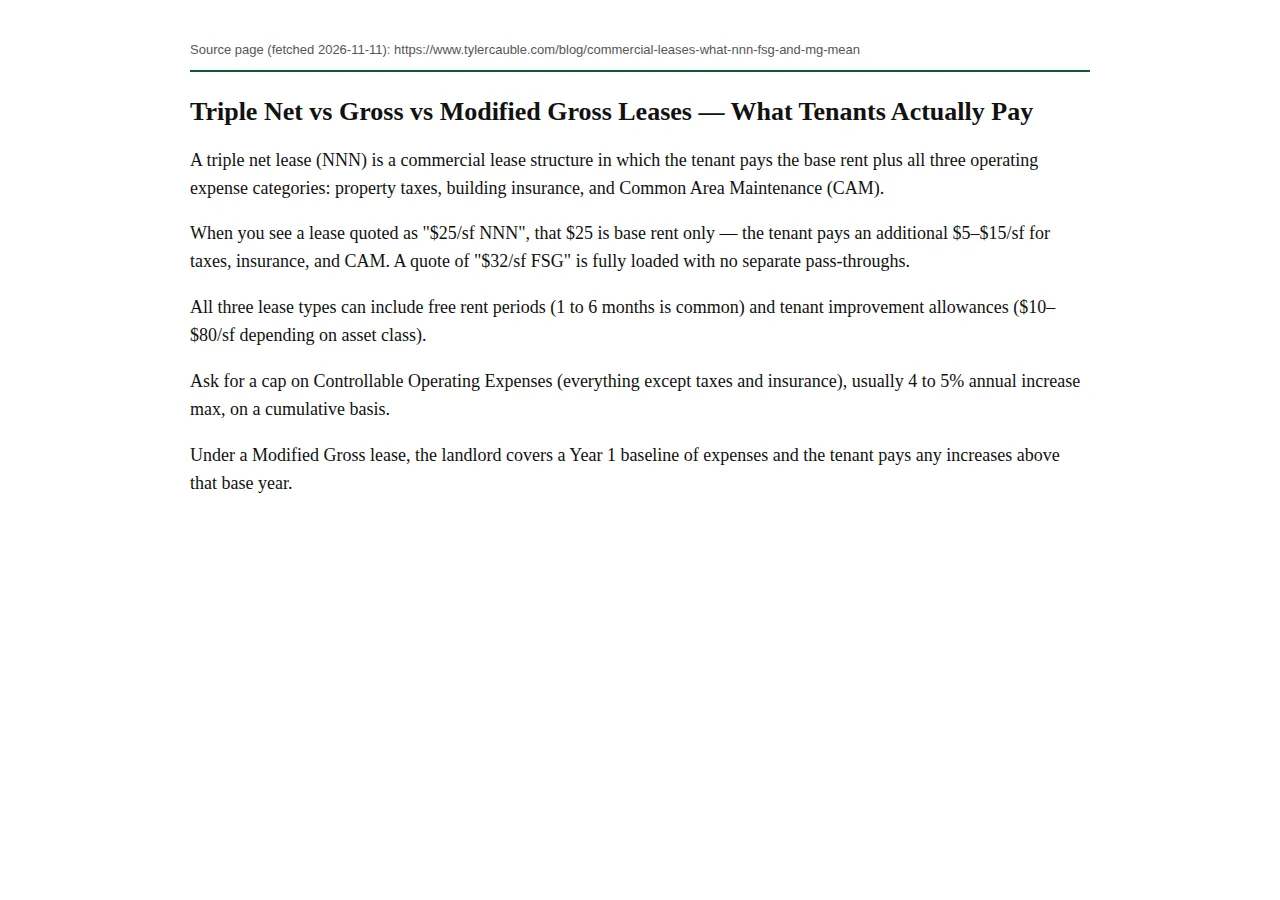
A founder signs a five-year lease for 5,000 square feet at $25 per square foot, budgeting $10,417 a month. The first invoice is $14,583. The extra $4,166 is the triple-net pass-through — taxes, insurance, and common-area maintenance — carried in three letters after the rate. The same founder could have bought a comparable building for $100,000 down and a $6,651 monthly mortgage. Both numbers were available before signing.
This guide is for an owner-operator choosing a home for a business that needs real office space: a team that meets clients in person, a lease term of three years or more, and a budget that must survive the term. It is not for a solo operator who can work from home, a business that needs space for less than a year, or anyone shopping for an investment property. The buy side here is owner-occupied space only — the only kind the Small Business Administration will finance. The entity holding the building changes the annual cost — see the Delaware vs Wyoming vs Nevada LLC annual compliance cost playbook.
The three lease structures: who pays for what
Every commercial office lease is a variation on three structures, and the difference turns on one question: who pays the building's operating expenses — property taxes, building insurance, and common-area maintenance — on top of the rent?
In a gross lease, the tenant pays one flat rate and the landlord covers operating costs out of it. In a triple-net lease, written NNN, the tenant pays a lower base rent plus a share of all three costs. In a modified-gross lease the split is negotiated; the common form is the base-year stop, where the landlord covers a Year 1 baseline and the tenant pays only the increases above it in later years.
| Structure | Base rent | Who pays taxes, insurance, CAM | Typical setting | Authority |
|---|---|---|---|---|
| Gross (full-service) | Highest; one all-in rate | Landlord, from the rent | Multi-tenant office | Cauble Group lease guide, 2020 |
| Triple-net (NNN) | Lowest base; pass-throughs on top | Tenant, as a share of the three costs | Retail, single-tenant, industrial | Cauble Group lease guide, 2020 |
| Modified gross | Middle; base-year stop common | Negotiated split; tenant pays increases above Year 1 baseline | Class B office, flex space | Cauble Group lease guide, 2020; Timm Clarke Commercial Leasing 101 |
No statute fixes these definitions. A lease labelled triple-net in one building can assign different responsibilities from the same label in another. The lease text controls. Never compare two quotes by the headline rate alone — compare total occupancy cost, the only number that clears the bank account.
What a quote actually costs: the monthly math at three sizes
The inputs are stated assumptions, not market quotes: a triple-net base rent of $25 per square foot per year with $10 of pass-throughs, and a full-service gross rate of $32. The $10 pass-through sits inside the guide's $5 to $15 range, and $32 is its fully loaded example. Replace them with your own quotes and rerun the arithmetic.
| Space | NNN monthly: ($25 + $10) per sq ft | NNN annual | Full-service gross monthly: $32 per sq ft | Gross annual |
|---|---|---|---|---|
| 2,000 sq ft | $5,833 | $70,000 | $5,333 | $64,000 |
| 5,000 sq ft | $14,583 | $175,000 | $13,333 | $160,000 |
| 10,000 sq ft | $29,167 | $350,000 | $26,667 | $320,000 |
The gross lease is cheaper per month at every size here — $500 a month cheaper at 2,000 square feet, $1,250 at 5,000 — because a $32 all-in rate beats a $35 all-in triple-net rate. $25 looks cheaper than $32 until the pass-throughs land. The gap scales with size: at 10,000 square feet the structure choice is a $2,500 monthly decision.
The $1,250 monthly gap is the price of the risk transfer. Under gross the landlord absorbs tax and insurance spikes; under triple-net the tenant does. A tenant who chooses triple-net should insist on two protections the guide names as the single biggest tenant safeguard: a cap on controllable operating expenses — everything except taxes and insurance — usually 4 to 5 percent a year on a cumulative basis, and the right to audit the landlord's CAM reconciliation each year.
Tenant improvements and free rent: the money before month one
The build-out is the second place a lease quote hides money. A tenant improvement allowance, or TI allowance, is money the landlord contributes toward fitting the space usually quoted per square foot. The Cauble Group guide reports TI allowances of $10 to $80 per square foot by asset class, and free-rent periods of one to six months as common.
Take the running case: a 5,000-square-foot build-out at $60 per square foot, or $300,000. A TI allowance of $40 per square foot — inside the reported range — covers $200,000. The tenant funds the remaining $100,000 — $1,667 a month over a 60-month term, cost absent from the rent quote:
Three months free on a 60-month triple-net term saves three months of the $14,583 monthly cost, or $43,750. Free rent is not free space: the landlord recovers it through the rate, the term, or the TI allowance. Compare offers on effective rent — total cash paid over the term, including the build-out gap, divided by the number of months.
Escalation clauses: the rent in year ten
Commercial leases run long — three to ten years is typical. Escalations raise the rent each year by a fixed percentage or by an index, and a few points a year compounds into a very different number by year ten.
On the running case, a 3 percent annual escalation lifts the $25 base rate to $32.62 per square foot by year ten. The monthly base rent on 5,000 square feet rises from $10,417 to $13,591, and with the $10 pass-through held flat the total reaches $17,758 a month — $3,175 more than year one, Over five years the triple-net lease costs $913,642, an effective $15,227 a month, and $14,498 a month once three months of free rent are credited.
Three clauses deserve a line-by-line read: escalation, renewal, and assignment and subletting.
The buy side: SBA financing and the occupancy rule
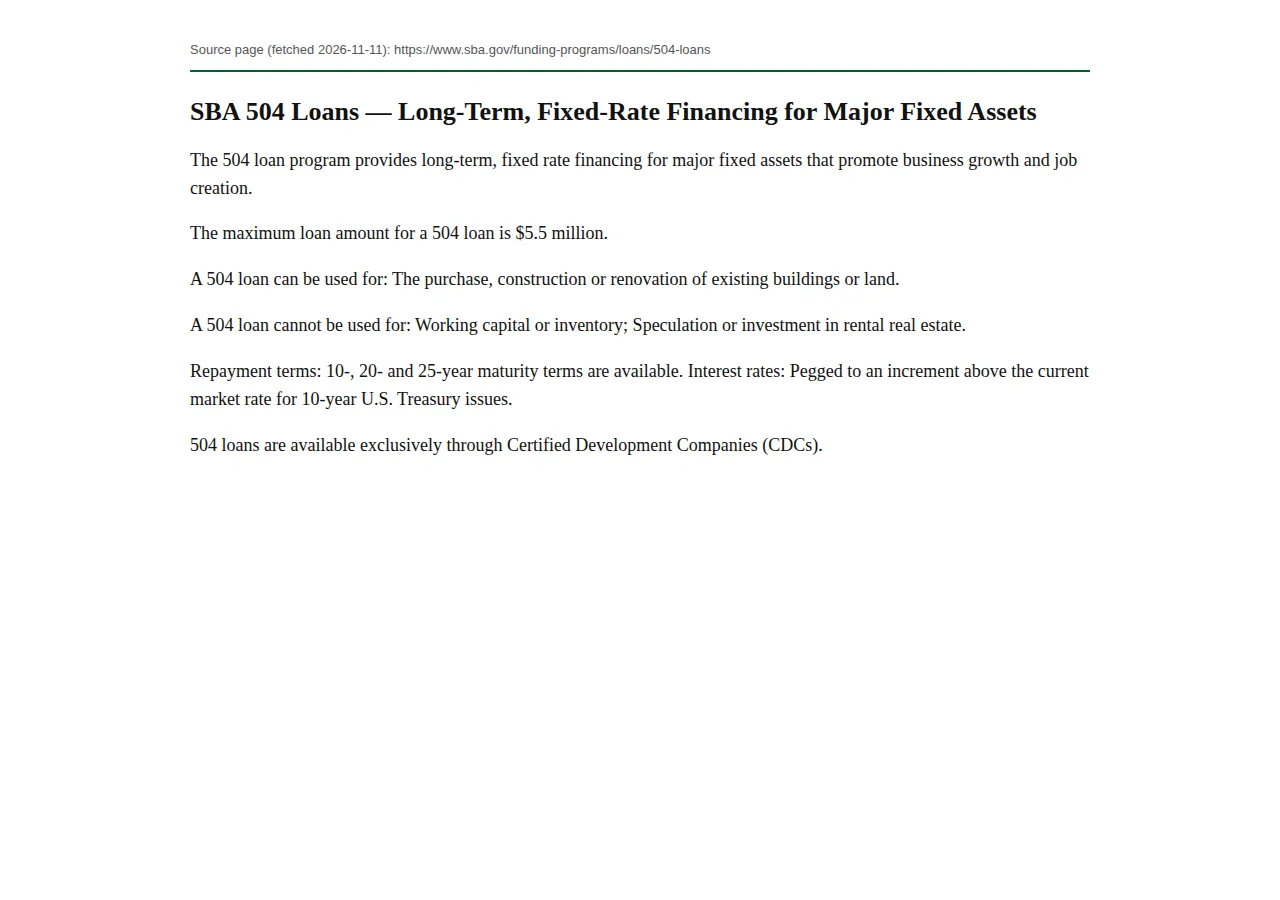
Buying means the business pays a mortgage instead of rent, and the Small Business Administration is the usual small-business route. The 504 loan provides long-term, fixed-rate financing for major fixed assets, with a maximum of $5.5 million, repayment terms of 10, 20, and 25 years, through Certified Development Companies only. The 7(a) loan carries a maximum of $5 million and can also fund real estate purchases. A 504 loan cannot be used for working capital or inventory, or for speculation or investment in rental real estate. If the purchase needs debt beyond the mortgage, price the alternatives in the business line of credit vs term loan vs invoice factoring playbook.
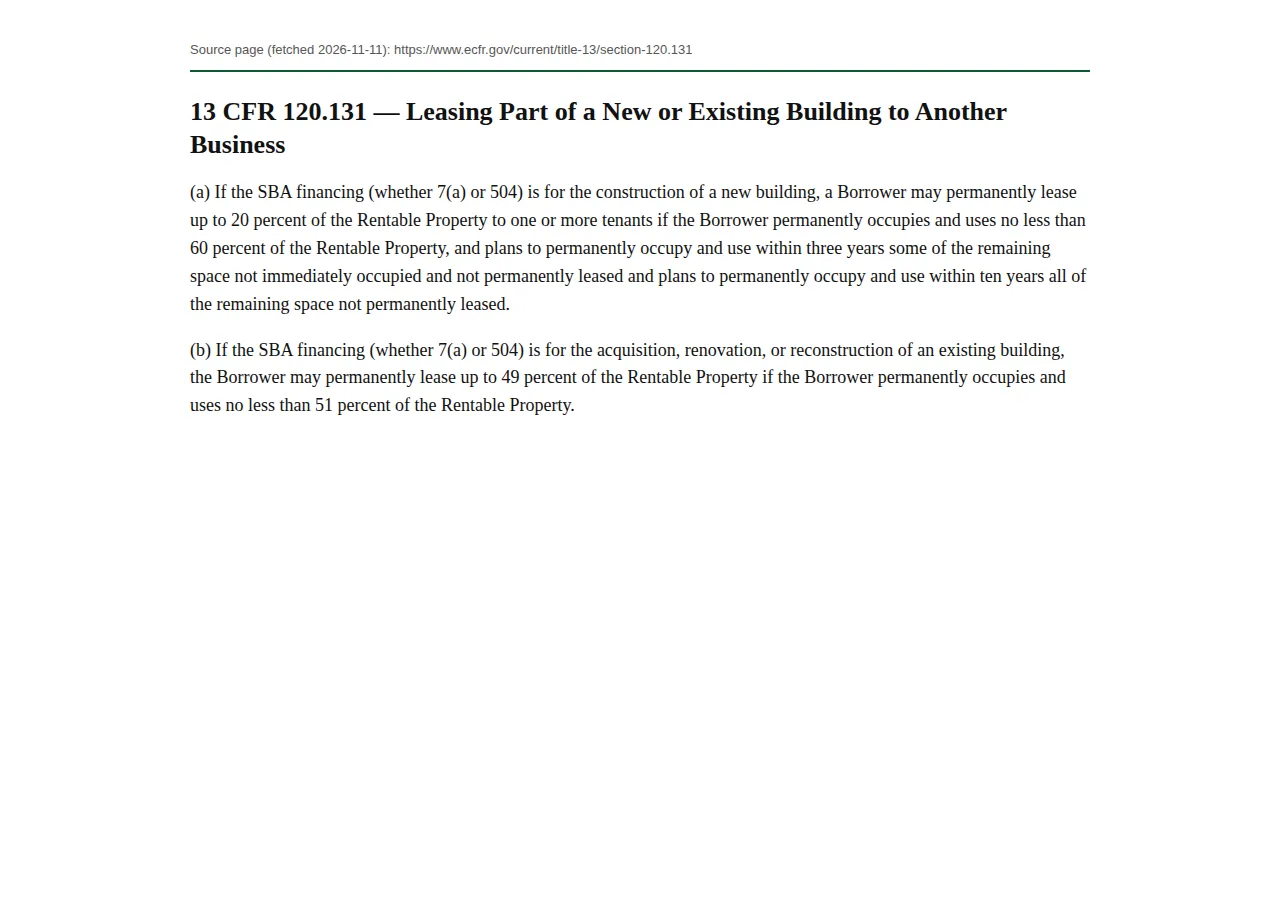
The occupancy rule decides whether the SBA will finance the purchase. Under 13 CFR 120.131, a borrower buying an existing building must occupy no less than 51 percent of the rentable property and may permanently lease up to 49 percent to other tenants. For new construction the bar is higher: the borrower must occupy no less than 60 percent, may lease up to 20 percent, and must plan to occupy the rest within three years and all of it within ten years.
The buy-side math uses stated model assumptions: a 5,000-square-foot building bought at $200 per square foot, or $1,000,000; a 10 percent down payment of $100,000; a $900,000 loan amortised over 25 years at a 7.50 percent annual rate; and operating costs of $10 per square foot per year, or $50,000 a year, held flat. Rerun the formula with your lender's rate.
The $6,651 monthly mortgage is less than half the $14,583 triple-net rent. Run the same comparison on your own quotes with the business loan calculator. Add the $50,000 of operating costs and the buy side comes to $129,811 a year, or $10,818 a month — still $3,766 a month below year-one rent. Year-one interest is $67,068 and year-one principal repaid is $12,743 — equity the business keeps — leaving a balance of $887,257.
The tax split: rent deducted now, buildings depreciated slowly
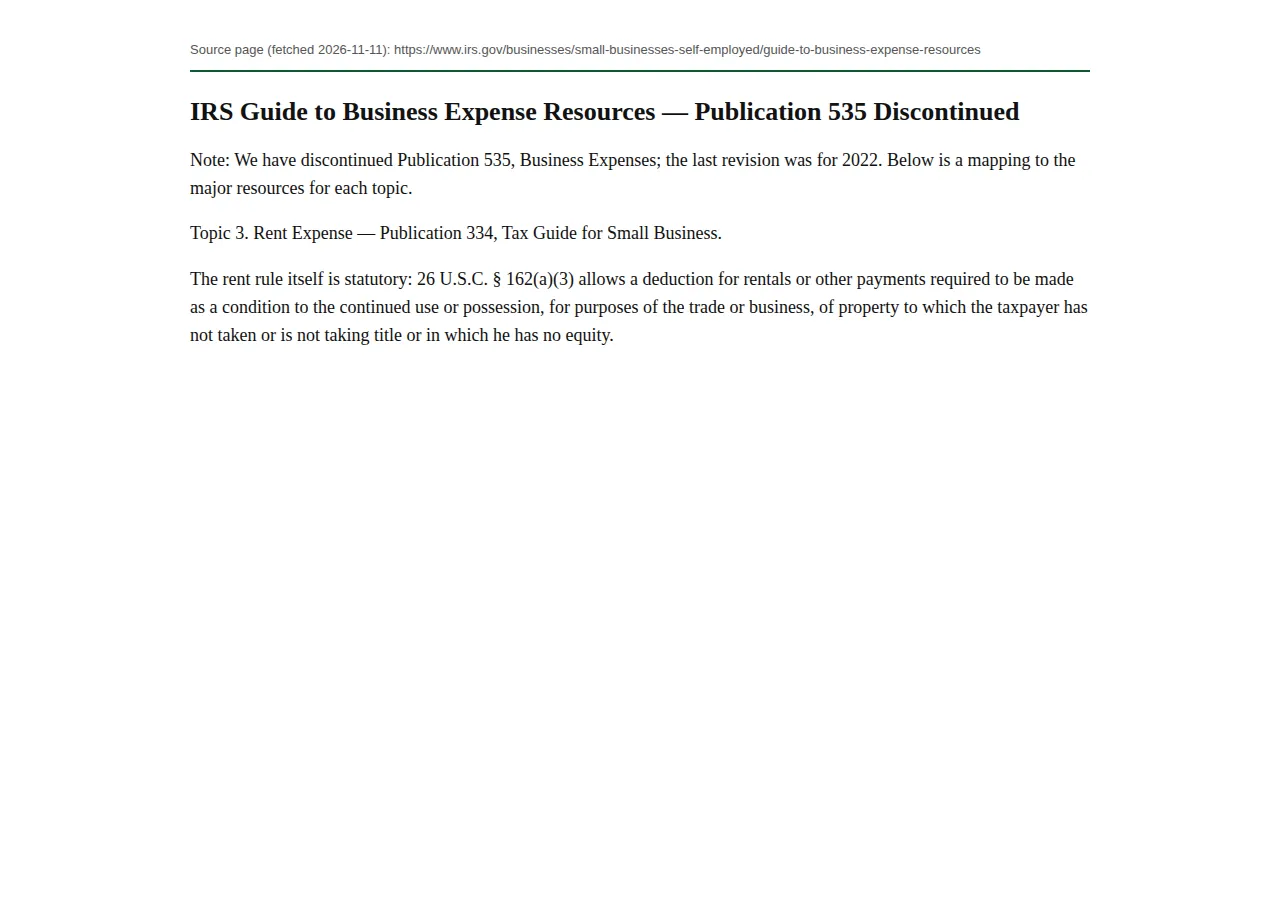
The tax treatment is the sharpest structural difference. Under 26 U.S.C. § 162(a)(3), a business may deduct rentals required as a condition to the continued use or possession, for purposes of the trade or business, of property to which the taxpayer has not taken title or in which he has no equity. Rent for space the business uses is deductible in the year it is paid or accrued.
The owner gets a slower benefit. A purchased building is capitalised and depreciated, not deducted. Under 26 U.S.C. § 168, nonresidential real property carries a 39-year recovery period. On the running case, with land taken at 20 percent of the $1,000,000 price, the depreciable basis is $800,000 and the annual depreciation is $20,513:
Section 179 softens the edge for the contents, not the shell: a taxpayer may elect to expense qualifying property up to $2,500,000, phasing out once section 179 property placed in service in the year exceeds $4,000,000. The building itself does not qualify.
One citation trap to avoid: IRS Publication 535, Business Expenses, was discontinued by the IRS — the last revision was for 2022 — and its rent-expense topic now maps to Publication 334, Tax Guide for Small Business.
Founder & CEO Insight — Enow A. Jovial
The break-even year: when buying pulls ahead
The break-even question has two honest answers. On a pure cash basis — down payment plus mortgage payments plus operating costs, with no credit for equity — the buy side costs $229,811 in year one against $175,000 of lease cost, trails by $5,872 at the end of year two, and crosses ahead in year three, when buy cash of $489,433 falls below lease cash of $536,362. Crediting principal repaid as equity kept, the buy side pulls ahead in year two: $333,146 against $353,750.
| Year | Cumulative lease cost | Cumulative buy cash (no equity credit) | Cumulative buy net (principal credited) |
|---|---|---|---|
| 1 | $175,000 | $229,811 | $217,068 |
| 2 | $353,750 | $359,622 | $333,146 |
| 3 | $536,362 | $489,433 | $448,159 |
| 5 | $913,642 | $749,055 | $674,648 |
| 10 | $1,932,985 | $1,398,110 | $1,215,568 |
By year ten the gap is wide: $1,932,985 of lease cost against $1,215,568 net buy cost, a $717,417 difference on the stated inputs. The result turns on the price-to-rent ratio: double the purchase price to $400 with the same rent and the buy side's monthly cost passes the rent.
Execution checklist: from first tour to signature
- Measure the real need: headcount for the next three years, client-facing space, storage, and parking, then convert it to a square-foot range.
- Collect three quotes in writing, each stated as base rent, pass-throughs, and total monthly occupancy cost.
- Price the build-out: get a contractor's number, subtract the written TI allowance, and add the gap to the monthly cost over the term.
- Model the escalation: run the year-ten rent at the clause's own rate and check the business can carry it.
- Read the guaranty, renewal, assignment, and subletting clauses line by line, and mark the renewal notice deadline on the calendar.
- If buying, confirm SBA eligibility and the occupancy rule before ordering the appraisal.
- Get the lender's actual rate and rerun the mortgage formula; never sign on the model's assumed rate.
- Have an attorney review the agreement and a CPA confirm the tax treatment.
Operational checklist
- [x] Total monthly occupancy cost computed from base rent plus pass-throughs, not the headline rate
- [x] TI allowance confirmed in writing: coverage, payment timing, contractor
- [x] Controllable opex cap of 4 to 5 percent a year requested on any net lease
- [x] CAM audit right written into the lease
- [x] Escalation clause modelled to year ten at the stated rate
- [x] Free rent credited in the effective-rent calculation
- [x] Personal guaranty limited, capped, or given a burn-off date
- [x] Renewal notice deadline on the calendar
- [x] SBA occupancy percentage confirmed before the appraisal
- [x] Depreciation schedule and section 179 position confirmed with the CPA