A lockbox is the oldest automation in receivables, and it still earns its keep for one reason: your customers' checks reach your bank before they reach your office. Instead of mailing payment to you, the customer mails it to a post office box your bank controls. The bank opens the envelope, deposits the check, scans the remittance slip, and sends you a data file your accounting system can post without a human touching the payment. This playbook prices it from a published fee schedule and works the per-check break-even.
Who this is for, and who should stop here
This playbook is for a business that still receives a meaningful share of revenue by paper check: a manufacturer collecting from distributors, a wholesaler invoicing on net-30 terms, a property manager collecting rent checks, a healthcare provider receiving payer remittances. The common thread is volume and value — hundreds of checks a month, each large enough that a day of float matters and a misapplied payment creates real work.
If fewer than 100 checks a month arrive, stop here. A lockbox has monthly base fees that do not scale down, and at low volume the per-check cost is dominated by fees you pay whether or not a single envelope arrives. If nearly all receipts already arrive by ACH, card, or wire, a lockbox solves a problem you no longer have.
How a lockbox actually works
The U.S. Treasury's own General Lockbox Network describes the operation in four steps, and commercial banks run the same sequence: the bank collects mail from the post office box, opens and extracts the envelope contents, scans and captures data from the payment instruments and documents, and forwards the captured images for electronic check processing and settlement. The data file is the part operators underestimate: the bank returns a structured file — in the BAI2 bank-statement format or the EDI 823 lockbox format — that your ERP uses to auto-apply cash to open invoices. If that file cannot post cleanly, the lockbox has moved the manual work from opening envelopes to fixing exceptions.
Wholesale, retail, and wholetail
J.P. Morgan's lockbox guide draws the three-way split every bank uses, and choosing the wrong one is the most common buying mistake.
| Type | Volume and value | What it optimizes | Typical user |
|---|---|---|---|
| Wholesale lockbox | Low volume, high value | Detailed document imaging, payment-acceptance rules, advanced reporting | Manufacturers, B2B service firms |
| Retail / scannable lockbox | High volume, low value | Processing speed, standardized reporting | Utilities, insurers, subscription services |
| Wholetail lockbox | Mixed consumer and B2B | Both service levels through one system | Firms with both customer bases |
Wholesale lockbox is the one this guide prices, because it is where the money is: each payment carries remittance detail — invoice numbers, deduction claims, short-pays — that must be captured accurately or the cash application breaks. Retail lockbox is a speed operation; the bank scans the check and the stub and moves on. Wholetail is the hybrid for businesses with both consumer and B2B customers, running varied payment types through a single system.
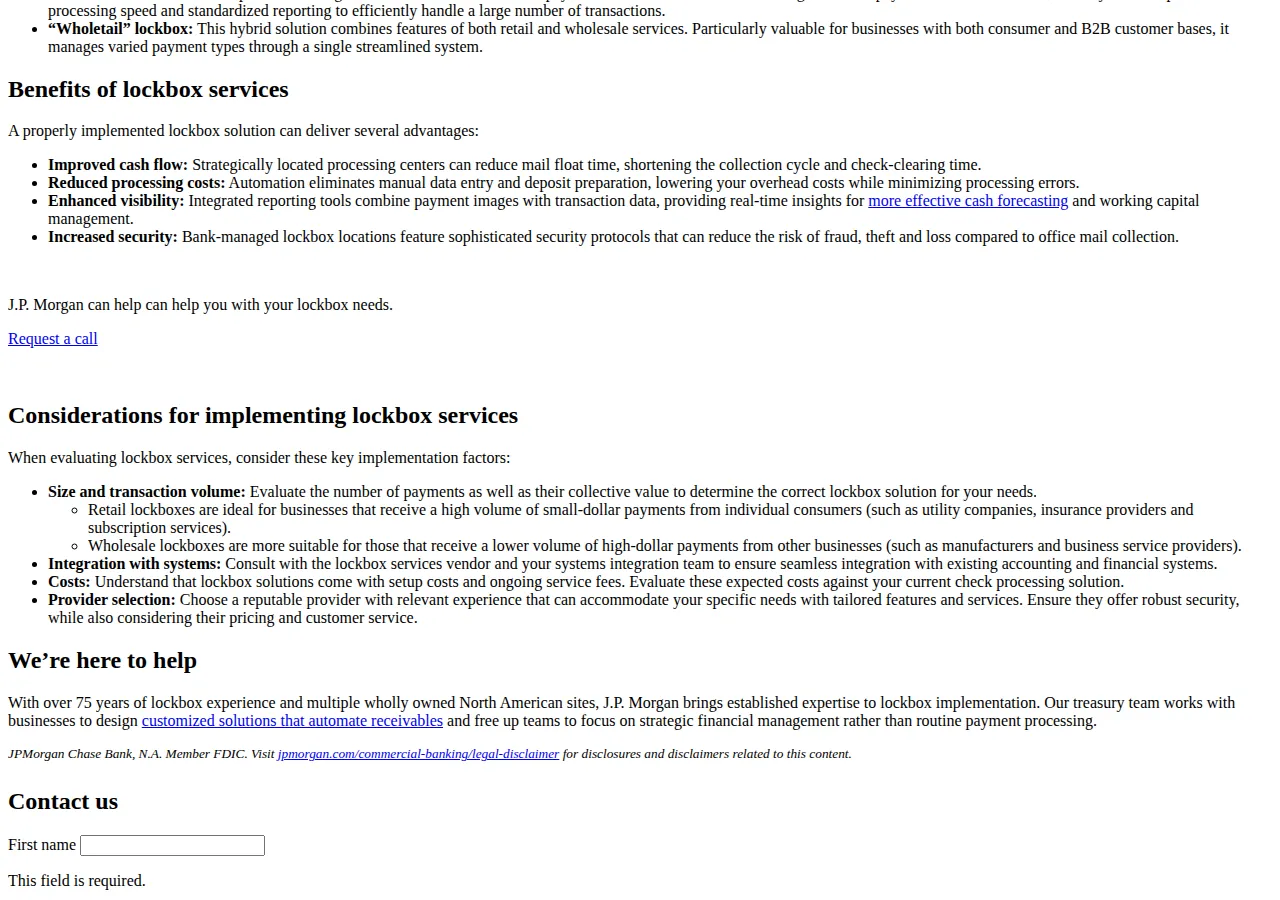
J.P. Morgan lists four benefits: improved cash flow from processing centers that reduce mail float and shorten the collection cycle; reduced processing costs because automation eliminates manual data entry and deposit preparation; enhanced visibility because integrated reporting combines payment images with transaction data for real-time cash forecasting; and increased security because bank-managed locations run security protocols that beat office mail collection. The bank brings more than 75 years of lockbox experience and eight wholly owned wholesale lockbox locations in the United States.
The price table that decides the buy
Lockbox pricing is almost never published on a bank's website; it is quoted per client. The exception that makes this guide possible is a public municipal request for proposal: Wells Fargo's June 2022 pricing proposal to the City of Beaumont, published as a public meeting document, prints the wholesale lockbox line items with volumes and unit prices. Treat these as a June 2022 reference point for the structure of the fees, not as a quote you can demand today.
| Line item | Volume | Unit price | Monthly total |
|---|---|---|---|
| Wholesale lockbox base | 1 | $220.00 | $220.00 |
| Transmission base | 1 | $125.00 | $125.00 |
| Deposited check | 1,900 | $0.14 | $266.00 |
| Standard check processed | 1,900 | $0.20 | $380.00 |
| Document scanned | 3,800 | $0.035 | $133.00 |
| Miscellaneous credits posted | 21 | $0.55 | $11.55 |
| CEO TIR report per item | 21 | $0.05 | $1.05 |
| Monthly total | $1,136.60 |
The arithmetic that matters is the all-in cost per check, the number you compare against your in-house cost:
Annualised, the service costs $13,639.20 a year at that volume. Two facts in the table do most of the deciding. First, the base fees — $345 a month before a single check arrives — mean the per-check cost explodes at low volume: counting only the base plus the $0.41 of variable charges per check (deposit, processing, and two scanned documents), the same schedule costs about $1.10 per check at 500 checks a month, and about $2.14 at 200. Second, the per-item charges are small — $0.34 per check for deposit plus processing — so once the base is covered, each additional check is cheap. A lockbox is a fixed-cost service; volume is what makes it pay.
The break-even: float, labour, and the honest comparison
A lockbox pays through two channels, and only one of them is the float. Work the example with stated assumptions: 1,900 checks a month averaging $1,000 each, so $1,900,000 of monthly check receipts, or about $63,333 a day. If the lockbox puts cash in the account two days faster — one day of mail float and one day of processing float — it frees $126,667 of working capital. At a 5% annual cost of capital, that float is worth $6,333 a year. Against a $13,639 annual lockbox cost, float alone does not pay. Saying otherwise would be dishonest arithmetic.
Labour is where the case closes. If handling those 1,900 checks in-house — opening mail, keying remittance, preparing deposits, chasing exceptions — consumes half a full-time employee at a $60,000 loaded cost, that is $30,000 a year of internal cost against $13,639 of lockbox fees. The net position under these stated assumptions:
The formula to carry into your bank meeting is the break-even volume: the monthly check count at which the lockbox cost equals your in-house cost. With base fees of $345 a month and $0.41 of per-check charges, the break-even against an in-house cost of $1.10 per check is roughly 500 checks a month. Below that, the base fees eat the saving; above it, every additional check widens the gap in the lockbox's favour. Plug in your own loaded labour cost per check — that single number decides the buy.
Run the same arithmetic through our break-even calculator before you sign: it turns the per-check figures above into the monthly volume at which the service pays for itself. Our treasury management bank fee analysis playbook prices the wider fee stack a lockbox sits inside, and our ACH vs FedNow vs wire payment rails guide covers the electronic rails that should be shrinking your check volume in the first place.
Lockbox vs remote deposit capture
Remote deposit capture — Wells Fargo calls it Desktop Deposit — is the lockbox's in-house rival: you scan checks at your own office and deposit the images. It is cheaper and it is not the same service.
| Factor | Lockbox | Remote deposit capture |
|---|---|---|
| Mail handling | Bank opens and sorts | You open and sort |
| Remittance capture | Bank keys or OCR-reads | You key or OCR-read |
| Deposit timing | Same-day bank processing | Same-day if scanned before cutoff |
| Data file | BAI2 / EDI 823 to your ERP | Deposit record; remittance still manual |
| Monthly base cost | $220–$345 and up | Low or bundled with checking |
| Best for | High check volume, complex remittance | Low volume, simple remittance |
The decision rule is short. If the pain is opening mail and keying remittance detail, buy the lockbox. If the pain is only the trip to the branch, remote deposit capture fixes it for a fraction of the price. Wells Fargo's own business fee schedule, effective 28 July 2026, bundles Desktop Deposit into its Optimize Business Checking relationship — $75 a month with 250 transactions included.
Buying it: selection in order
Bank selection is a treasury decision, not a price comparison. J.P. Morgan's implementation guidance names the four factors in order: size and transaction volume, integration with your systems, costs, and provider selection. Work them in that order, because a cheap provider that cannot post a clean BAI2 file into your ERP is the most expensive lockbox you will ever buy.
First, count honestly. Pull twelve months of check volume, average check value, and the share of payments carrying remittance detail beyond a stub. A lockbox priced on the wrong volume band reprices at renewal, after you have already reprinted every invoice with the lockbox address. Second, get three written quotes on the same volume assumptions, and demand the full line-item schedule — base, transmission, per-check, per-document, exception handling, and image archive fees. The Beaumont schedule above is the template for a complete quote. Third, test the data file before you sign: ask for a sample BAI2 or EDI 823 file from a client with your ERP, and post it in a test environment. Fourth, pilot one lockbox address on one customer segment for one cycle, and measure DSO before and after on that segment alone. Fifth, plan the exit: your invoices and ERP all carry the lockbox address, so negotiate the renewal cap and the termination notice in the first contract.
Founder & CEO Insight — Enow A. Jovial
Failure modes worth naming before you sign
- The exception queue. Unreadable remittance, a check with no invoice number, a short-pay with no deduction code — these arrive as an exception file. If nobody owns the exception queue daily, the lockbox deposits the money and the AR ledger drifts from reality.
- Misapplied payments. A lockbox keys what the remittance says. If the customer references the wrong invoice, the bank applies it to the wrong invoice. Your AR team still owns the matching logic.
- Single-site risk. One processing site is one flood, one outage, one postal disruption away from stopping your collections. The multi-site point in the J.P. Morgan guide is a selection criterion, not a boast.
- Fee creep on exceptions. Exception items, research requests, and image retrievals are priced separately in most schedules. A lockbox that looks cheap at $0.60 a check can cost double that once exception volume is counted.
- The federal wind-down. Executive Order 14247, signed 25 March 2025, directs federal payments to go electronic and phases out the Treasury's physical lockboxes, with the General Lockbox Network transitioning to J.P. Morgan as sole provider by 2 April 2027. If your customer base includes federal agencies, the lockbox address you print today may not be the one they pay tomorrow.
Build checklist
- Count twelve months of checks. Volume, average value, and the share carrying remittance detail beyond a stub.
- Price the in-house cost per check. Loaded labour, equipment, and bank deposit fees, honestly counted.
- Compute the all-in lockbox cost per check. Base fees plus per-item charges at your actual volume, using the formula above.
- Get three written quotes on identical volumes. Demand the full line-item schedule including exception handling.
- Test the BAI2 or EDI 823 file in your ERP. A sample file, posted in a test environment, before signing.
- Pilot one segment for one cycle. Measure DSO on that segment before and after; no movement in 60 days means no scale-up.
- Negotiate renewal and exit in the first contract. Renewal cap, termination notice, and who pays to reprint the invoices.