Bench vs Pilot vs QuickBooks Live: Done-for-You Bookkeeping Pricing
Bench, Pilot, and QuickBooks Live all sell the same promise — a human does your books every month — but they meter the work three different ways, and the meter decides the bill. Bench prices by revenue band and transaction volume, Pilot by average monthly expenses in six published bands, and QuickBooks Live by average monthly expenses too, except Intuit does not publish the dollar tiers. Every price below was read from the vendor's own pricing page on 14 November 2026; unverified figures are labelled as reported.
The meter is the price
Bench's Light plan is gated by annual revenue (only $250,000 a year or less) and its complexity tiers by transactions per month: up to 500, up to 2,000, then unlimited. Pilot's Essentials plan is gated by monthly expenses, with businesses above $100,000 a month ineligible, and Core steps through six expense bands priced on a three-month average. QuickBooks Live re-evaluates average expenses every three months and moves the tier automatically.
Bench: the flattest price, the hardest history
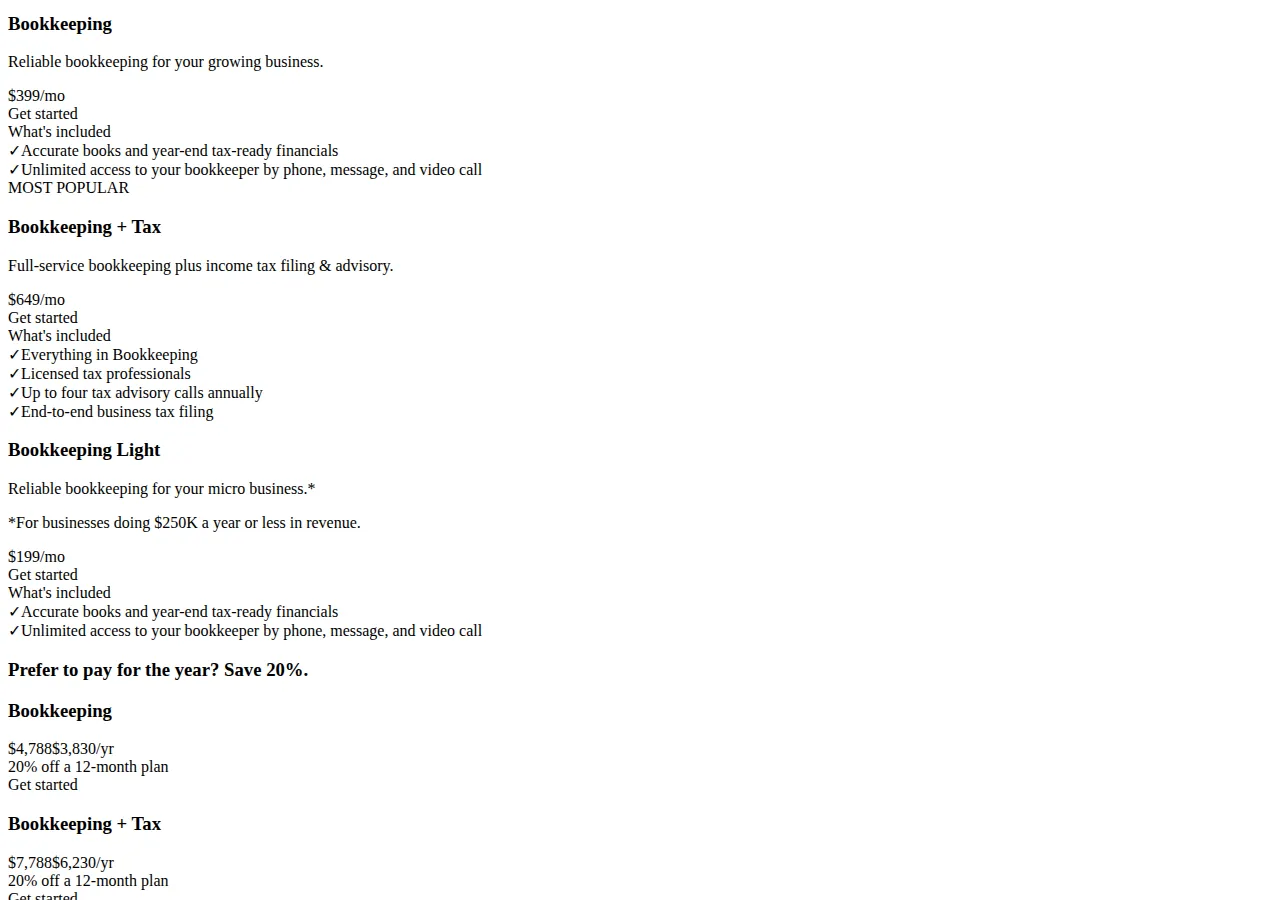
Bench sells three service plans. Bookkeeping Light costs $199 a month for a micro business doing $250,000 a year or less. Bookkeeping costs $399 a month. Bookkeeping + Tax costs $649 a month and adds licensed tax professionals, up to four tax advisory calls a year, and end-to-end business tax filing. All three include a dedicated bookkeeper reachable by phone, message, and video call, plus year-end tax-ready financials. Pay annually and each plan drops 20 percent: Light to $1,910 a year, Bookkeeping to $3,830, Bookkeeping + Tax to $6,230.
Bench shows a second pricing view for businesses that already run QuickBooks: Complexity 1 at $399 a month for cash-basis books up to 500 transactions a month, Complexity 2 at $699 for cash or accrual books up to 2,000 transactions, and Complexity 3 from $999 for unlimited transactions. Confirm which view your quote sits in before you sign.
On 27 December 2024 Bench told customers the platform would no longer be accessible; its own transition notice records that Bench Accounting, Inc. became insolvent that day. On 30 December 2024 Employer.com announced it had acquired Bench, and service resumed in January 2025. The books live inside Bench's proprietary platform.
Pilot: the most transparent ladder, the steepest climb
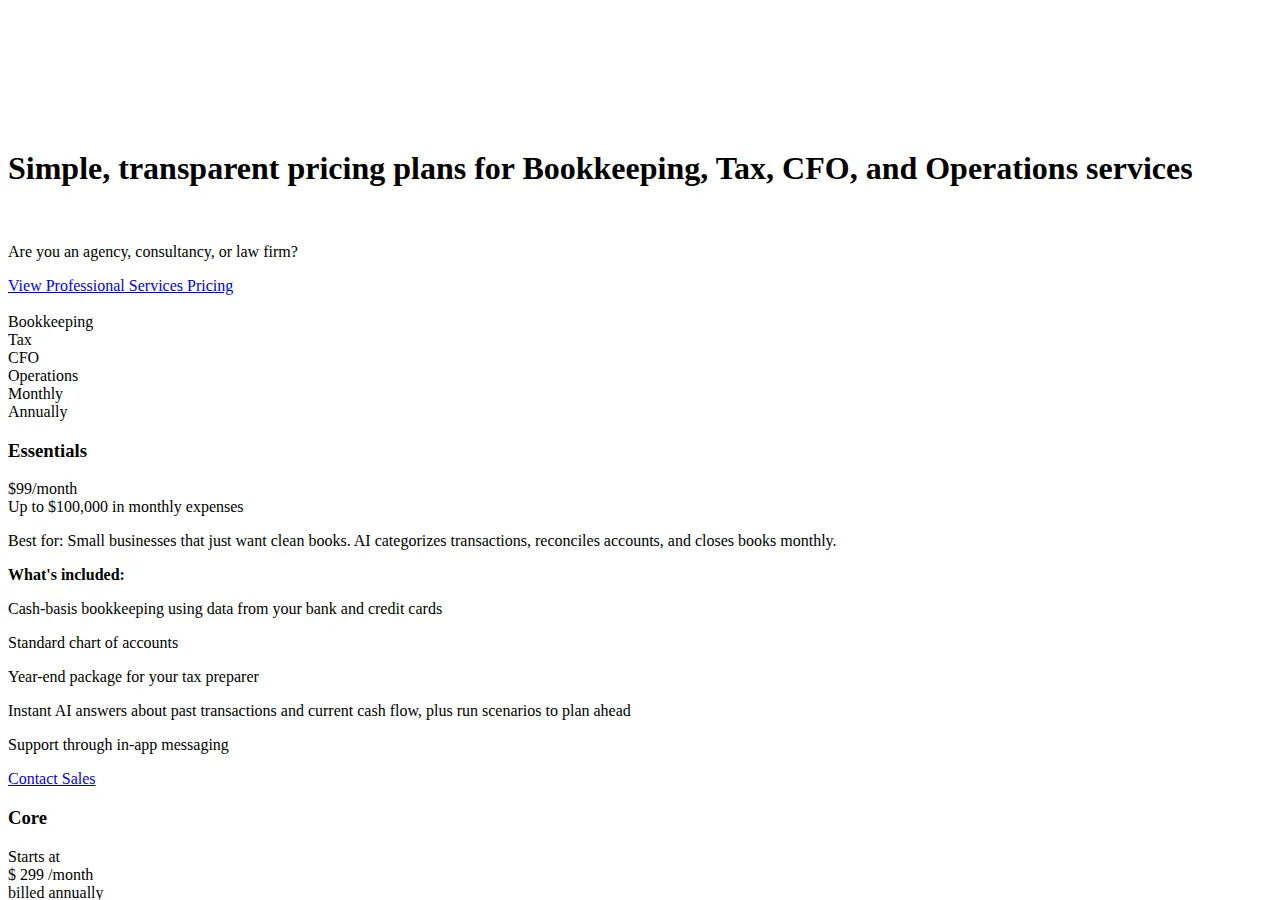
Pilot publishes the most complete ladder of the three, priced by monthly expenses averaged over three months. Essentials costs $99 a month: AI categorizes transactions, reconciles accounts, and closes the books monthly, on a cash basis, for up to $100,000 in monthly expenses. There is no human bookkeeper on Essentials.
Core adds the US-based bookkeeper, cash or accrual books, a custom chart of accounts, bill management for up to 10 vendor bills a month, and reports on the 10th business day. Core is billed annually by expense band, each labelled "starts at" on Pilot's pricing page:
| Monthly expenses | Core, billed annually | Core, month to month |
|---|---|---|
| Under $15,000 | $299 | $399 |
| $15,000 to $30,000 | $499 | $599 |
| $30,000 to $60,000 | $559 | $669 |
| $60,000 to $100,000 | $679 | $815 |
| $100,000 to $150,000 | $799 | $959 |
| $150,000 to $200,000 | $999 | $1,199 |
Above $200,000 a month, Core becomes a custom plan with a quoted price. Pilot only supports businesses on QuickBooks Online.
Pilot Tax is a separate purchase, priced by entity. A single-member LLC starts at $1,000 a year, including federal and state filing, quarterly safe-harbor payments, and Schedule C. Partnerships and S-corps start at $2,000 a year and add Delaware franchise tax filing and up to 25 Form 1099-NEC filings. C-corps start at $2,450 a year with up to 10 Form 1099-NEC filings.
QuickBooks Live: the cheapest headline, the least verifiable price
QuickBooks Live is Intuit's own service, and it has one structural advantage neither rival can match: your bookkeeper works inside the QuickBooks Online file you already own, with no migration and no second platform. See the QuickBooks Online vs Xero comparison for the software-only decision.
QuickBooks Live does not send invoices or pay bills, does not manage inventory, accounts receivable, or accounts payable, does not give financial or tax advice, does not file income or sales tax returns, does not create or send 1099s, and does not manage payroll.
Intuit's own pages publish no dollar tier for Full Service Bookkeeping. The help article says only that the first month carries a flat cleanup and setup fee, and that after the first month the price is based on average monthly expenses, re-evaluated every three months. The dollar tiers are quoted inside the signup flow, not on the public page.
Two current third-party reads, both dated September and October 2026, report different ladders for the same bands: one reports $200 a month up to $10,000 in average monthly expenses, $300 from $10,000 to $50,000, and $400 above $50,000, with a $500 first-month setup fee; the other reports $300, $500, and $700. The gap is $100 a month at every band — $1,200 a year — and neither figure can be confirmed from Intuit's public pages, so this article uses both as a reported range, never as a settled price. On top of either ladder sits a QuickBooks Online subscription: Simple Start $38, Essentials $85, Plus $140, and Advanced $340 a month, each at half price for the first three months.
Reproducible monthly cost at three volumes
The table below uses published prices only. QuickBooks Live appears as a reported range because Intuit publishes no tier price; the all-in figure adds the QuickBooks Online plan a business at that volume would normally hold.
| Volume | Bench | Pilot | QuickBooks Live (reported) |
|---|---|---|---|
| Micro: $8,000/mo expenses, ~150 txns | Light $199/mo | Essentials $99/mo, AI-only | $200–$300/mo + $38 QBO = $238–$338/mo |
| Growing: $40,000/mo expenses, ~800 txns, tax filing | Bookkeeping + Tax $649/mo | Core $559/mo + Tax $2,000/yr = $726/mo | $300–$500/mo + $140 QBO = $440–$640/mo, no tax filing |
| Large: $120,000/mo expenses, ~2,500 txns, 1099s | Complexity 3 from $999/mo | Core $799/mo + Tax $2,000/yr = $966/mo | $400–$700/mo + $340 QBO = $740–$1,040/mo, no 1099s |
ext{Bench annual saving} = 12 imes $399 imes 0.20 = $957.60
ext{Pilot Core + Tax (growing)} = $559 +
rac{$2{,}000}{12} = $559 + $167 = $726 ext{/mo}
ext{Cost per $1,000 of monthly expenses} =
rac{ ext{monthly fee}}{ ext{monthly expenses} div 1{,}000}
At $40,000 of monthly expenses, Bench Bookkeeping + Tax costs $16.23 per $1,000 of expenses, Pilot Core plus tax $18.15, and QuickBooks Live's reported service fee $7.50 to $12.50 before the $140 software subscription.
ext{12-month gap, growing business} = ($726 - $649) imes 12 = $924 ext{/yr}
Pilot Core plus tax costs $924 more than Bench over a year at the growing volume. At the large volume the gap reverses: $966 a month against Bench Complexity 3 from $999 is $33 a month, or $396 a year, in Pilot's favour — before Bench's tax filing is counted, since Complexity 3 is bookkeeping only. Run the same arithmetic on your own expense average, and carry the result into a full margin model on the profit calculator.
Scenario: a $480,000-revenue agency switches from doing it herself
Example: a marketing agency with $480,000 in annual revenue, about 800 transactions a month, and $40,000 in average monthly expenses. The founder does the books herself in QuickBooks Online Plus at $140 a month, spending roughly six hours a month on categorization, and paying a CPA $2,400 a year for the return plus 1099s for eight contractors.
On Bench, Bookkeeping + Tax at $649 a month covers the bookkeeping and the return: $7,788 a year, or $6,230 on the annual plan, and she cancels the $2,400 CPA return. All-in: $6,230 a year. Bench does not publish 1099-NEC filing as included, so her eight contractors' 1099s need separate filing — the $6,230 covers the return, not the 1099s. On Pilot, Core at the $30,000-to-$60,000 band costs $559 a month billed annually, and Pilot Tax for her S-corp starts at $2,000 a year including up to 25 Form 1099-NEC filings, which covers her eight contractors. Combined: $726 a month, or $8,708 a year, plus QuickBooks Online Plus at $140 a month — another $1,680 a year at list price. All-in: $10,388 a year, $4,158 a year more than Bench.
On QuickBooks Live, the reported service fee at her band is $300 to $500 a month, plus QuickBooks Online Plus at $140 — but the 1099s and the tax return are not included, so she keeps the $2,400 CPA bill. All-in: $7,680 to $10,080 a year. The decision is not $649 against $559; it is $6,230 against $10,388 against $7,680 to $10,080 with the return still to buy.
The decision table
| Decision factor | Bench | Pilot | QuickBooks Live | Authority |
|---|---|---|---|---|
| Cheapest entry | $199/mo Light, revenue ≤ $250K | $99/mo Essentials, AI-only, cash basis | Reported $200–$300/mo + QBO subscription | Vendor pricing pages; QB Live reported |
| Human bookkeeper | Yes, all plans | Core and above, from $299/mo annual | Yes, dedicated QB-certified bookkeeper | Vendor pages; Intuit help article |
| Tax filing included | Bookkeeping + Tax $649/mo; tax-only $300/mo | No; Pilot Tax from $1,000/yr by entity | No; not offered | Vendor pages; Intuit help article |
| 1099-NEC filings | Not published as included | Up to 25 (S-corp) or 10 (C-corp) with Pilot Tax | Not included | Vendor pricing pages; Intuit help article |
The record-keeping clock the bookkeeper works against
The IRS sets the retention clock, not the vendor. IRS Publication 583, Starting a Business and Keeping Records, states the rule: keep records that support an item of income or deduction until the period of limitations for that return runs out — three years from the filing date or the due date, whichever is later, for an ordinary return. Employment tax records must be kept at least four years after the tax becomes due or is paid, whichever is later; the window stretches to six years if gross income was understated by more than 25 percent, and to seven years for a bad-debt deduction. If no return was filed, or the return was fraudulent, there is no time limit at all. That clock is why the export question matters more than the monthly fee: Bench keeps your books in its own platform, while Pilot and QuickBooks Live keep them in your QuickBooks Online file. For the close itself, see the 5-day month-end close playbook.
Founder & CEO Insight — Enow A. Jovial
Who should NOT use each vendor
Bench does not fit a business that needs its books inside QuickBooks Online, or one that cannot accept a proprietary platform after the December 2024 shutdown. It does not fit a business above $250,000 in revenue that wants the $199 Light plan, or one that needs accrual books below the $699 Complexity 2 tier. It fits a micro business that wants the flattest published price and the tax return bundled in.
Pilot does not fit a business that runs anything other than QuickBooks Online, a business above $200,000 a month in expenses that wants a published price, or a business that needs a human bookkeeper for less than $299 a month. Essentials at $99 is AI-only. It fits a startup on QuickBooks Online that wants accrual books, a US-based bookkeeper, and reports on the 10th business day.
QuickBooks Live does not fit a business that needs 1099s filed, bills paid, invoices sent, or a tax return prepared — none of that is in the service. It does not fit a business that needs accrual books, or one whose expenses swing enough that a quarterly re-tiering would move the bill without warning. It fits a business already on QuickBooks Online that wants a certified bookkeeper inside the file it owns, and is willing to get the tier price in writing.
Failure modes are specific to each vendor. Outgrow Bench's Light plan by crossing $250,000 in revenue and the price moves to $399 a month; outgrow Complexity 1's 500 transactions and it moves to $699. Outgrow Pilot's expense band and Core steps to the next band on the three-month average. Grow QuickBooks Live's three-month average and Intuit re-tiers the service automatically at the next quarterly review. Recovery is the same in every case: keep a current export of your books outside the vendor's platform, and re-price the service every quarter.
Execution checklist: choosing and switching safely
- [x] Step 1: Measure your meter — Three-month average expenses, transactions, revenue.
- [x] Step 2: Price three volumes — Current, double, and twelve months out.
- [x] Step 3: Price the tax return and 1099s in the same table — Count contractors.
- [x] Step 4: Get QuickBooks Live's tier in writing — Intuit publishes none.
- [x] Step 5: Test the export — Confirm seven years of records travel.
- [x] Step 6: Confirm the catch-up terms — Current year free on Bench annual.
- [x] Step 7: Re-price every quarter — Tiers move with expense averages.