A founder who owns a home and a business holds a small, legal lever: rent the home to the business for a few days a year, and the rent is not taxed at all. Not deferred, not deducted against other income — excluded from gross income entirely, by a statute that has sat unchanged in the Internal Revenue Code since 1976. The rule is IRC § 280A(g), the Augusta Rule, and it works because the statute draws a hard line at 15 days: rent your residence for fewer than 15 days in the year, and the income derived from that rental "shall not be included in the gross income of such taxpayer under section 61." Cross to 15 days and the whole amount becomes taxable, not just the fifteenth day's rent.
The statute: what § 280A actually says
Section 280A starts from a denial. Subsection (a) provides that, for an individual or an S corporation, "no deduction otherwise allowable under this chapter shall be allowed with respect to the use of a dwelling unit which is used by the taxpayer during the taxable year as a residence." Subsection (b) saves the deductions that exist without regard to business use — mortgage interest, property taxes, casualty losses — which is why those stay on Schedule A under the Augusta Rule. Subsection (c) carves out certain business and rental uses, subject to the paragraph (c)(5) cap: deductions attributable to the use cannot exceed the gross income from that use minus the allocable deductions that are allowable anyway.
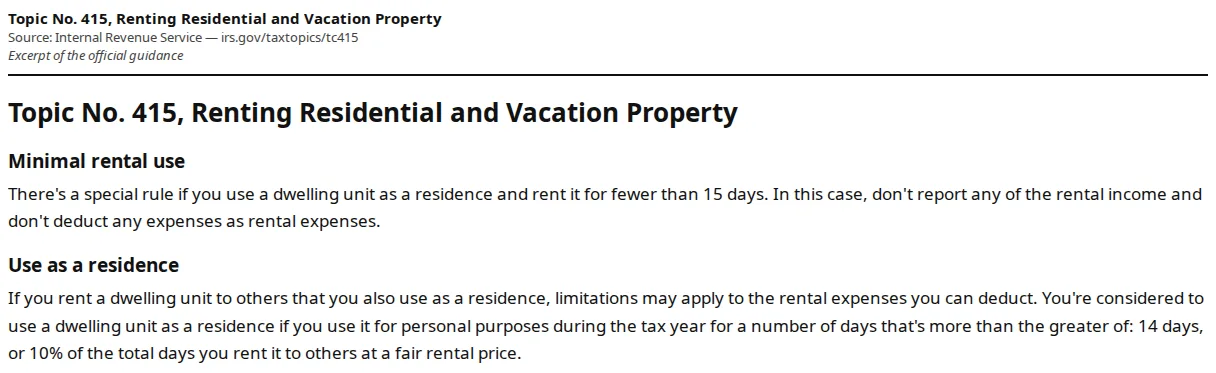
Subsection (d) defines the residence test. A taxpayer uses a dwelling unit as a residence if personal use exceeds the greater of 14 days or 10 percent of the days the unit is rented at a fair rental. Personal use, under § 280A(d)(2), includes any day the unit is used by the taxpayer, by a family member as defined in § 267(c)(4), by anyone under an arrangement that lets the taxpayer use some other dwelling unit, or by anyone at less than a fair rental.
Then comes subsection (g), the whole play, in two sentences:
Three conditions, and all three must hold. The unit must be used as a residence during the year. It must actually be rented — a paper lease with no payment and no use is not a rental. And the rental must total fewer than 15 days. The IRS states the same rule in plain language in Topic 415: "There's a special rule if you use a dwelling unit as a residence and rent it for fewer than 15 days. In this case, don't report any of the rental income and don't deduct any expenses as rental expenses." Publication 527 (2025) adds the filing consequence: the activity "shouldn't be reported on Schedule E (Form 1040)."
The 15th-day cliff
The arithmetic of the exclusion is simple; the cliff is what founders miss. The exclusion is all or nothing for the tax year. Rent for 14 days and every dollar is excluded. Rent for 15 days and every dollar is included, with expenses then divided between rental and personal use under the § 280A rules and the § 280A(c)(5) gross-income limitation. There is no partial exclusion for the first 14 days, and no de minimis for the fifteenth.
Take a home whose fair rental value is $1,500 a day, documented from comparable short-term listings. Twelve days of board meetings and strategy sessions produce $18,000 of rent. At 14 days or fewer, the owner's tax on that $18,000 is zero, and no Schedule E is filed. Add a thirteenth and fourteenth day and the excluded total rises to $21,000. Add one more day — a fifteenth rental day, perhaps a family reunion booked through the same listing — and the entire $22,500 becomes gross income, with expenses allocated by days and capped at that gross income under § 280A(c)(5).
Augusta vs the alternatives
| Route | Owner's tax on the rent | Business deduction | Filing | Authority |
|---|---|---|---|---|
| Augusta Rule, ≤14 days | $0 — excluded from gross income | Yes, if ordinary and necessary under § 162 | No Schedule E | 26 U.S.C. § 280A(g); IRS Topic 415; Pub. 527 (2025) |
| Same rental, ≥15 days | All rent taxable; expenses allocated by days, capped at gross rental income | Yes, same § 162 test | Schedule E required | 26 U.S.C. § 280A(c)(5), (d); Pub. 527 Ch. 5 |
| Home-office deduction | No rent involved; deduction limited to the office portion, regular-and-exclusive use | Business deducts the office share, not rent | Form 8829 | 26 U.S.C. § 280A(c)(1); our home-office deduction guide |
| Salary or bonus instead | Taxed as wages, plus FICA on the full amount | Yes, as compensation | W-2 | 26 U.S.C. §§ 61, 3121; S-corp reasonable compensation |
| Dividend or distribution | Taxed as a dividend (C-corp) or as a distribution (S-corp/LLC, basis permitting) | No deduction for the company | 1099-DIV / K-1 | 26 U.S.C. §§ 301, 1368 |
The table is the decision. The Augusta Rule is the only route in which the same dollars are a deduction for the business and excluded income for the owner. The home-office deduction is a different tool — it deducts a share of the home's costs for a room used regularly and exclusively for business, and it never produces rent. Our Form 8829 guide covers that route; the two can coexist, but the Augusta days and the home-office room must not be double-counted for the same space on the same day.
Renting to your own business
The highest-value use, and the one the IRS watches, is renting the home to your own company — for board meetings, annual planning, a product launch, a strategy retreat. The business pays rent and deducts it as an ordinary and necessary business expense under § 162. The owner receives the rent and excludes it under § 280A(g), provided the 14-day ceiling holds. The saving against paying the same amount as salary is the payroll tax: $18,000 paid as salary carries $2,754 of FICA at 15.3% (employer plus employee share), while $18,000 paid as rent at fair value carries none, because the payment is rent, not wages.
That saving is real only if the rent is genuine. Four conditions decide whether it survives an examination:
- Fair rental value. The rent must be what an unrelated tenant would pay for the same space for the same use. Document it before the first meeting: two or three comparable listings for similar homes or meeting venues in the same area, dated and saved. A $5,000-a-day rate for a two-bedroom flat with no comparables is a recharacterisation waiting to happen.
- A real business purpose. Each rental day needs a meeting that actually happened — a board meeting, a planning session, a client event — with an agenda and minutes. The company must need the space; a house that is also the company's registered office, used daily, is not being "rented" for a meeting.
- A real payment. The company pays the owner by bank transfer, on or near the rental date, for the invoiced amount. No journal entries with no cash movement, no round-tripping the same money back the next day.
- A written agreement. A short lease or facilities-use agreement between the company and the owner, signed before the first rental day, stating the daily rate, the permitted uses, and the 14-day annual cap.
Related-party scrutiny is the reason for the paperwork. The owner and the company are related parties, and the IRS may recharacterise an inflated rent as a disguised dividend or distribution — taxable to the owner and non-deductible to the company. Fair value plus documentation is the whole defence.
The traps, in order of how often they bite
Counting only the business days. The 14-day ceiling counts every rental day in the tax year, from every tenant. The common failure: tracking the company's 12 meeting days and forgetting the 3 days the house was listed for a local festival. Keep one calendar for all rentals, and stop at 12 days if any other rental is plausible.
Personal-use days that are not personal. Under § 280A(d)(2), a day counts as personal use if the unit is used by a family member, by anyone under a swap arrangement, or by anyone at less than fair rental. A day your brother stays free is a personal-use day, and personal-use days feed the residence test. Renting at a discount to a friend is both a personal-use day and not a rental day at fair value, so it muddies both tests at once.
Claiming expenses against excluded income. Section 280A(g)(1) is explicit: no deduction is allowed because of the rental use. No depreciation, no cleaning costs, no allocated utilities, no "rental portion" of the mortgage. The mortgage interest and property taxes remain deductible — but on Schedule A, as they would be without any rental, under § 280A(b). Claiming the same interest on Schedule E as a rental expense is a double claim.
The S-corp wrinkle. An S corporation is expressly within § 280A(a)'s scope, and the same exclusion applies when an S-corp owner rents a personal residence to the corporation. But S-corp owners must still pay a reasonable salary before distributions. Rent is not salary and does not cure an unreasonably low salary. Use the Augusta Rule alongside a defensible salary, not instead of one — our S-corp reasonable compensation guide sets the salary floor first.
The short-term rental platform habit. A home listed year-round on a short-term platform will blow past 15 rental days in the first month. The Augusta Rule is a tool for occasional rentals — a tournament, a conference, a handful of company meetings — not a strategy for a part-time Airbnb. Once the listing is live and booking, the exclusion is already gone for the year.
A worked example: one founder's year
A founder owns a four-bedroom home with a fair rental value of $1,500 a day, documented from comparables. The company holds its quarterly board meetings at the house (4 days), an annual planning retreat (3 days), and a product-launch working session (2 days) — 9 rental days, $13,500 of rent, paid by bank transfer against a signed agreement, each day minuted.
The company deducts the $13,500 under § 162. The owner excludes it under § 280A(g), files no Schedule E, and continues to deduct mortgage interest and property taxes on Schedule A. The same $13,500 paid as a bonus would have cost $3,240 of income tax plus $2,066 of FICA — $5,306 that stays with the founder instead. The company could add 5 more rental days before hitting the ceiling; a prudent founder leaves 2 days of buffer and stops at 12.
Execution checklist
- [x] Confirm the unit is a residence: personal use exceeds the greater of 14 days or 10% of rental days under § 280A(d)(1).
- [x] Price the day: collect two or three comparable rentals or meeting venues, dated and saved, before the first rental.
- [x] Sign a facilities-use agreement: company and owner, daily rate, permitted uses, 12-day annual cap, signed before the first meeting.
- [x] Minute every rental day: agenda, attendees, and what was decided; keep the minutes with the lease.
- [x] Pay by bank transfer: invoiced amount, on or near the rental date — no journal-only entries.
- [x] Keep one rental calendar: every tenant, every day; check the total before confirming any booking.
- [x] File nothing on Schedule E: with 14 or fewer rental days, the rent is excluded and no rental expenses are claimed.
- [x] Run the numbers first: model the rent, the rate, and the salary alternative on our tax estimator before the first meeting.
Founder & CEO Insight — Enow A. Jovial