Publish the same book — a 250-page, 6-by-9-inch black-and-white paperback at a $19.99 list price — on all three platforms and four different cheques arrive. Amazon KDP pays $7.99 a copy. IngramSpark pays $3.64. Lulu pays $9.40 if the reader buys from the Lulu Bookstore and $1.40 if the same copy sells through a retailer. KDP pays a royalty on the list price, IngramSpark pays what is left of a wholesale price, and Lulu pays a share of the margin after printing.
Three different businesses wearing one label
KDP is Amazon's own press: the book sells on Amazon, Amazon prints it, and the royalty is a percentage of the list price minus the printing cost. IngramSpark is the trade wholesaler's press: the book enters Ingram's catalogue, bookstores and libraries order it at a wholesale discount, and the author is paid what remains of the wholesale price after printing and a distribution fee. Lulu is the author's own press with a storefront attached: the book sells from Lulu's bookstore or through global distribution, and the author keeps 80 percent of the gross profit after printing and any fee.
The model decides what can go wrong. With KDP, the book sells only where Amazon sells it — no bookstore orders a KDP paperback, and KDP hardcovers have no Expanded Distribution. With IngramSpark, the book reaches more than 45,000 retailers, libraries, and universities, but the author carries the returns. With Lulu, the print cost is not published as a table — it is quoted by a calculator per title.
Distribution is the first fork: KDP paperbacks can use Expanded Distribution; KDP hardcovers cannot. IngramSpark is distribution-first — the whole point is the catalogue. Lulu distributes through Ingram's network too, under its Global Distribution programme, a one-time $4.99 enrolment per title.
The royalty formulas, from the platforms' own pages
| Platform | Formula | Rate on a $19.99 list | Authority |
|---|---|---|---|
| KDP paperback | Royalty rate × list price − printing cost | 60% at $9.99+; 50% at $9.98 and below | KDP help (Nov 18) |
| KDP hardcover | Royalty rate × list price − printing cost | Same 60%/50% split | KDP hardcover page (Nov 12) |
| IngramSpark | List price − wholesale discount − print cost − 1.875% fee | 55% discount recommended; 40% minimum in the U.S. | Rate card, Feb 1, 2026 |
| Lulu Bookstore | 80% × (list price − print cost) | No distribution fee | Creator Revenue Guide |
| Lulu retail | 80% × (list price − 50% distribution fee − print cost) | 50% of list | Creator Revenue Guide |
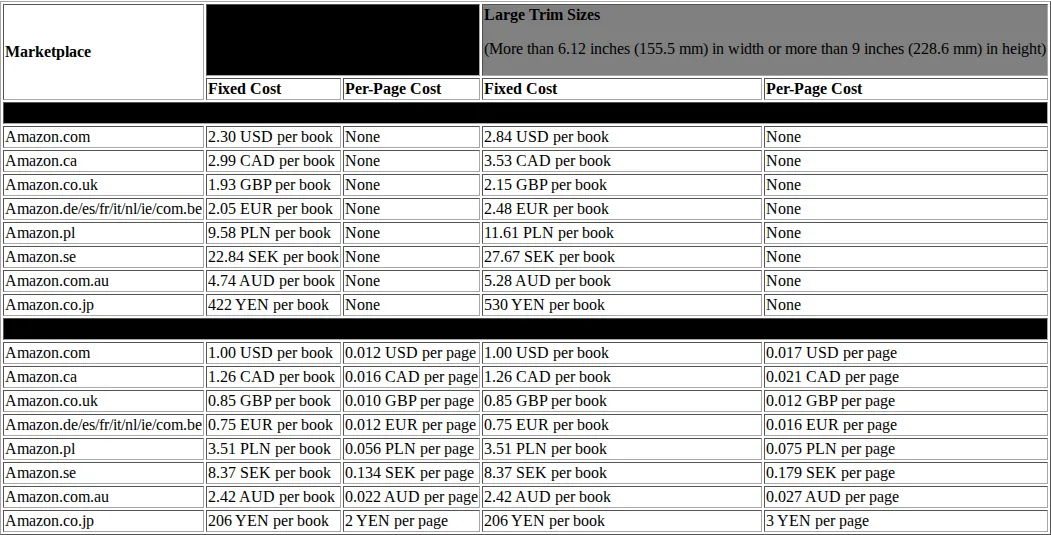
KDP's printing cost is a published table: fixed cost plus page count times per-page cost. On Amazon.com for a regular-trim black-ink paperback it runs $2.30 flat for 24 to 110 pages, then $1.00 plus $0.012 a page to 828 pages. Premium color is $1.00 plus $0.065; standard color is $1.00 plus $0.0255. The minimum list price is the printing cost divided by the royalty rate.
IngramSpark's printing cost is also a published formula: $1.33 plus $0.0146 a page for a black-and-white paperback under 6.15 inches wide on 50 lb paper, from the rate card effective February 1, 2026. A 200-page book costs $4.25 to print; a 300-page book costs $5.71. The hardcover runs $5.31 plus $0.0132 a page — $7.95 at 200 pages. Title setup and revisions are free. On top of printing, every copy sold through distribution carries a 1.875 percent market access fee on the list price, up from 1.5 percent before February 2026.
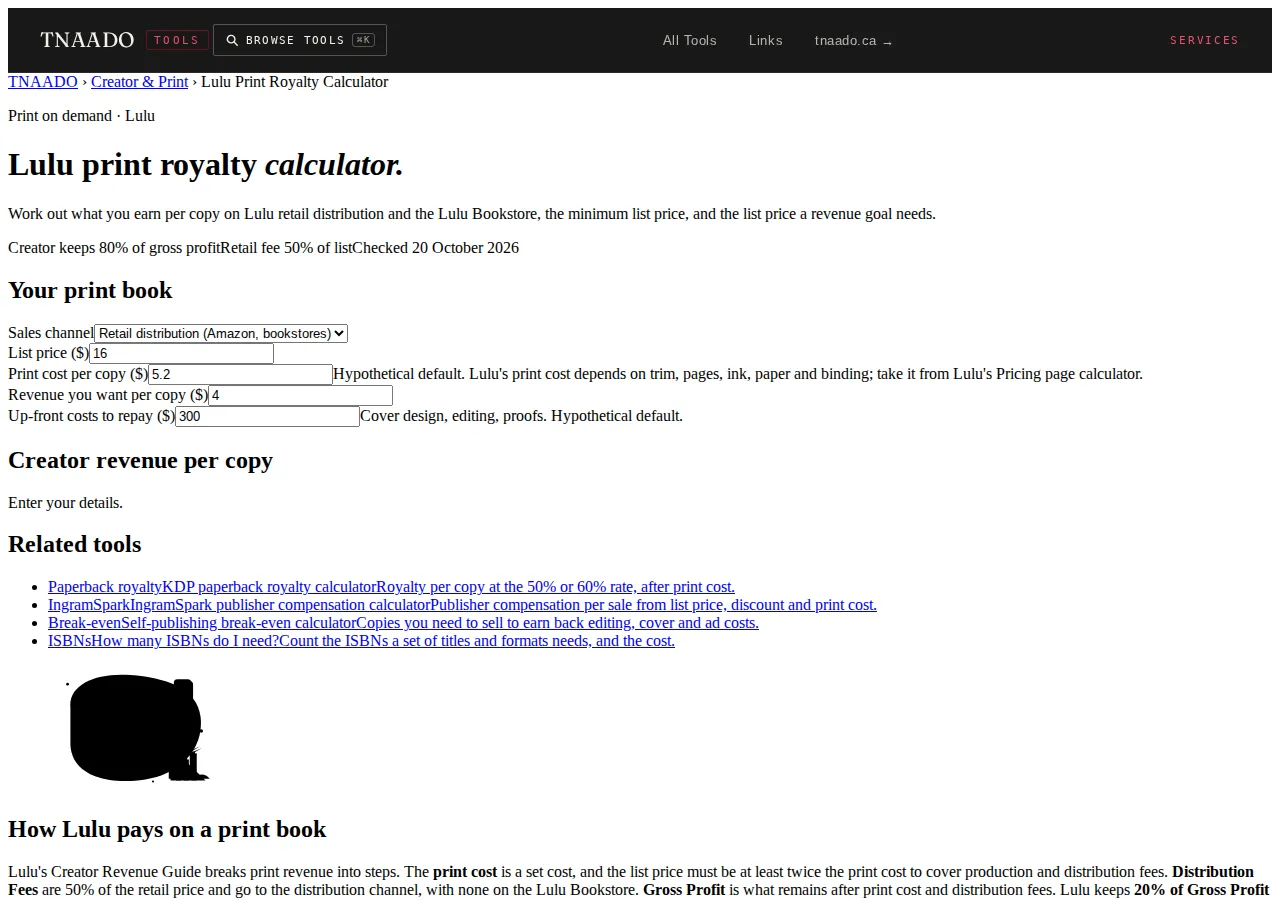
Lulu publishes no print-cost table at all: the print cost depends on trim size, page count, ink, paper, and binding, and Lulu quotes it through the pricing calculator on its site. What Lulu does publish is the revenue split: a 50 percent distribution fee on retail sales, none on the Lulu Bookstore, and a 20 percent Lulu share of the gross profit. The minimum list price for retail distribution is twice the print cost; on the bookstore it is the print cost itself.
Worked math 1: one 250-page paperback at $19.99
Example: a 250-page, 6-by-9-inch black-and-white paperback, regular trim, sold in the United States at a $19.99 list price. The print costs come from each platform's own published rates; the Lulu print cost of $8.24 is BookSpace's September 2026 read of Lulu's calculator for this specification.
KDP — printing cost $1.00 plus 250 pages at $0.012, royalty 60 percent of list minus printing:
IngramSpark — printing cost $1.33 plus 250 pages at $0.0146, wholesale price less the 55 percent discount, market access fee 1.875 percent of list:
Lulu Bookstore — gross profit is list minus the $8.24 print cost, author keeps 80 percent:
Lulu retail — the 50 percent distribution fee comes off first, then the print cost, author keeps 80 percent of what remains:
The same book, the same price, a $7.99 spread between the best and worst cheque. Lulu's bookstore pays the most because no retailer takes a cut. IngramSpark pays the least because the bookstore's 55 percent comes off the top. KDP sits in the middle — the cheapest print cost, but a royalty of only 60 percent of the cover price.
Worked math 2: the hardcover premium, and the discount that costs $3.00 a copy
A hardcover earns more only if the list price carries the extra printing cost. On KDP, a 250-page black-ink hardcover costs $5.65 plus 250 pages at $0.012 — $8.65, against $4.00 for the paperback. The hardcover table is KDP's own, read in three independent November 2026 reproductions that agree to the cent: 75 to 108 pages cost a flat $6.80, 110 to 550 pages cost $5.65 plus $0.012 a page, premium color $5.65 plus $0.065. The fixed-cost gap is $4.65 at every page count from 110 to 550, and the premium needed to earn the same royalty is that gap divided by the 60 percent rate:
At $24.99 the hardcover earns $6.34 — less than the $7.99 the paperback earns at $19.99. At $29.99 it earns $9.34 and finally pulls ahead. Note the constraints: 75 to 550 pages only, case laminate only, no standard color, no Expanded Distribution.
The wholesale discount is the second lever, and it belongs to the author. At a 40 percent discount — the minimum IngramSpark accepts in the U.S. — the same book at $19.99 pays $6.64 a copy instead of $3.64:
The 15-point discount difference is worth $3.00 a copy. The trade is reach: IngramSpark's user guide says 53 to 55 percent, with the book returnable, "generally allows for the widest availability".
The 500-copy year: what volume actually buys
| Channel | Per copy | 500 copies/year |
|---|---|---|
| KDP paperback, Amazon | $7.99 | $3,995.00 |
| IngramSpark, 55% discount | $3.64 | $1,820.34 |
| IngramSpark, 40% discount | $6.64 | $3,320.00 |
| Lulu Bookstore | $9.40 | $4,700.00 |
| Lulu retail distribution | $1.40 | $700.00 |
At 500 copies the channel choice is worth $4,000 a year — the gap between Lulu's bookstore and Lulu's retail distribution on the same book. The ranking holds at any volume because every formula here is per-copy. Payment timing widens the gap: KDP pays about 60 days after the month of sale, IngramSpark about 90 days, Lulu monthly.
Returns: the cost IngramSpark charges back
IngramSpark offers three return settings, and the choice is a pricing decision, not a preference. "No" makes the book non-returnable and many stores will not stock it. "Yes, destroy" lets stores send copies back to be pulped and charges the author the wholesale price of each returned copy. "Yes, deliver" ships the returned copies to the author and adds $3.00 a book to a U.S. address.
On the 250-page book at $19.99 and a 55 percent discount, the wholesale price is $9.00 — one returned copy costs $9.00 against $3.64 earned on a sale:
A 5 percent return rate on 500 copies — 25 returns — costs $225 against $1,820 earned, a 12 percent haircut on the year's IngramSpark income. KDP has no equivalent cost. The shelf IngramSpark buys is the only shelf an unknown author can reach, and the returns are the rent.
The business footing: entity, tax, and the costs after the print bill
A self-published book is a business, and the royalty is only the first line of the return. Run it as an LLC — an S-Corp election at scale, a C-Corp only with outside investors — with an EIN on the publishing account and a CPA reviewing the first year's return. Under GAAP there is no inventory on the balance sheet: the print cost is COGS recognized at the sale. The author's income is subject to SECA self-employment tax on net earnings, not FICA withholding, and the Schedule C carries the ISBN registration, the copyright filing, and the cover and editing costs as ordinary expenses.
The second-order costs decide whether the $7.99 KDP royalty survives the launch. A professional edit and a cover design are paid before the first royalty arrives, and at $7.99 a copy the copies needed to repay them is the bill divided by $7.99 — a $1,000 editing bill needs 126 copies. Each format needs its own ISBN: paperback, hardcover, and ebook are three ISBNs, not one. We placed no test orders with any of the three platforms, so this guide makes no claim about print quality or delivery times beyond what the vendors state. The ebook runs on a different table: KDP pays 70 percent at $2.99 to $12.99, IngramSpark pays 85 percent of net revenue, Lulu pays 90 percent after its costs.
Founder & CEO Insight — Enow A. Jovial
What each platform is actually for
KDP is for the author whose readers shop on Amazon: the lowest print cost, the simplest royalty, no distribution beyond Amazon. IngramSpark is for the author who needs bookstores and libraries: the widest catalogue reach, the highest print cost, and the lowest per-copy earnings — at the cost of carrying the returns. Lulu is for the author who sells direct: the highest earnings on its own bookstore, the widest format range, and a print cost that arrives as a quote rather than a table. The Printful versus Printify versus Gelato playbook prices the same print-on-demand economics for merchandise, and the Ghost versus Substack versus Beehiiv playbook prices the newsletter platforms that build the audience a direct sale depends on.
Execution checklist
- [x] Step 1 — Fix the specification first: trim size, page count, ink, and paper, before any platform sees the file.
- [x] Step 2 — Read the print cost from the platform's own table or calculator.
- [x] Step 3 — Compute the per-copy earnings on every channel you will use: KDP, IngramSpark at your discount, Lulu bookstore, Lulu retail.
- [x] Step 4 — Set the list price from the minimums: KDP's minimum is print cost divided by the royalty rate.
- [x] Step 5 — Choose the return setting deliberately: non-returnable limits the shelf; returnable carries the wholesale price on every copy sent back.
- [x] Step 6 — Order one author copy before launch: confirm the print, the trim, and the cover before the first reader sees it.
Who should not use each one
Do not choose KDP if your readers buy in bookstores: the book will never reach a shelf, and the hardcover will never leave Amazon. Do not choose IngramSpark if you cannot carry returns: one returned copy costs $9.00 against $3.64 earned, and a bad returns month can erase a quarter's earnings. Do not choose Lulu if you need a published print-cost table — the quote arrives per title. And do not choose any of them if the book is not finished: the cheapest print cost in the world cannot sell a manuscript that is still a draft.