A Wyoming LLC formed on May 15 files nothing on May 15 ever again. Its annual report is due May 1, every year, for $60. The state sends no bill, auto-drafts nothing, and does not forgive a missed year because the company was dormant. Two missed years cost $120 in delinquent license tax plus a $100 reinstatement fee, and a lapse past two years has no reinstatement route.
What the filing actually is
W.S. 17-29-209(a) states the duty in one paragraph. Every LLC organized under Wyoming law, and every foreign LLC holding a certificate of authority to transact business in Wyoming, must file with the secretary of state on or before the first day of the month of organization of every year a certification, under the penalty of perjury, by its treasurer or other fiscal agent. The certification sets out the LLC's capital, property, and assets located and employed in Wyoming, plus the address of its principal office. That is the whole report: one asset figure, one address, and a sworn signature — not member names, revenue, profit, or your EIN.
Three details in the same section decide how operators prepare. First, the financial information must be current as of the end of the LLC's fiscal year immediately preceding execution, under W.S. 17-29-209(c), while all other information must be current as of the execution date — a report signed in May carries December 31 numbers for a calendar-year LLC. Second, if the report lacks the required information, the secretary of state must promptly notify the LLC in writing and return it for correction, under W.S. 17-29-209(d). Third, the LLC must preserve for three years at its principal place of business the records and books needed to determine the fee, available for examination, under W.S. 17-29-209(e). The asset figure is a number your books must support for three years after you certify it, under penalty of perjury.
The duty covers every LLC: dormant, single-member, and foreign LLCs qualified in Wyoming all file on the same date and fee, and a holding company with no Wyoming assets files and pays the $60 minimum. The only carve-out is narrow: under W.S. 17-29-209(b)(i), an LLC carrying goods, passengers, or information interstate reports only the capital, property, and assets used in intrastate business in Wyoming.
The due date is an anniversary, not a calendar deadline
The report is due on or before the first day of the month of organization, every year. An LLC formed on May 15 owes its report by May 1; one formed on December 30 owes it by December 1. The first report is not due in the year of formation but on the first day of the anniversary month in the year after — an LLC formed on May 15, 2026 files its first report by May 1, 2027, two weeks before its first birthday, not after it.
That timing traps two kinds of founders. One formed late in the year and assumes the first report is a year away: an LLC formed on November 20, 2026 owes its first report by November 1, 2027, eleven months later. The other confuses the state report with the federal return. The annual report has nothing to do with the IRS — it is not Form 1065 or Form 1120-S, and a foreign-owned single-member LLC still owes its federal Form 5472 filing on its own deadline. Put the state date in the calendar the day the articles of organization are filed: the state sends no invoice and the portal does not chase you.
The license tax math
The fee is not a flat $60. It is the greater of $60 or two-tenths of one mill on the dollar ($0.0002) of the assets reported, under W.S. 17-29-209(a). The formula:
The crossover point is exact — and it tells an operator whether the asset figure matters at all:
An LLC with $300,000 or less in Wyoming assets pays $60. Above that line, every additional dollar adds $0.0002. The worked cases:
| Wyoming assets | Calculation | License tax |
|---|---|---|
| $0 | Floor applies | $60 |
| $500,000 | $0.0002 × $500,000 | $100 |
Only assets located and employed in Wyoming count. Bank balances, inventory, and equipment held outside Wyoming do not enter the figure — which is why the typical remote founder pays the floor: a Wyoming LLC holding a Delaware bank account, a Texas warehouse, and a laptop in Lisbon reports $0 in Wyoming assets and pays $60. The trap is the reverse. An LLC that moves equipment, vehicles, or inventory into Wyoming during the year must count it, because the certification is under penalty of perjury and the books must support it for three years. A CPA should confirm the figure from the balance sheet before anyone signs; the defensible starting point is the GAAP carrying value of property physically in the state, since the statute values property at its actual value under W.S. 17-29-209(b)(iii).
Ten years on time costs $600 at the floor and $1,000 at $500,000 of Wyoming assets. The number to watch is not the annual fee. It is the cost of the lapse.
How to file online
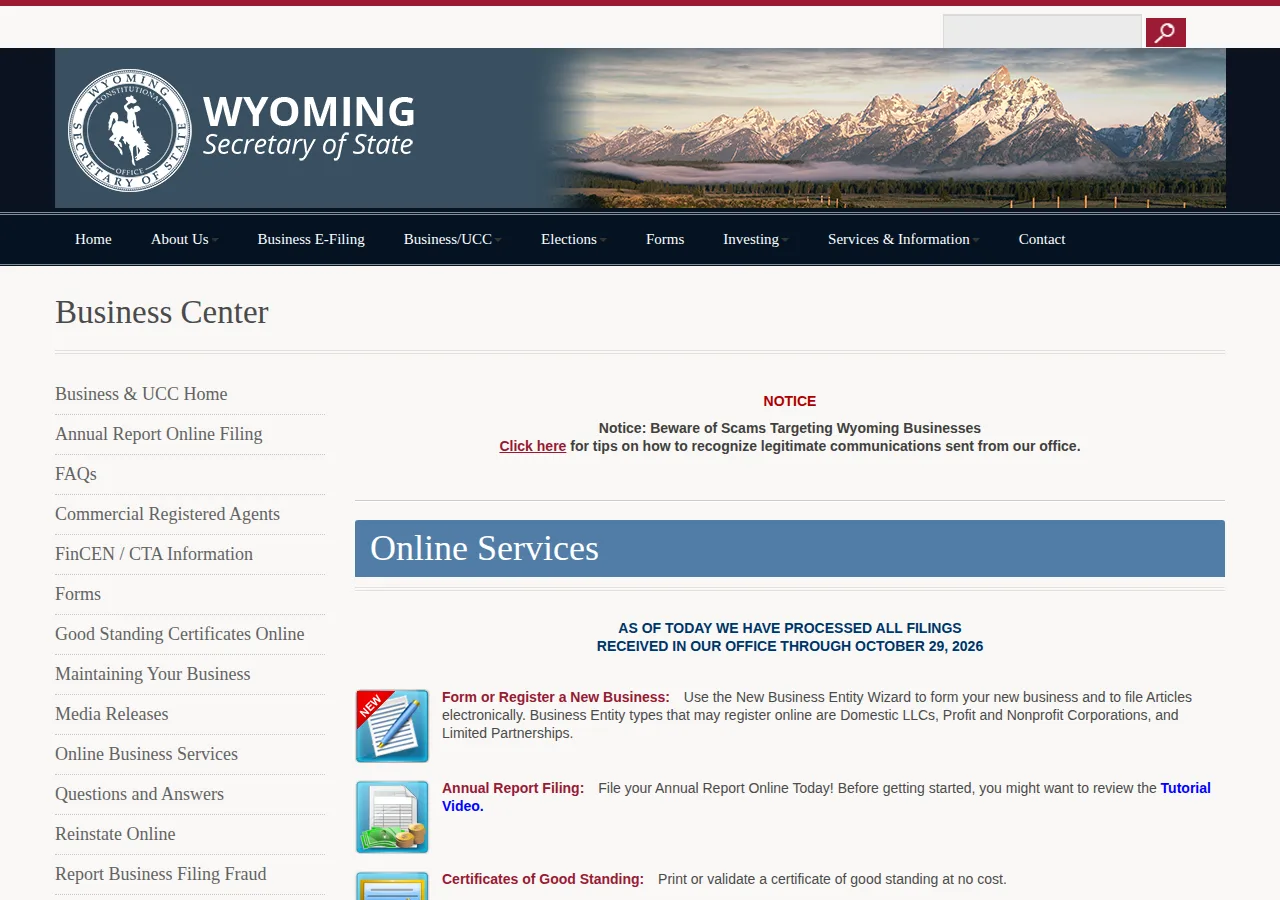
The filing runs through WyoBiz, the Wyoming Secretary of State's online business portal at wyobiz.wyo.gov, where the Business Center page lists Annual Report Online Filing in its left navigation. The sequence is short:
- Find the filing ID. Search the entity on WyoBiz and open its record.
- Confirm the principal office address. It must be current on the day of execution, under W.S. 17-29-209(c).
- Enter the Wyoming asset figure. Capital, property, and assets located and employed in Wyoming, current as of the end of the last fiscal year. Have the CPA-confirmed number in hand.
- Review the license tax. The portal computes the greater of $60 or $0.0002 per dollar. Check it against the formula above before paying.
- Certify and sign. The certification is made under penalty of perjury by the treasurer or fiscal agent.
- Pay with the filing and keep the confirmation. The annual fee accompanies the report and is due on or before the filing date, under W.S. 17-29-210(a)(iii).
The online route is the one to use: it is immediate, it computes the tax from the entered figure, and it returns a confirmation in the same session. One warning: a person who signs a document knowing it is false in a material respect, with intent that it be delivered to the secretary of state for filing, is guilty of a misdemeanor punishable by a fine of not more than $1,000, by imprisonment for not more than six months, or both, under W.S. 17-29-210(b).
The registered agent update rides the same filing
Every Wyoming LLC must maintain a registered agent and a registered office in the state, and the annual report is the natural moment to fix either one. The fee schedule prices agent changes separately from the report: appointment of a new registered agent and office $5.00, a registered agent information update $5.00 per entity affected, a resignation the same $5.00 per entity.
Two agent failure modes matter, and both run on the same 60-day clock as the tax forfeiture. First, if a registered agent resigns, the agent must have sent notice to each affected entity at least 30 days before filing the resignation, and the entity must then provide a statement of change within 30 days, under W.S. 17-28-103. An LLC that ignores a resignation notice for a month has already spent its cure period. Second, if an LLC is without a registered agent or registered office for any reason, the secretary of state gives notice by first-class mail or electronic means, and unless compliance is made within 60 days the LLC is deemed defunct and forfeits its articles of organization, under W.S. 17-29-705(a). Reinstatement within two years requires the necessary statement plus a reinstatement fee set by rule, together with a penalty of $250. The fee schedule sets that fee at $350 for an LLC, so the no-agent lapse costs $600 before any delinquent license tax. Commercial registered agents sell B2B subscriptions that include the address and the forwarding. Check the agent and the office every year when the report is due: the report already asks for the principal office, and the agent is the address the state uses to reach you.
What happens when you miss it
Wyoming charges no separate late fee for a late annual report. That sentence misleads founders into thinking a late filing is cheap. It is not cheap; it is binary. The sanction is forfeiture on a fixed clock under W.S. 17-29-705(b): if an LLC has failed to pay the fee required by W.S. 17-29-210, it is deemed to be transacting business in Wyoming without authority and to have forfeited its franchises, rights, and privileges. The secretary of state provides notice at the LLC's last known mailing address, by first-class mail or electronic means. Unless compliance is made within 60 days of the date of notice, the LLC is deemed defunct and forfeits its articles of organization.
Reinstatement is available only inside two years after the forfeiture, and only by paying the delinquent fees. When effective it relates back to the date the LLC was deemed defunct, so the LLC resumes business as if it had never been defunct, under W.S. 17-29-705(b). After two years, the statute provides no reinstatement route. The cost arithmetic:
Two missed years cost $120 in delinquent license tax plus the same $100 fee: $220, or 1.83 times the on-time cost.
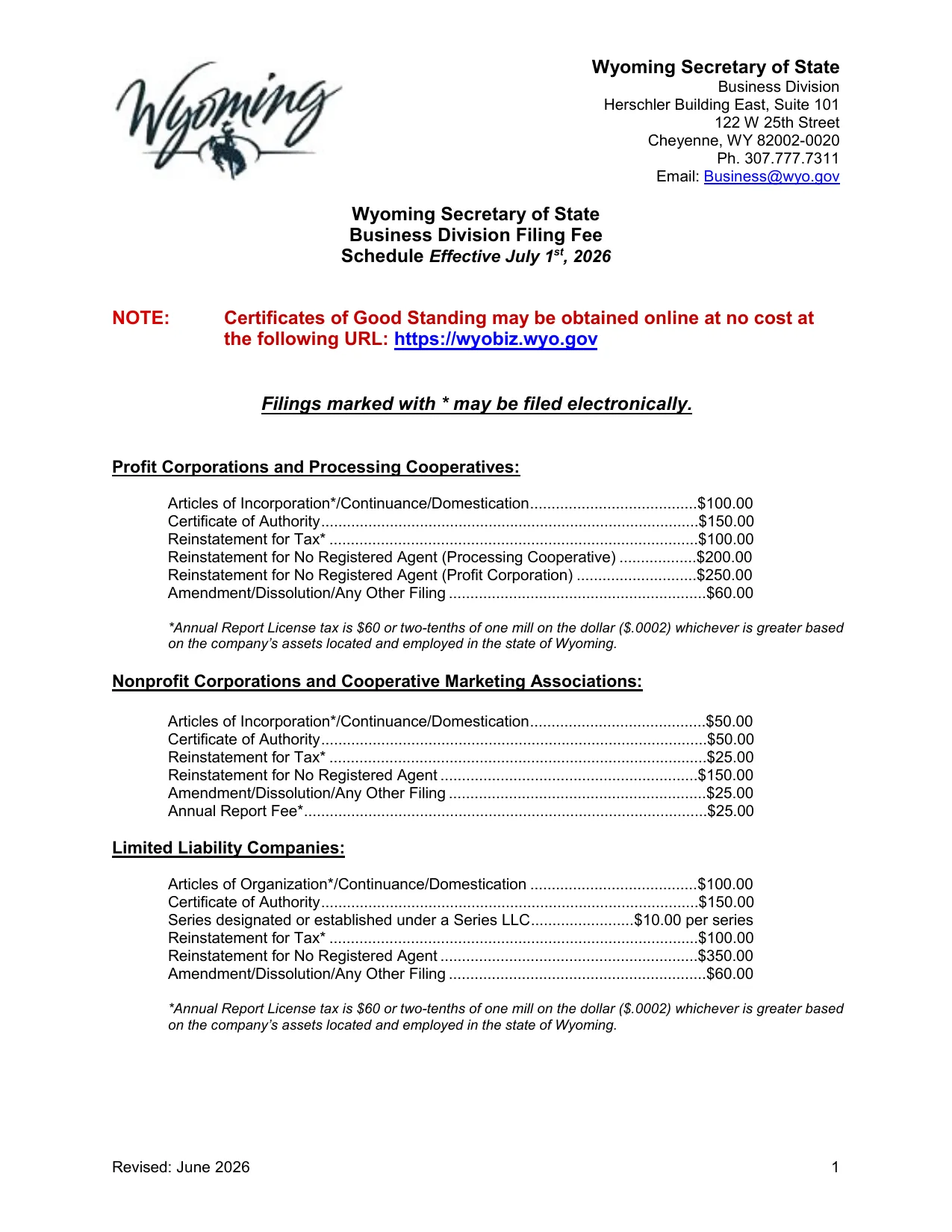
The $100 is the reinstatement-for-tax fee on the secretary of state's fee schedule, effective July 1, 2026, which states the LLC figures plainly: reinstatement for tax $100, reinstatement for no registered agent $350, and the annual report license tax $60 or $0.0002 per dollar of Wyoming assets, whichever is greater.
The comparison that matters is the gap years: a defunct LLC that signs contracts or collects revenue while defunct is operating without the entity the state recognizes, and relation-back cures the status only if reinstatement completes inside the two-year window. An LLC that discovers the lapse in year three cannot pay its way back; it forms a new LLC and pays the $100 articles-of-organization fee again.
The same 60-day clock and two-year window apply to the no-agent forfeiture in W.S. 17-29-705(a), at the harsher price: a $250 statutory penalty plus the $350 reinstatement fee, $600 in total, before delinquent license tax. The cheapest filing in American entity maintenance is also the one with the sharpest cliff: a $60 report, missed, becomes a $160 repair in year one, a $220 repair in year two, and a dead entity in year three.
The operator boundary
This playbook is for the operator who holds a Wyoming LLC and wants the filing done right every year. It is not a formation guide, and it is not a tax plan. The annual report does not change the LLC's federal tax classification: an LLC that elected S-Corp treatment still files the same Wyoming report, and a C-Corp files under the corporation statute instead, W.S. 17-16-1630. The license tax is not a payroll tax — no FICA, no withholding — and unlike an ACH payroll debit, the $60 does not leave the account unless the owner files.
Founder & CEO Insight — Enow A. Jovial
The filing checklist
- [x] Step 1: Calendar the date. First day of the month of organization, every year.
- [x] Step 2: Confirm the agent and office. Registered agent active, registered office and principal office addresses current.
- [x] Step 3: Get the Wyoming asset figure. Capital, property, and assets located and employed in Wyoming, as of the end of the last fiscal year, CPA-confirmed.
- [x] Step 4: Compute the tax before opening the portal. Greater of $60 or $0.0002 per dollar. At $300,000 or less, the answer is $60.
- [x] Step 5: File on WyoBiz and pay with the filing. Certify under penalty of perjury, pay the fee, save the confirmation receipt.
- [x] Step 6: Verify good standing. Pull a certificate of good standing after filing; the fee schedule notes they are available online at no cost.
The Wyoming LLC is cheap to keep because the state asks for almost nothing: one number, one address, one signature, once a year. Keep the number honest, the address current, and the date in the calendar, and the entity stays alive for $60 a year. Our Delaware vs Wyoming vs Nevada annual compliance cost playbook prices the same obligation in all three states, and our LLC formation tax guide covers the articles of organization and the $100 formation fee. Run the federal side in the tax estimator: the license tax is a state asset tax, and your income tax is a different bill.