A retrieval-augmented generation stack needs a vector database, and the three most-asked-about names after Qdrant and Pinecone are Weaviate, Milvus, and Chroma. The comparison that matters is not which one is "best" — it is which pricing model fits the workload. Weaviate sells managed clusters with a pay-as-you-go floor. Zilliz Cloud sells managed Milvus by the compute unit. Chroma sells nothing as a license: the open-source database is free, and Chroma Cloud bills per gigabyte written, per tebibyte queried, and per gigabyte stored. Three products, three different bills, and the cheapest one changes with the corpus size and the query volume.
The decision table
| Attribute | Weaviate | Zilliz Cloud (Milvus) | Chroma Cloud | Authority |
|---|---|---|---|---|
| License | Open source, Apache 2.0 | Open source, Apache 2.0 (Milvus) | Open source, Apache 2.0 | Vendor docs |
| Managed free tier | $0: 100,000 objects, 1 GB memory, 10 GB disk | $0: 5 GB storage, 2.5M vCUs/month, 5 collections | $5 in credits for new users | Vendor pricing pages |
| Managed monthly floor | Flex from $45/month | Standard serverless from $0; dedicated from $126/month | No floor: usage-based only | Vendor pricing pages |
| Production tier | Premium, prepaid contract, contact sales | Enterprise dedicated from $197/month | Same usage rates, no tier gate | Vendor pricing pages |
| Uptime SLA | 99.5% Flex; up to 99.95% Premium | 99.95% Enterprise | Not published on the pricing page | Vendor pricing pages |
| Index | HNSW, with compression options | HNSW and IVF, GPU-accelerated options | HNSW, dense and sparse vectors | Vendor docs |
| Self-hosted cost | $0 license; you run the cluster | $0 license; you run Milvus | $0 license; you run Chroma | Vendor docs |
The table's first lesson is that "free" means three different things. Weaviate's free tier caps objects at 100,000 and disk at 10 GB. Zilliz's caps storage at 5 GB and compute at 2.5 million vCUs a month. Chroma's is $5 of usage credits, which buys 2 GiB of writes, or about 15 GiB-months of storage. A pilot with 50,000 documents fits all three free tiers. A pilot with 500,000 documents fits none of them except Zilliz's, if the vectors fit in 5 GB.
Weaviate: the managed cluster with a floor
Weaviate Cloud has three tiers. Free costs $0 forever, with no credit card required: one cluster per user, 100,000 objects, 1 GB of memory, 10 GB of disk, one collection with up to three tenants, embeddings at 2,000 requests a day, and the Query Agent at 1,000 requests a month. Flex starts at $45 a month, pay-as-you-go, with no commitment: a shared cloud cluster with the full core database toolkit and replication, baseline security with RBAC, 99.5 percent uptime, and standard support. Premium is a prepaid contract with a choice of shared or dedicated deployment, up to 99.95 percent uptime, global coverage on AWS, GCP, and Azure, and enterprise support with one-hour Sev 1 response.
The $45 floor is the number to budget, not the number to compare. Weaviate prices Flex through a calculator that takes vector dimensions, object count, object size, and an optimization profile — Cost Optimized with a lower memory footprint, or Performance Optimized with in-memory retrieval, HNSW, and RQ-8 compression. The per-object and per-dimension rates sit behind that calculator, not on the pricing page, so no honest per-million-vector price can be quoted from the published page alone. What can be stated is the floor and the ceiling: $45 a month buys the entry to Flex, and the free tier's 100,000-object cap is the line where a pilot becomes a bill.
Zilliz Cloud: managed Milvus by the compute unit
Zilliz Cloud is the managed Milvus service, and Milvus itself is open source under the Apache 2.0 license. The free tier costs $0: 5 GB of storage, 2.5 million vCUs a month included, up to five collections, and community support. Standard costs from $0 a month on serverless and from $126 a month on dedicated, with a 30-day free trial: fully managed vector databases with core APIs, backup and restore, basic monitoring, and built-in encryption in transit and at rest. Enterprise costs from $197 a month on dedicated, with a 30-day free trial: a 99.95 percent uptime SLA, audit logs, SSO with SAML 2.0, granular RBAC, multi-replica and elastic scaling, private endpoints, and VPC peering. Business Critical is a quoted plan for regulated workloads, with CMEK, HIPAA eligibility, and priority support.
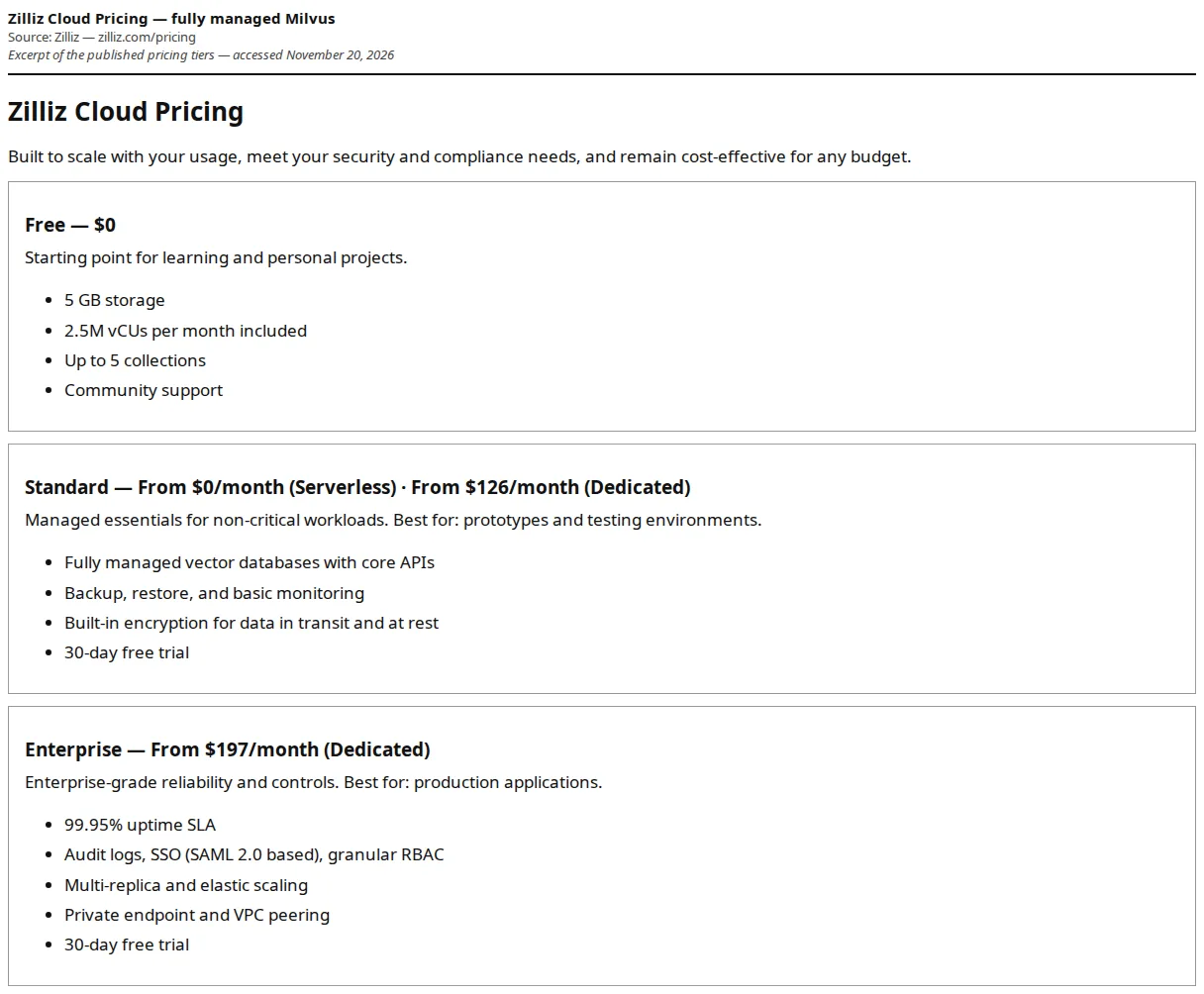
The vCU is the unit that decides the bill, and it is also the unit the pricing page does not price. Zilliz publishes the free-tier allowance — 2.5 million vCUs a month — and the dedicated floors, but the per-vCU metered rate for serverless is not on the pricing page; it is estimated in Zilliz's calculator. That is an honest limitation, not a gap to fill with a guess. What the published numbers do support is the floor comparison. A dedicated Milvus cluster starts at $126 a month on Standard and $197 on Enterprise, against Weaviate's $45 Flex floor and Chroma's $0 floor. The dedicated premium buys the SLA, the audit logs, and the VPC peering — and the buyer who does not need those is paying for them anyway.
Chroma: the open-source database with a usage meter
Chroma is the open-source data infrastructure for AI, with dense and sparse vectors, metadata filtering, full-text search, and retrieval across text and images built in. The database itself costs $0 as a license: run it on your own server, in a container, or embedded in the application. Chroma Cloud is the managed service, and its pricing is the most transparent of the three — every rate is published on the pricing page.
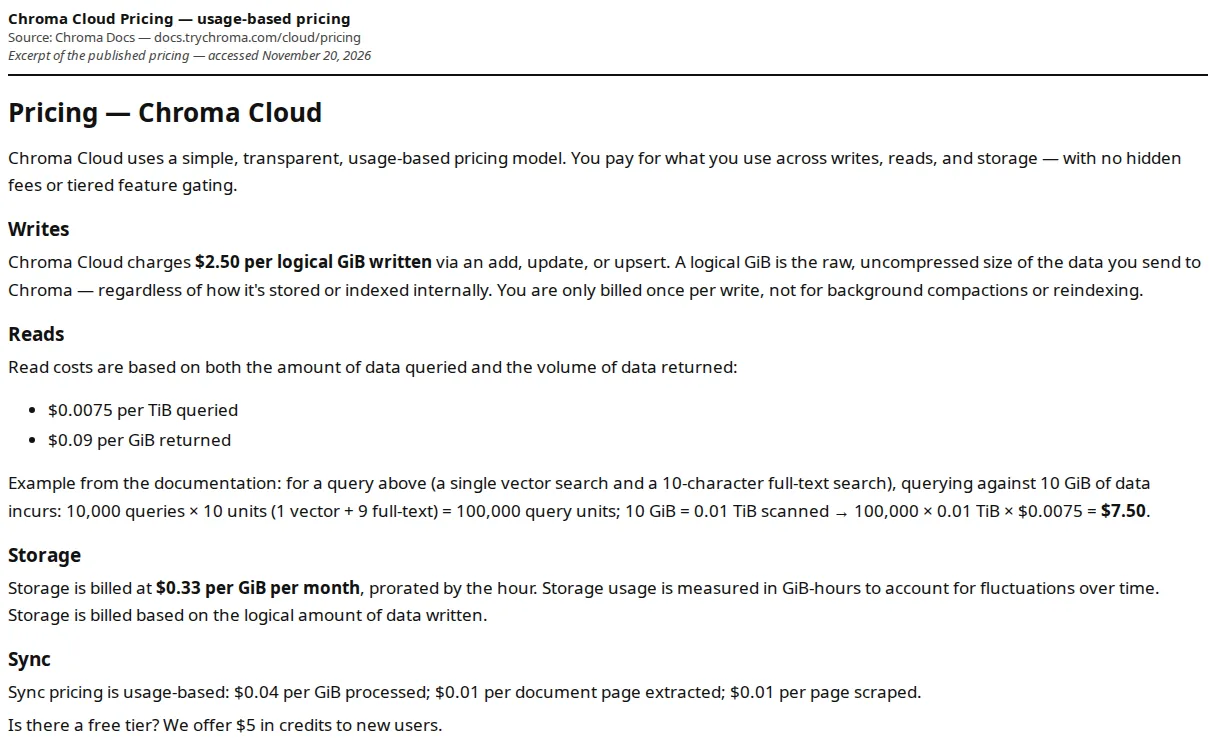
Writes cost $2.50 per logical GiB written through an add, update, or upsert. A logical GiB is the raw, uncompressed size of the data sent to Chroma, regardless of how it is stored or indexed internally, and the charge applies once per write — background compactions and reindexing are not billed. Reads cost $0.0075 per TiB queried plus $0.09 per GiB returned. A single vector similarity query counts as one query, each metadata or full-text predicate counts as an additional query, and full-text and regex filters are billed as the number of characters minus two. Storage costs $0.33 per GiB per month, prorated by the hour and measured in GiB-hours. Forking a collection costs $0.03 per fork request, copy-on-write. Sync costs $0.04 per GiB processed, $0.01 per document page extracted, and $0.01 per page scraped. New users get $5 in credits.
Chroma's own documentation works the example: a single vector search plus a 10-character full-text search, 10,000 queries, against 10 GiB of data — 10,000 queries times 10 units is 100,000 query units, and 10 GiB is 0.01 TiB scanned, so 100,000 times 0.01 TiB times $0.0075 is $7.50. That example is the reproducible core of this comparison.
The reproducible math: one corpus, three bills
Take a 10 GiB corpus with 10,000 queries a month, the volume in Chroma's own example. On Chroma Cloud the first month is writes plus storage plus reads: 10 GiB written once at $2.50 a GiB is $25.00, 10 GiB stored at $0.33 a GiB a month is $3.30, and the documented read cost is $7.50.
In a steady month with no new writes, the bill is storage plus reads only:
The same corpus on Zilliz Cloud exceeds the free tier's 5 GB storage, so it lands on Standard serverless, which starts at $0 a month and bills by vCU — and the per-vCU rate is not published, so the serverless bill must be estimated in Zilliz's calculator. The dedicated floor is published: $126 a month on Standard, $197 on Enterprise. On Weaviate the same corpus fits the free tier only if it holds fewer than 100,000 objects; above that it lands on Flex, which starts at $45 a month.
The floor comparison is the decision. Chroma has no monthly floor: a quiet month costs $10.80 on the example volume, and a month with no queries costs $3.30. Weaviate's floor is $45 whether the month is quiet or busy. Zilliz's dedicated floor is $126. The trade is not price against price — it is a floor against a meter. A workload with spiky, unpredictable queries is cheapest on the meter; a workload with steady, high-volume queries is cheapest on the floor.
The ceilings that decide the tier
Each vendor's free tier has a ceiling that ends the pilot. Weaviate's is the object count: 100,000 objects, 1 GB of memory, 10 GB of disk, one collection, three tenants. Zilliz's is storage and compute together: 5 GB of storage and 2.5 million vCUs a month, five collections. Chroma's is the $5 credit balance: once it is spent, every write, read, and GiB-month bills at the published rates. Weaviate caps the number of things stored. Zilliz caps the storage and the compute. Chroma caps nothing except the credit balance.
The paid tiers have their own ceilings. Weaviate's Flex is a shared cluster; the step to Premium is a prepaid contract for dedicated deployment and the 99.95 percent uptime tier. Zilliz's Standard serverless has no published ceiling on the pricing page; the step to dedicated is a floor of $126 a month, and the step to Enterprise is $197 for the SLA, audit logs, and VPC peering. Chroma Cloud has no tier gate at all: the same usage rates apply from the first GiB. A team that needs an SLA and audit logs will pay the Zilliz Enterprise floor or the Weaviate Premium contract; a team that needs neither should not pay for either.
Who should not buy each one
Do not buy Weaviate Flex if the corpus is under 100,000 objects and the query volume is low: the free tier covers it, and $45 a month buys nothing the free tier does not already provide. Do not buy Zilliz Standard dedicated if the workload is a prototype: serverless starts at $0, and the $126 floor is a production commitment, not a trial. Do not buy Chroma Cloud if the workload writes the same data repeatedly: $2.50 per logical GiB is charged on every add, update, and upsert, because a pipeline that re-indexes the whole corpus daily pays the write charge daily. Do not self-host any of the three to save the managed bill unless someone on the team owns the cluster: the license is $0, but the pager is not.
The 30-day selection sequence
- Count the corpus in objects, GiB, and dimensions. Record the document count, the raw GiB, and the embedding dimension.
- Measure the query volume. Record queries a month, predicates per query, and GiB returned.
- Run the three calculators. Price the corpus on Weaviate's calculator and Zilliz's calculator with the same dimensions and volume; compute Chroma's bill by hand from the example above.
- Pilot on the free tier. Load the real corpus, or a 10 percent sample, on each finalist's free tier and time the first hundred queries.
- Price the second year. Confirm the renewal floor, the SLA tier, and the cost of growing past the free-tier caps.
- Sign only after the exit is priced. Confirm the export path for vectors and metadata on each finalist, and the cost of moving the corpus out.
- [x] Corpus counted: objects, GiB, and embedding dimensions recorded.
- [x] Query volume measured: queries a month, predicates, and GiB returned.
- [x] Three calculators run: Weaviate and Zilliz priced on the same dimensions; Chroma computed by hand.
- [x] Free-tier pilot built: real corpus or a 10 percent sample loaded, first hundred queries timed.
- [x] Second year priced: renewal floor, SLA tier, and free-tier cap growth costed.
- [x] Exit priced: vector and metadata export path confirmed on each finalist.
Founder & CEO Insight — Enow A. Jovial
Related reading on this site: our Qdrant vs Pinecone vs pgvector guide for the other three vector databases in this series, and our self-hosting LLMs and vector databases guide for the cost of running the open-source versions yourself. Before signing, run the monthly totals through the break-even calculator at the corpus size and query volume the team will reach in year two.