The three base prices
Three vendors, three different answers to what a backend costs. Supabase Pro starts at 25 dollars a month. Firebase Blaze has no monthly fee at all — pay as you go, with Spark's no-cost quotas included. Appwrite Pro starts at 25 dollars a month. Two vendors at 25 dollars and one at zero, and the zero-dollar vendor is not the cheapest once the meters run. The meter is the whole comparison: Supabase meters users, disk, egress, storage, functions, realtime, and connections; Firebase meters each product separately; Appwrite meters almost nothing here — Pro includes 200,000 users, 2 TB of bandwidth, 150 GB of storage, and 3.5 million executions.
Every total below is worked from the vendors own pricing pages, read November 21, 2026, at one fixed set of volumes: 120,000 monthly active users, a 10 GB database, 300 GB of egress, 120 GB of file storage, 3 million function invocations, and 6 million realtime messages a month.
The three rate cards
Supabase sells four plans. Free ($0): 50,000 MAU, 500 MB database, 5 GB egress, 1 GB file storage, 500K Edge Function invocations, 2M realtime messages, 200 connections, 2 projects. Pro (from $25/mo): 100,000 MAU, then $0.00325 each; 8 GB disk, then $0.125/GB; 250 GB egress, then $0.09/GB; 100 GB file storage, then $0.0213/GB; 2M Edge Function invocations, then $2 per million; 5M realtime messages, then $2.50 per million. Point-in-time recovery is $100/mo per 7 days of retention; the spend cap is on by default. Team (from $599/mo) adds SOC2 and ISO 27001, single sign-on, and SLAs. Enterprise is custom. Compute is separate: every project runs its own Postgres instance, from Micro at $10/mo to 16XL at $3,730/mo. Paid plans include $10/mo in compute credits and the first Micro is free.
Firebase sells two plans and a long list of per-product meters. Spark is the no-cost plan. Blaze is pay as you go with no subscription fee. Auth is no-cost up to 50,000 MAU, then Google Cloud pricing. Firestore Standard is no-cost up to 1 GiB stored, 10 GiB of egress a month, 20K writes a day, 50K reads a day, and 20K deletes a day, then Google Cloud pricing. Cloud Functions are no-cost up to 2M invocations a month, then $0.40 per million. Cloud Storage on legacy buckets is no-cost up to 5 GB stored, then $0.026/GB, and no-cost up to 1 GB a day downloaded, then $0.12/GB. Hosting is no-cost up to 10 GB stored, then $0.026/GB, and no-cost up to 360 MB a day of transfer, then $0.15/GB. Realtime Database is no-cost up to 1 GB stored, then $5/GB, and no-cost up to about 10 GB a month downloaded, then $1/GB; connections run 100 on Spark and 200,000 on Blaze. SQL Connect gives 250,000 operations a month no-cost, then $0.90 per million, with Cloud SQL for PostgreSQL from $9.37/mo.
Appwrite sells three plans and a separate database menu. Free ($0): 1 database, 1 bucket, and 2 functions per project, 1 member, 5 GB of bandwidth, 2 GB of storage, 750K executions, and 75,000 MAU, across 2 projects that pause after one week idle. Pro (from $25/mo): unlimited databases, buckets, and functions, daily backups, no pausing, unlimited members, 2 TB of bandwidth, 150 GB of storage, 3.5M executions, and 200,000 MAU. Enterprise is custom and adds uptime SLAs and SOC-2, HIPAA, and BAA coverage. A Start plan at $10/mo exists for a listed set of countries, with 10 databases, buckets, and functions, 3 members, 80 GB of bandwidth, 40 GB of storage, and 100,000 MAU. Serverless databases carry no fixed fee: reads and writes run against the plan quota. Dedicated databases are priced per database, from Starter at $10/mo (1 core, 1 GB) to Scale Max at $4,099/mo (32 cores, 256 GB). A high-availability replica costs the full tier price again, point-in-time recovery adds 20 percent, and every plan includes $10/mo of compute credits, which covers one Starter database outright.
The modeling rules
Every price is in United States dollars before tax. The scenario is fixed: 120,000 MAU, a 10 GB database, 300 GB of egress, 120 GB of file storage, 3M function invocations a month, and 6M realtime messages a month. Firebase holds 10 GB in Realtime Database and downloads 20 GB, Cloud Storage on a legacy bucket holds 120 GB and downloads 300 GB, and Firestore and Hosting sit at their ceilings. Supabase compute is one Micro instance and Appwrite runs one Starter database, each covered by its $10 monthly credit.
Two gaps are carried through every total. Firebase Auth and Firestore overage have no printed rate on the Firebase pricing page, so they are excluded from its total and flagged wherever it appears. Appwrite serverless read and write overage rates are not printed either, so no Appwrite overage math appears here. A total that hides its exclusions is worse than no total. All figures were read from the vendors own pricing pages on November 21, 2026; confirm them on the day you buy.
Supabase Pro: 99.68 dollars a month
At the scenario volumes, Supabase Pro bills 99.68 dollars a month. The plan fee is the smallest line: the user overage is 65 dollars, two and a half times the subscription itself.
The rest is small: egress $4.50, Edge Functions $2.00, Realtime $2.50, disk $0.25, and file storage $0.43. Compute is one Micro instance at $10, covered exactly by the $10 monthly credit — an annual total of $1,196.16. Users are 65 percent of the invoice. The overage equals the plan fee at 7,692 users past the included 100,000 — at 107,692 MAU, the overage alone costs $25.
Firebase Blaze: 90.79 dollars on printed rates
Firebase Blaze has no subscription fee, so the whole bill is metered lines. At the scenario volumes, the lines with printed rates total 90.79 dollars a month — incomplete by construction, because the two meters a growing app hits first, Auth and Firestore, have no printed rate on the pricing page.
Realtime Database storage is half the priced total at $45.00, with downloads adding $10.00. Cloud Storage downloads add $32.40 and stored gigabytes $2.99, while Cloud Functions add $0.40 — an annual total of $1,089.48 for the priced lines.
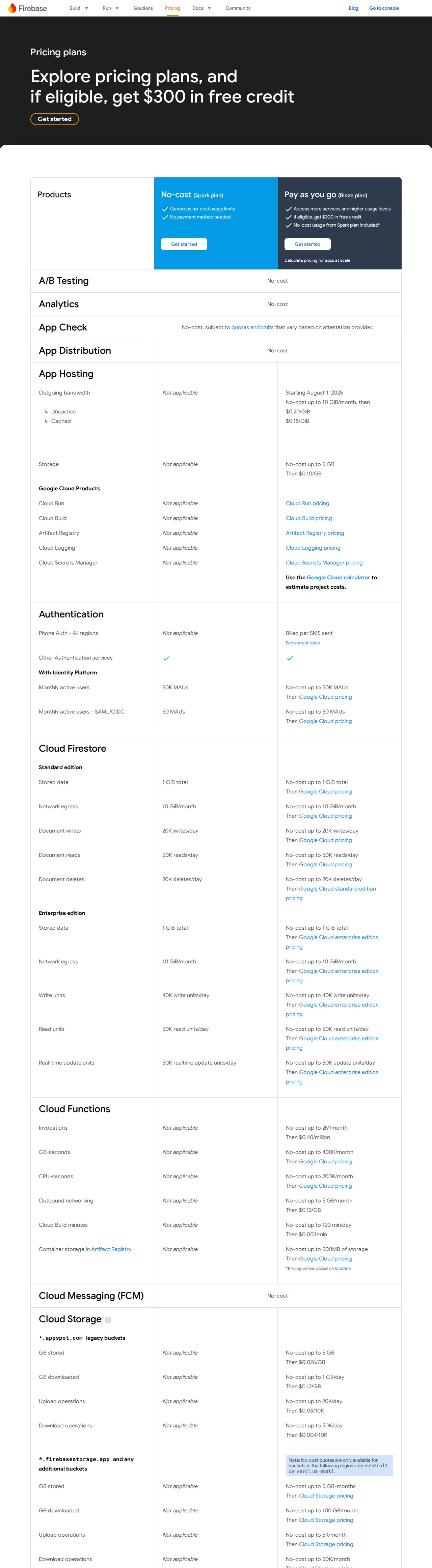
Realtime Database storage at $5 per GB is the highest per-gigabyte rate of the three vendors, nearly forty times Supabase's $0.125 — while Cloud Functions at $0.40 per million are one-fifth of Supabase's $2.
Appwrite Pro: 25 dollars flat
At the scenario volumes, Appwrite Pro bills 25 dollars a month — the plan fee, and nothing else. Every meter sits inside the Pro plan's included quotas.
Bandwidth is 300 GB against 2 TB, storage is 120 GB against 150 GB, executions are 3 million against 3.5 million, and users are 120,000 against 200,000. One Starter dedicated database at $10 a month is covered exactly by the $10 monthly compute credit. The annual total is $300 — $896.16 a year below Supabase Pro, and $789.48 below Firebase's priced lines.
The flat $25 holds until a quota breaks. Executions break first: 500,000 more a month reaches the 3.5 million ceiling, and the price of the next execution is not printed on the pricing page.
The annual totals
Annualised, Supabase Pro is $1,196.16 a year, Firebase Blaze's priced lines are $1,089.48 a year before Auth and Firestore overage, and Appwrite Pro is $300 a year. Supabase runs $106.68 a year above Firebase's priced lines — a gap that reverses once Auth overage is priced in, since Firebase's Auth line starts charging at 50,000 users and Supabase's at 100,000.
The ranking is a property of the volumes. Cut the user count to 60,000 and Supabase falls to $34.68 a month; raise it to 200,000 and Supabase adds another $260 a month in MAU overage, while Appwrite stays flat at $25 until its 200,000-user ceiling.
The decision table
No vendor is cheapest in general: the pick depends on which meter the product feeds and whether the team needs Postgres, Google's stack, or a flat bill. Our Neon vs PlanetScale vs Turso serverless database pricing playbook prices the serverless Postgres layer underneath a Supabase-style stack, and our Cloudflare Workers D1 and Hyperdrive edge SQL latency benchmark measures the edge alternative.
| Situation | Pick | Authority |
|---|---|---|
| 120K MAU, 10 GB DB, 300 GB egress | Appwrite Pro, $25/mo flat | Appwrite pricing page, Nov 21 2026 |
| Postgres-first, branching, PITR | Supabase Pro, $99.68/mo here | supabase.com/pricing |
| Google Cloud native, Firestore scale | Firebase Blaze, price Auth + Firestore separately | firebase.google.com/pricing |
| Need SSO, SOC2, 14-day backups | Supabase Team, $599/mo | supabase.com/pricing |
| Dedicated Postgres/MySQL with HA | Appwrite dedicated, Starter $10/mo | Appwrite pricing page |
| Over 200K MAU | Re-price all three; Appwrite Pro caps at 200K | Vendor pricing pages |
Who should not pick each vendor
Do not pick Supabase Pro if user growth is the business model. Every 1,000 users past 100,000 costs $3.25 a month, forever — at 200,000 MAU the overage alone is $325 a month, thirteen times the plan fee.
Do not pick Firebase Blaze if the finance team needs one predictable number. The bill is a sum of per-product meters, two of which — Auth and Firestore — have no printed rate on the pricing page. Blaze fits a team already on Google Cloud; it is a poor fit for a founder who wants the monthly number in advance.
Do not pick Appwrite Pro if the workload needs per-operation pricing certainty. Serverless read and write overage rates are not printed on the pricing page, and neither are the Pro plan's read and write quotas. The flat $25 is real at these volumes, but the price past the quota is a number the buyer must obtain before committing a production workload.
Do not run production on any free tier. Supabase pauses projects after one week of inactivity, Appwrite freezes projects that pass their limits until the next billing cycle, and Firebase Spark caps Realtime Database at 100 simultaneous connections.
What the fee actually buys
Each vendor is a hosted backend: database, authentication, file storage, serverless functions, and realtime updates behind an SDK. The difference is what leaves with the customer. Supabase is Postgres, so the database exports with standard tooling. Firebase is Firestore and Google services, so the document model, the security rules, and the auth users are the lock-in — an export exists, but the query model does not transfer. Appwrite is open source, so the same stack runs self-hosted and the exit is operational rather than proprietary.
That portability difference is worth more than any single month's bill. A team that outgrows Supabase keeps its Postgres; a team that outgrows Firebase rewrites its data layer; a team that outgrows Appwrite Cloud keeps the software and moves the servers. For the vector layer beside these backends, see our Qdrant vs Pinecone vs pgvector architecture comparison.
Run the decision
Work the decision in order, with your own numbers, before entering card details.
- [x] Count monthly active users, not registered users
- [x] Split the database, storage, functions, and realtime volumes; price each meter separately
- Count monthly active users from the last 90 days — the maximum month, not the average.
- Price Supabase Pro: $25, plus $0.00325 per user past 100,000, plus $0.125 per GB of disk past 8 GB, plus $0.09 per GB of egress past 250 GB.
- Price Firebase Blaze: zero base, plus the printed lines — functions at $0.40 per million past 2 million, Realtime Database storage at $5 per GB past 1 GB, downloads at $1 per GB past 10 GB — then open the linked Google Cloud pages and price Auth past 50,000 users and Firestore past its ceilings.
- Price Appwrite Pro: $25 flat while every meter sits inside the plan quotas, plus $10 per dedicated database past the one the compute credit covers.
- Open the vendor pricing page and confirm the figures on the day you buy. Firebase prints two of its biggest rates on linked pages; Appwrite prints its overage rates in a comparison table.
Founder & CEO Insight — Enow A. Jovial
At the scenario volumes, Appwrite Pro is 25 dollars a month flat, Firebase Blaze prices 90.79 dollars on printed rates before Auth and Firestore overage, and Supabase Pro is 99.68 dollars with the user meter doing the damage. The expensive mistake is buying on the base price — a per-user meter on a growing product, a 5-dollar-per-GB storage line on a realtime design, or a free tier that pauses the week the launch lands. Confirm the total through our pricing calculator with your own volumes.