Sole Proprietor vs LLC vs S Corp: The Entity Choice Playbook
Three founders each earn $100,000 of profit. One is a sole proprietor, one runs an LLC, one runs an S corporation. Their income tax bills are close. Their self-employment tax bills are not: the sole proprietor pays $14,129.55, the S corporation owner pays $9,180 on a $60,000 salary, and the LLC owner pays whichever of those two applies to how the LLC is taxed. The entity is a tax bill, a liability shield, and a pile of annual paperwork — and the right answer changes as the profit grows.
The three structures in one table
| Feature | Sole proprietor | LLC (default tax) | S corporation |
|---|---|---|---|
| Formed by | Nothing — start working | State filing | State filing plus Form 2553 election |
| Liability shield | None — owner and business are one person | Yes, if the veil holds | Yes, if the veil holds |
| Taxed as | Owner's return, Schedule C | Disregarded entity (single member) or partnership | Corporation with pass-through election (max 100 shareholders) |
| SE tax on profit | 15.3% on 92.35% of profit | Same as sole proprietor | Only on the salary, not on distributions |
| 199A QBI deduction | Yes, on business income | Yes, on business income | Yes, but salary is not QBI |
| Annual state cost | $0 filing | Varies — Delaware $300/yr, California $800/yr | Varies, plus payroll and a separate return |
| Authority | IRC 1401, 1402; Schedule SE | State LLC act; IRC 1361 for the S election | IRC 1361, 1362; Form 2553 |
An LLC is not a tax status. It is a state-law shell, and the tax code taxes it as something else: a single-member LLC is disregarded and taxed exactly like a sole proprietorship, and a multi-member LLC as a partnership, unless the owners elect otherwise. The S corporation is the election, not the shell — a corporation or an LLC can make it by filing Form 2553. That is why the comparison has three columns but only two tax regimes: pay self-employment tax on everything, or pay payroll tax on a salary and take the rest as a distribution.
The sole proprietor's bill: 15.3 percent on $100,000
Self-employment tax has two pieces. Section 1401 charges 12.4 percent for Social Security and 2.9 percent for Medicare, a combined 15.3 percent, on net earnings from self-employment. Section 1401(b)(2) adds a further 0.9 percent Medicare tax on self-employment income over $200,000 for a single filer and $250,000 for a joint return. Schedule SE does the arithmetic in four lines: multiply net profit by 92.35 percent, multiply the result by 12.4 percent for Social Security and 2.9 percent for Medicare, and take half of the total as a deduction from income.
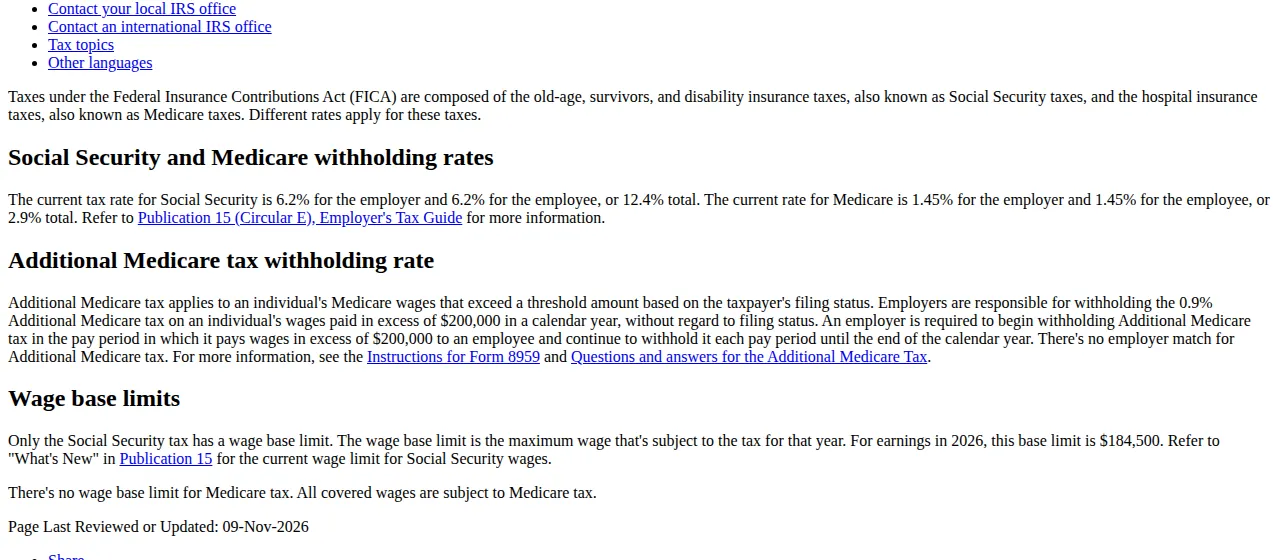
Take a single filer with $100,000 of profit in 2026. Net earnings are $100,000 times 92.35 percent, which is $92,350. The Social Security piece is $92,350 times 12.4 percent, which is $11,451.40 — under the 2026 wage base of $184,500, so the full amount is taxed. The Medicare piece is $92,350 times 2.9 percent, which is $2,678.15. The additional 0.9 percent does not apply, because $92,350 is below the $200,000 threshold. The total is $14,129.55, and half of it — $7,064.78 — is deductible from income.
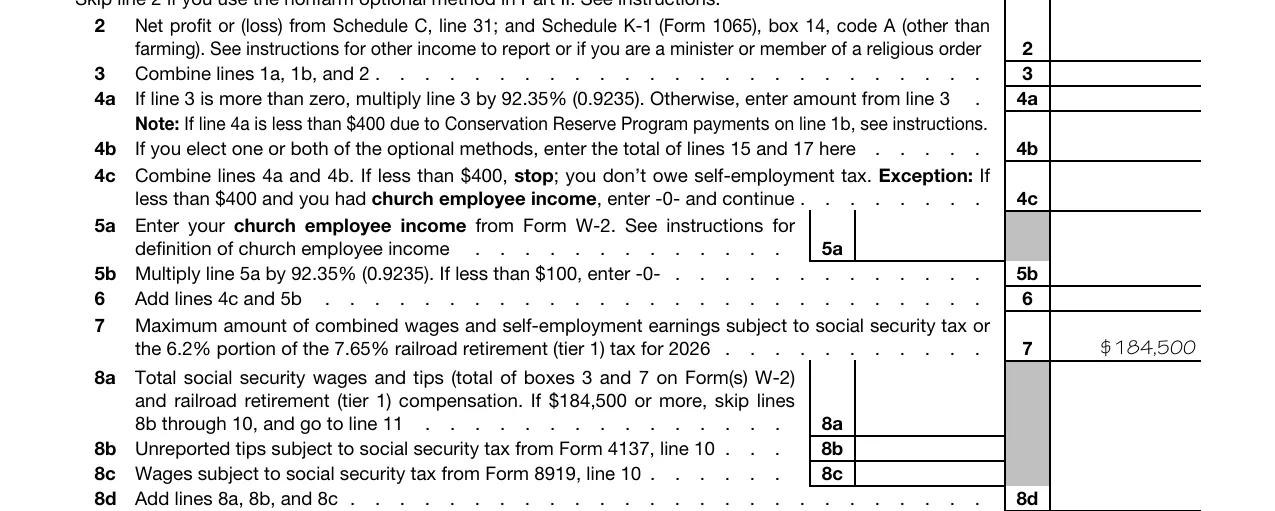
That $14,129.55 sits on top of income tax. It is the price of the default structure, and the number every other structure is measured against. At $250,000 of profit the bill changes shape: net earnings are $230,875, the Social Security piece caps at the $184,500 wage base for $22,878.00, Medicare is $6,695.38, and the additional 0.9 percent applies to the $30,875 above $200,000 for $277.88 — a total of $29,851.26. The wage base cap is the first reason the S corporation's advantage shrinks at high profit: the sole proprietor stops paying the 12.4 percent piece once earnings pass $184,500, while the S corporation owner still pays payroll tax on the salary.
The S corporation play: salary vs distribution
The S corporation owner is an employee of their own company. The company pays a salary, withholds payroll tax, and the owner takes the remaining profit as a distribution. Distributions are not wages. They carry no payroll tax and no self-employment tax. The saving is the gap between the 15.3 percent on the whole profit and the 15.3 percent on the salary alone — and the IRS knows it, which is why the salary has to be reasonable.
Run the same $100,000 through an S corporation with a $60,000 salary — an illustrative figure a tax adviser would test against market pay for the work. Payroll tax on the salary is $60,000 times 15.3 percent, which is $9,180: $4,590 from the employee and $4,590 from the employer. The distribution is the $100,000 profit minus the $60,000 salary and the $4,590 employer payroll tax, which leaves $35,410. The self-employment tax saving against the sole proprietor is $14,129.55 minus $9,180, which is $4,949.55.
But the S corporation gives some of that back through section 199A. The qualified business income deduction is up to 20 percent of qualified business income, and wages are not qualified business income. The sole proprietor's QBI is the $100,000 profit minus the $7,064.78 deductible half of self-employment tax, which is $92,935.22, for a 20 percent deduction of $18,587.04. The S corporation's QBI is the $35,410 distribution, for a deduction of $7,082. The S corporation loses $11,505.04 of deduction, which at an assumed 22 percent marginal rate costs $2,531.11 of extra income tax. The net advantage before the S corporation's running costs is $4,949.55 minus $2,531.11, which is $2,418.44.
Then the running costs arrive: payroll service, a separate corporate tax return, unemployment insurance, and the state fees. At $100,000 of profit the $2,418.44 advantage is real but thin — one year of payroll service and extra preparation can take half of it. The S corporation pays at higher profit, where the distribution dwarfs the salary and the fixed running costs stop mattering. Our S corp election threshold guide works the same comparison across profit levels, and the Form 8832 election guide covers the classification election that sits underneath it.
Section 199A: the deduction that changes the answer
Section 199A lets an eligible owner deduct up to 20 percent of qualified business income. For 2026, the thresholds in Revenue Procedure 2025-32 are $403,500 of taxable income for a joint return and $201,750 for all other returns, with the phase-in range running to $553,500 and $276,750. Below the threshold, the full 20 percent applies and the wage and property limits do not bite. Above it, the deduction phases down, and for specified service businesses — health, law, accounting, consulting, financial services, and the other listed trades — it phases out entirely.
Two 199A details matter for entity choice. First, the S corporation's salary shrinks QBI, as the math above shows: every dollar of salary is a dollar that is not QBI, so the 20 percent deduction falls by 20 cents per salary dollar. Second, the 2026 law adds a minimum deduction — $400 for most returns and $1,000 for joint returns — for tax years after December 31, 2025, under the One Big Beautiful Bill Act's amendment to section 199A(i). The minimum is small, but a low-profit owner with little QBI still gets something. Check your threshold position in the tax estimator before assuming the full 20 percent applies.
Liability: the shield and how it breaks
The sole proprietor has no shield. The owner and the business are the same legal person, so a business debt, a contract claim, or a lawsuit reaches the owner's house, car, and bank accounts. The LLC and the corporation both create a separate legal person, and the shield holds — until the owner breaks it. Veil piercing is the court's decision to ignore the entity, and the facts that invite it are the same in every state: commingled funds, no separate bank account, no operating agreement or minutes, undercapitalization, and a business account used as a personal wallet.
The shield is a habit, not a filing. Open the separate account the week the entity is formed. Sign contracts in the entity's name, keep minutes for the big decisions even if the state does not require them, and fund the entity with enough capital to meet its foreseeable obligations. An LLC that has never held a meeting, never kept a record, and pays the owner's mortgage from the business account is a sole proprietorship with a filing fee attached. The Delaware LLC guide covers the formation side of that habit in detail.
Formation and annual costs: the price of the shield
| Cost | Sole proprietor | LLC | S corporation |
|---|---|---|---|
| Formation filing | $0 — no filing exists | State fee (Delaware $90) | State fee plus Form 2553 election, $0 IRS fee |
| Annual state cost | $0 | Delaware $300/yr due June 1; California $800/yr | State fee plus payroll and separate return |
| Payroll | None | None (default tax) | Required once a salary is paid |
| Tax returns | Schedule C on the owner's return | Same as sole proprietor (single member) | Form 1120-S plus the owner's K-1 |
| Authority | IRC 1401, 1402 | State LLC act; CA FTB for the $800 | IRC 1361; Form 2553 |
Delaware charges a $90 filing fee for a Certificate of Formation and a $300 annual franchise tax due every June 1, with a $200 late penalty. California charges an $800 annual tax on every LLC, due even if the business is not conducting business, until the LLC is cancelled. The Delaware figures are corroborated by multiple 2026 secondary reads; the Division of Corporations fees page was opened this cycle but renders its amounts through scripts that did not return them. The California $800 figure is verbatim from the Franchise Tax Board. Add a registered agent — typically $50 to $300 a year — and the real annual cost is the state fee plus the agent, every year, whether the business earns or not.
Conversion paths: changing your mind is allowed
Entities are not permanent. A sole proprietor forms an LLC by filing with the state — the tax treatment does not change, because a single-member LLC is disregarded by default. An LLC elects corporate tax treatment with Form 8832, and elects S corporation status with Form 2553. A corporation elects S status the same way. The deadlines matter: Form 2553 must be filed no more than 2 months and 15 days after the beginning of the tax year the election is to take effect, and it must be signed by all shareholders.
The conversions that cost money are the ones that change the tax regime midstream. Electing S status late in the year still leaves the early months taxed as a sole proprietor. Converting a C corporation to an S corporation can trigger built-in gains tax on appreciated assets. Converting an S corporation back to a C corporation is easy to file and expensive to regret, because the accumulated adjustments account follows the business for years. Make the election in January, with the year's profit forecast in hand, not in December when the profit is already a fact.
Founder & CEO Insight — Enow A. Jovial
The decision rule
Use this order. First, if the business has real liability exposure — customers on your premises, employees, contracts with real money — form the LLC and take the shield. Second, if the profit after a defensible salary is large enough that the 15.3 percent saving beats the running costs and the lost 199A deduction, make the S election. At $100,000 of profit with a $60,000 salary, the net advantage before running costs is $2,418.44 — real, but thin enough that the running costs decide it. Third, if the profit is small, the work is solo, and the liability is low, stay a sole proprietor. Revisit the choice every January, when the profit forecast is fresh and the Form 2553 deadline is still ahead of you.