Form 2553 is a one-page election with a two-month fuse. File it on time and your corporation is taxed as an S corporation — income, deductions, and credits pass through to the shareholders' returns, and the corporation itself generally pays no federal income tax. File it late, without every shareholder's consent, or for a corporation that fails one of the eight eligibility tests, and the election is not merely delayed: under 26 U.S.C. § 1362(b)(3) an election made after the 15th day of the third month of the tax year is treated as made for the following tax year — a full year of C-corporation double taxation.
The election is made under § 1362(a), and § 1362(a)(2) makes consent absolute: every shareholder on the day it is made must consent, in Part I, column K.
Who may elect: the eight tests
The Instructions for Form 2553 list eight tests, and the corporation must meet all of them:
| Test | Rule | Authority |
|---|---|---|
| Domestic | A domestic corporation, or a domestic entity eligible to elect corporate treatment, that timely files Form 2553 | § 1361(a); Form 2553 instructions |
| Shareholder count | No more than 100 shareholders; a spouse and their estates count as one, and all members of a family (as defined in § 1361(c)(1)(B)) count as one | § 1361(b)(1)(A), (c)(1) |
| Shareholder identity | Only individuals, estates, § 401(a) or § 501(c)(3) exempt organizations, and certain trusts under § 1361(c)(2)(A) | § 1361(b)(1)(B) |
| No nonresident aliens | No nonresident alien shareholders (other than as potential current beneficiaries of an ESBT) | § 1361(b)(1)(B) |
| One class of stock | Only one class of stock, disregarding differences in voting rights; all shares must confer identical rights to distribution and liquidation proceeds | § 1361(b)(1)(D); Treas. Reg. § 1.1361-1(l) |
| Not ineligible | Not a bank or thrift using the reserve method under § 585, not an insurance company taxed under subchapter L, not a DISC or former DISC | § 1361(b)(2) |
| Tax year | Calendar year, natural business year, ownership tax year, a § 444 year, a 52-53-week year, or another year with an established business purpose | § 1378; Form 2553 instructions |
| Consent | Each shareholder consents, as explained in the instructions for column K | § 1362(a)(2) |
Three traps kill real elections. The 100-shareholder limit counts a family as one shareholder, but only a family as § 1361(c)(1)(B) defines it — a common ancestor, lineal descendants, and their spouses, within six generations. The one-class-of-stock test disregards voting differences, so voting and non-voting common stock is fine, but any share with a different right to distributions or liquidation proceeds — a preferred return, a liquidation preference, a side-letter distribution right — creates a second class and kills the election. And the shareholder-identity test excludes partnerships, corporations, and most LLCs: an LLC holding S-corporation stock is a disqualified shareholder unless it is a disregarded entity owned by a permitted shareholder.
If you have not yet chosen between an LLC and a C corporation, decide that first in the LLC versus Delaware C-Corp guide. An LLC that wants S-corporation treatment files Form 2553 directly and does not need Form 8832 first, provided the 2553 is timely. A corporation that wants C-corporation treatment instead files Form 8832.
The deadline, computed
Section 1362(b)(1) gives two windows: at any time during the tax year preceding the tax year the election is to take effect, or no more than 2 months and 15 days after the beginning of the tax year the election is to take effect. The IRS instructions work the arithmetic in two examples:
- Example 1 — no prior tax year. A calendar-year corporation begins its first tax year on January 7. The 2-month period ends March 6, and 15 days after that is March 21 — the filing window is January 7 through March 21, and an election made before January 7 is not valid.
- Example 2 — prior tax year. A calendar-year corporation filing Form 1120 as a C corporation wants S status for its next tax year beginning January 1. The 2-month period ends February 28 (29 in leap years), and 15 days after that is March 15; the corporation may file at any time during its last C-corporation year, through March 15.
A corporation with a prior tax year can file at any time during the preceding year. A brand-new corporation has only the 2-month-15-day window and cannot file before its first tax year begins.
For a calendar-year corporation the deadline is March 15.
What the form actually asks
Form 2553 (December 2017 revision) is short, and every line has a job. Part I carries the election: line A the employer identification number, line B the date incorporated, line C the state of incorporation, line D the date the election is to take effect, line E the tax-year start, and the shareholder consent statement in column K. Part II is the fiscal-year election; Part III is the QSST election, made by the trust beneficiary. Line I is the space for the reasonable-cause statement when the election is late.
File it in order:
- Complete Part I with every shareholder's consent in column K.
- Complete Part II only if the corporation wants a fiscal year.
- File the original — no photocopies — or fax it to the IRS service center for the corporation's principal place of business.
- Keep the original and the fax confirmation, and watch for the CP 261 acceptance letter within 60 days; if none arrives, call the IRS, because an election the IRS never received is an election that was never made.
Late elections: Rev. Proc. 2013-30
A missed deadline is not always fatal. Section 1362(b)(5) lets the Secretary treat a late election as timely when there was reasonable cause, and Rev. Proc. 2013-30, 2013-36 I.R.B. 173, is the exclusive simplified method for requesting that relief.
For a late S-corporation election filed by a corporation, the instructions require five things: (1) the corporation intended to be an S corporation as of the effective date on line E; (2) it fails to qualify on that date solely because Form 2553 was not filed by the due date; (3) it has reasonable cause for the failure and acted diligently to correct the mistake once discovered; (4) Form 2553 is filed within 3 years and 75 days of the date on line E; and (5) all shareholders who were shareholders during the period between line E and the filing date state that they reported their income on all affected returns consistent with the S election — completing Part I, column K meets this requirement.
A late election must carry "FILED PURSUANT TO REV. PROC. 2013-30" in the top margin of the first page of Form 2553. If it is attached to Form 1120-S, that form must carry "INCLUDES LATE ELECTION(S) FILED PURSUANT TO REV. PROC. 2013-30" in its top margin. It can be filed with the current 1120-S or separately. The reasonable-cause explanation goes on line I or an attached statement, and it must explain both the cause and the diligent correction — a one-sentence "we forgot" is not reasonable cause.
If the five requirements are not all met, the only route is a private letter ruling with a user fee under Rev. Proc. 2021-1 or its successor. For an LLC, the same 3-year-75-day window applies, with the added showing that it failed to qualify solely because Form 8832 was not timely filed.
Revocation and termination
An S election ends in two ways, and § 1362(d) governs both. Revocation is voluntary: shareholders holding more than one-half of the shares on the day of the revocation must consent, under § 1362(d)(1)(B). The effective date follows the same 15th-day-of-the-third-month logic as the election — a revocation made during the tax year and on or before the 15th day of the third month is effective on the first day of that tax year; a revocation made after that day is effective on the first day of the following tax year.
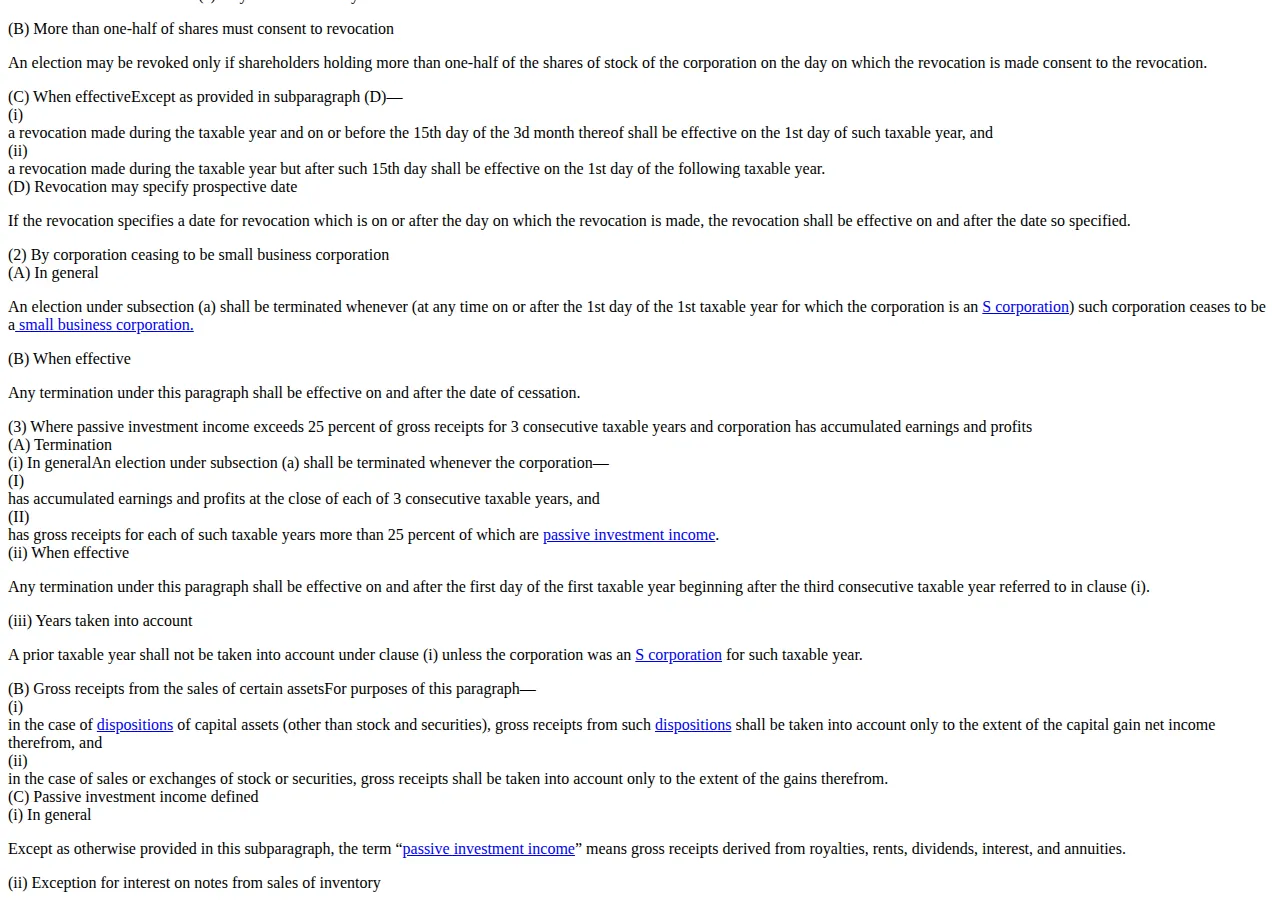
Termination is involuntary, and it happens in three ways under § 1362(d)(2) and (d)(3): the corporation ceases to be a small business corporation (a disqualified shareholder, a second class of stock, or more than 100 shareholders); its passive investment income exceeds 25 percent of gross receipts for three consecutive taxable years while it still holds accumulated earnings and profits from its C-corporation years; or the election is revoked. The passive-income test catches mature S corporations: a company that built up C-corporation earnings, then shifted to rental income, royalties, or portfolio income, can lose its S election on the third consecutive year over 25 percent, effective on the first day of the following tax year.
Founder & CEO Insight — Enow A. Jovial
The five-year bar
Termination has a tail. Under § 1362(g), a corporation whose election has terminated may not make a new S election for any taxable year beginning before the fifth taxable year that begins after the first taxable year for which the termination was effective, unless the Secretary consents.
The QSub and the classification fork
A parent S corporation can elect to treat an eligible wholly owned subsidiary as a qualified subchapter S subsidiary (QSub) on Form 8869. The parent must hold 100 percent of the subsidiary's stock. A QSub is not treated as a separate corporation — its assets, liabilities, and items of income, deduction, and credit are treated as the parent's.
The classification fork is the decision that precedes the form. An LLC that wants S-corporation treatment files Form 2553 and skips Form 8832. A corporation that wants to change its entity classification for other purposes files Form 8832 under the check-the-box regulations in Treas. Reg. § 301.7701-3. The three forms answer three different questions, and filing the wrong one is a common and expensive error — the IRS does not treat a Form 8832 as a Form 2553.
The savings math, and when the election pays
The election pays when the corporation's profit exceeds the reasonable salary the owner-employees must take. S-corporation income that flows through as a distribution is not subject to the 15.3 percent self-employment tax that applies to a sole proprietor's or a disregarded LLC's profit, while the salary portion is subject to payroll taxes:
Work it. A consulting corporation earns $180,000 of net profit. The owner takes a $90,000 reasonable salary and the remaining $90,000 flows through as a distribution. The saving is $90,000 × 15.3% = $13,770, less the added compliance cost of the 1120-S return, payroll processing, and bookkeeping, which a small corporation can reasonably put at $2,500 a year. Net saving: $11,270 a year, every year the election stays in effect. At $60,000 of profit with a $50,000 salary, the saving is $1,530 against the same $2,500 cost — a net loss, and the election does not pay. At $2,500 of compliance cost, the distribution must exceed $16,340 before the election saves a dollar. Run your own numbers through the tax estimator before filing, — and read the S-corp election tax savings threshold for the full threshold analysis.
Execution checklist
- [x] Confirm all eight tests: 100 or fewer shareholders, permitted types only, no nonresident aliens, one class of stock, eligible corporation, permitted tax year.
- [x] Audit the cap table for a second class: any preferred return or differing distribution right voids the election.
- [x] Collect every consent: all shareholders sign Part I, column K, or an attached consent statement, before filing.
- [x] Compute the deadline from the tax-year start: 2 months and 15 days; calendar-year corporations file by March 15; file in the preceding tax year when possible.
- [x] File the original or fax it: keep the original, keep the fax confirmation, and watch for the CP 261 letter within 60 days.
- [x] If late, use Rev. Proc. 2013-30: enter "FILED PURSUANT TO REV. PROC. 2013-30" in the top margin and file within 3 years and 75 days of the line E date.
- [x] Calendar the termination traps: monitor passive investment income against the 25 percent line while the corporation holds C-corporation earnings and profits.
- [x] Price the election first: run the savings formula above; if the distribution does not clear the compliance cost divided by 15.3 percent, do not file.