Three ways to rent a server, three different bills for the same app
Render, Railway, and Fly.io all host the same Node.js API, the same Postgres database, and the same background worker. They do not charge for them the same way. Render sells fixed-size instances by the month: pick a tier, pay the tier price, and the meter stops. Railway sells raw resources by the second: every vCPU-second and gigabyte-second is metered. Fly.io sells preset machines by the hour plus storage and egress by the gigabyte. The same workload costs $44 a month on two of them and $17 on the third — and at production size the ranking flips. Our Cloudflare Workers vs Vercel Edge Functions comparison covers the serverless edge side of this decision; this guide prices the hosted-service side, where the app runs 24 hours a day and the bill is dominated by always-on compute. Our CDN caching architecture guide covers the caching layer that keeps egress off all three bills, and our Vercel vs Netlify vs Cloudflare Pages comparison covers the frontend hosting that sits in front of them.
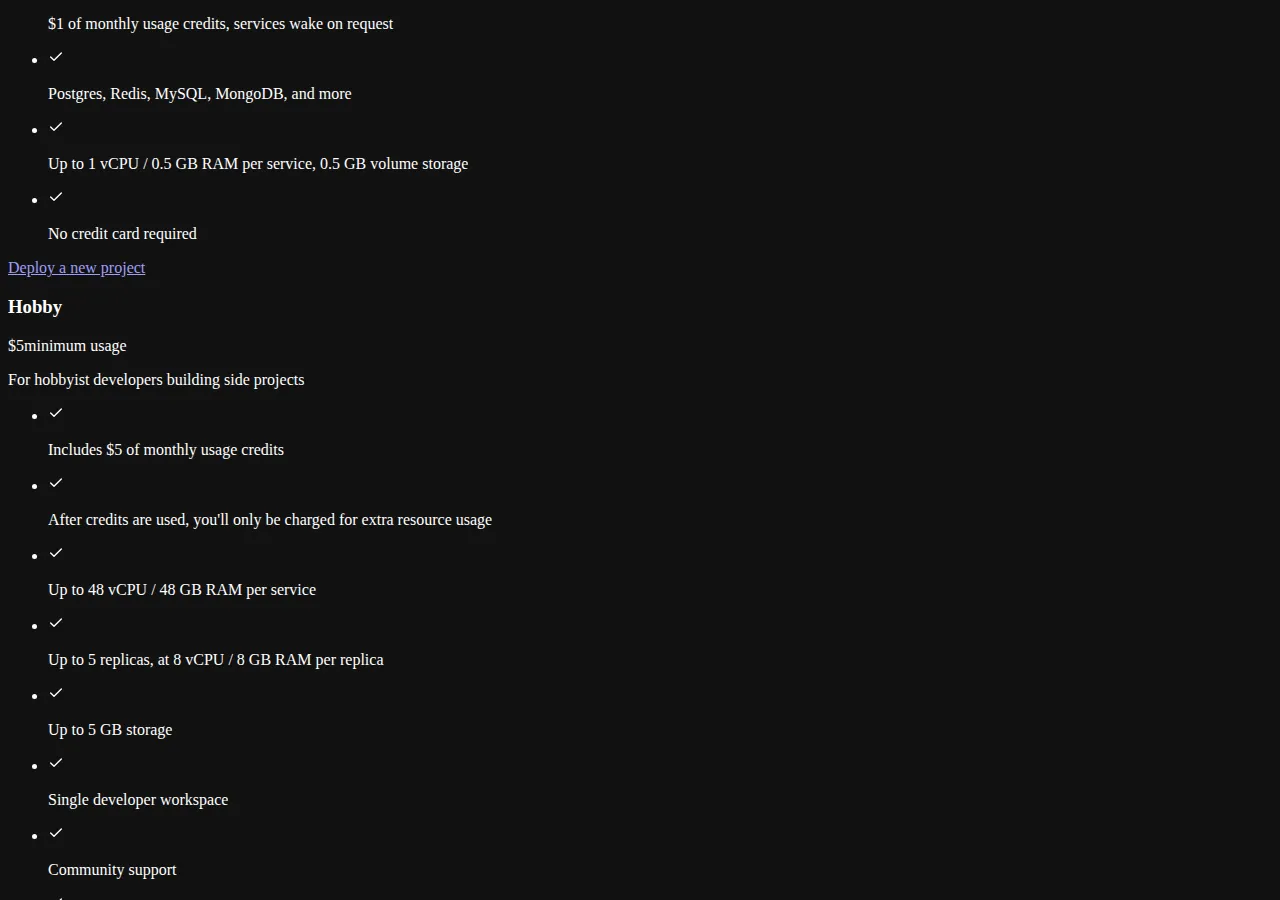
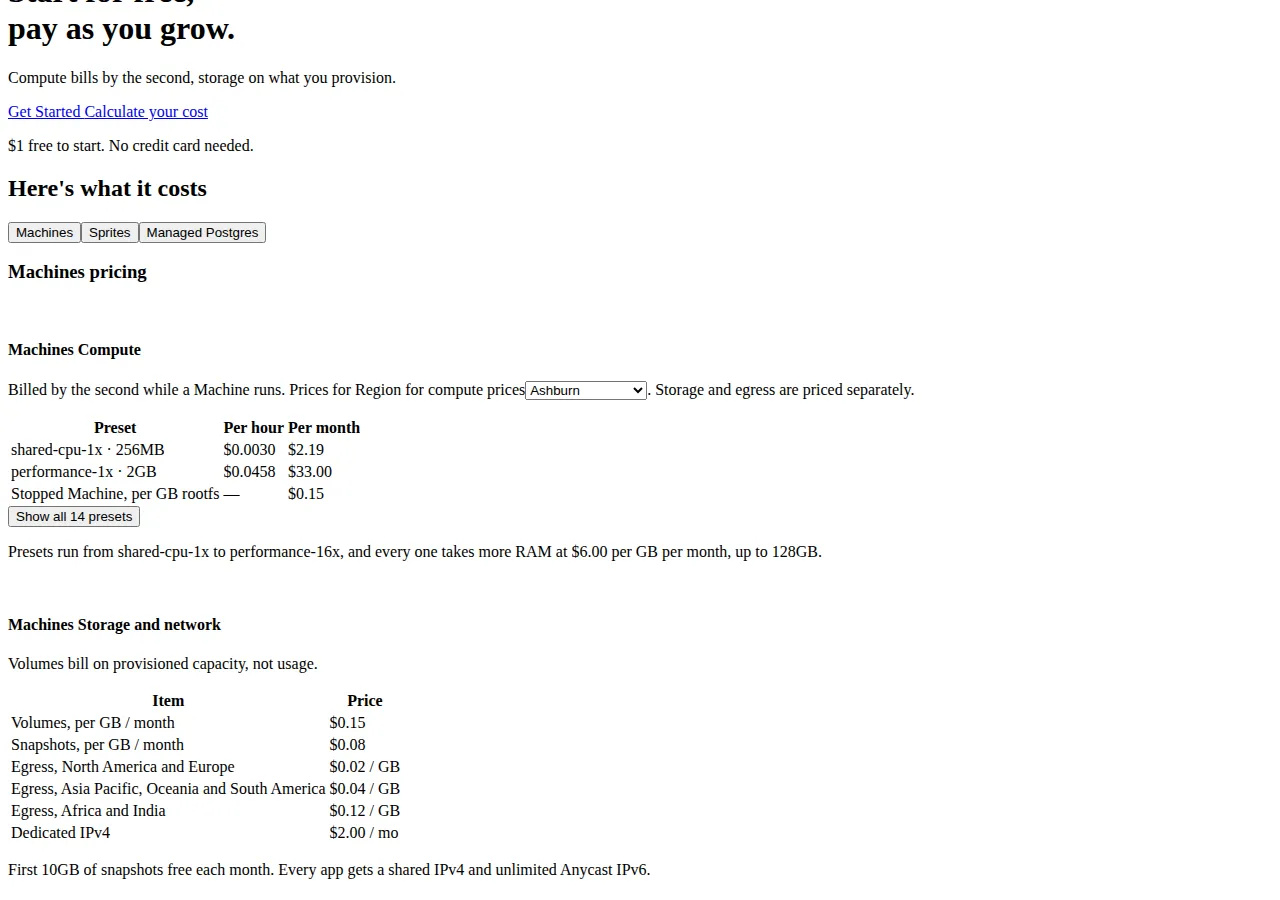
The three vendors publish their prices, and every figure in this guide was read from their pricing pages on November 20, 2026. Render's page lists instance tiers from Free at $0 to Pro Ultra at $450 a month, with managed Postgres from $6 to $55 a month. Railway's page lists usage rates per second and plan minimums. Fly.io's page lists machine presets by the hour and month, volume and egress rates by the gigabyte. Render's and Railway's pricing tables are client-rendered JavaScript, so the figures come from those pages' published data; the screenshots in this guide are the pages that did render — Fly.io's machine table and Railway's plan cards.
The price lists, read from the vendors' own pages
Render prices web services as fixed instance types. Free is $0 a month for 512 MB of RAM and 0.1 CPU. Starter is $7 a month for 512 MB and 0.5 CPU. Standard is $25 a month for 2 GB and 1 CPU. Pro is $85 a month for 4 GB and 2 CPUs. Pro Plus is $175 a month for 8 GB and 4 CPUs. Pro Max is $225 a month for 16 GB and 4 CPUs. Pro Ultra is $450 a month for 32 GB and 8 CPUs. Managed Postgres starts at $6 a month for 256 MB of RAM, $19 for 1 GB, $40 for 2 GB, and $55 for 4 GB, with a free tier at 256 MB and 100 connections. Bandwidth is included in the workspace plans — 100 GB a month at the entry paid tier, rising to 1 TB — and a free web service includes 5 GB a month. Fixed tiers are a step function: an app needing 2.1 GB of RAM pays the Pro price, not Standard, because no tier sits between them.
Railway prices everything by the second. The published usage rates are $0.00000772 per vCPU per second, $0.00000386 per GB of memory per second, $0.00000006 per GB of disk per second, and $0.05 per GB of outbound network transfer. Object storage is $0.015 per GB per month with free egress. Converted to a 30-day month of 2,592,000 seconds, those rates become $20.00 per vCPU per month, $10.00 per GB of memory per month, and $0.15 per GB of disk per month. The plans sit on top of usage: Free is $0 with $1 of monthly usage credits, services that sleep after a few minutes without outbound traffic, up to 1 vCPU and 0.5 GB of RAM per service, and 0.5 GB of volume storage, with no credit card required. Hobby is a $5 minimum usage plan that includes $5 of monthly usage credits, up to 48 vCPU and 48 GB of RAM per service, up to 5 replicas at 8 vCPU and 8 GB of RAM each, up to 5 GB of storage, a 99.9 percent availability target, and 7-day log history. Pro is $20 a month for teams shipping to production.
Fly.io prices machines as presets billed by the second while they run. Shared-cpu-1x with 256 MB is $2.19 a month. Shared-cpu-2x with 512 MB is $4.39. Shared-cpu-4x with 1 GB is $8.78. Shared-cpu-8x with 2 GB is $17.55. Performance-1x with 2 GB is $33.00. Performance-2x with 4 GB is $66.00. Performance-4x with 8 GB is $132.01. Every preset takes more RAM at $6.00 per GB per month, up to 128 GB. Storage and network are separate lines: volumes are $0.15 per GB per month on provisioned capacity, snapshots are $0.08 per GB per month with the first 10 GB free each month, egress is $0.02 per GB in North America and Europe, $0.04 in Asia Pacific, Oceania, and South America, and $0.12 in Africa and India, and a dedicated IPv4 address is $2.00 a month while a shared IPv4 and unlimited Anycast IPv6 are included. Managed Postgres is sold as clusters: Basic at $38 a month on shared-2x with 1 GB, Starter at $72 on shared-2x with 2 GB, Launch at $282 on performance-2x with 8 GB, Scale at $962, and Performance at $1,922, with database storage at $0.28 per GB. The page offers $1 free to start with no credit card needed.
Worked example one: the small API that runs all month
Take a small API: 1 vCPU and 2 GB of RAM running 24 hours a day, 10 GB of disk, 50 GB of egress a month in North America and Europe, and a 1 GB Postgres database. The arithmetic is the same on all three vendors, and the totals are not close.
Render. The 1 vCPU and 2 GB of RAM fits the Standard tier exactly: $25.00. Managed Postgres at 1 GB is $19.00. The 50 GB of egress fits inside the workspace plan's 100 GB allowance. Total: $25.00 + $19.00 = $44.00 a month, or $528.00 a year.
Railway. One vCPU at $20.00 a month plus 2 GB of memory at $10.00 a GB is $40.00. Disk is 10 GB at $0.15, or $1.50. Egress is 50 GB at $0.05, or $2.50. Total: $40.00 + $1.50 + $2.50 = $44.00 a month, or $528.00 a year. The $5 Hobby minimum is not binding, because $44.00 of usage clears it; the minimum only matters in months where usage falls below $5.00.
Fly.io. A shared-cpu-4x machine with 1 GB is $8.78, and the second gigabyte of RAM is $6.00, so compute is $14.78. A 10 GB volume at $0.15 is $1.50. Egress of 50 GB at $0.02 is $1.00. Total: $14.78 + $1.50 + $1.00 = $17.28 a month, or $207.36 a year, plus $2.00 a month if the app needs a dedicated IPv4 address. The managed Postgres is not in this total: Fly.io's Basic cluster at $38.00 would bring the Fly.io total to $55.28, which is more than Render or Railway with their managed databases included — the machine is cheap and the database is where Fly.io charges.
For compute alone, Fly.io costs less than half of either rival, because shared CPUs are priced for burstable workloads. For the whole stack including the database, Render and Railway tie at $44.00 and Fly.io costs $55.28 with its smallest managed Postgres. An app that brings its own database keeps Fly.io's advantage; an app that wants a managed database with one click does not.
Worked example two: the production service
Scale the workload to 2 vCPUs and 4 GB of RAM, 20 GB of disk, 500 GB of egress, and a 4 GB Postgres database.
Render. The 2 vCPU and 4 GB of RAM fits the Pro tier: $85.00. Managed Postgres at 4 GB is $55.00. The 500 GB of egress fits the 500 GB workspace allowance. Total: $85.00 + $55.00 = $140.00 a month, or $1,680.00 a year.
Railway. Two vCPUs at $20.00 are $40.00; 4 GB of memory at $10.00 are $40.00. Disk is 20 GB at $0.15, or $3.00. Egress is 500 GB at $0.05, or $25.00. The Pro plan adds $20.00 a month. Total: $80.00 + $3.00 + $25.00 + $20.00 = $128.00 a month, or $1,536.00 a year.
Fly.io. A performance-2x machine with 4 GB is $66.00. A 20 GB volume at $0.15 is $3.00. Egress of 500 GB at $0.02 is $10.00. Compute, disk, and egress total $79.00. The managed Postgres is the problem: Basic at $38.00 is a 1 GB instance and Starter at $72.00 is a 2 GB instance, so neither matches the 4 GB database. With Basic the total is $117.00 a month — the cheapest of the three, on a smaller database. With Starter it is $151.00 a month — the most expensive, on a 2 GB database. Fly.io wins production only if the database can stay small; at 4 GB, the Launch cluster at $282.00 makes it uncompetitive for this shape.
| Workload | Render | Railway | Fly.io |
|---|---|---|---|
| Small API, 1 vCPU / 2 GB, 50 GB egress, 1 GB DB | $44.00/mo | $44.00/mo | $55.28/mo (Basic DB) / $17.28/mo compute only |
| Production, 2 vCPU / 4 GB, 500 GB egress, 4 GB DB | $140.00/mo | $128.00/mo | $117.00/mo (1 GB DB) / $151.00/mo (2 GB DB) |
| Annual, small API | $528.00 | $528.00 | $663.36 (Basic DB) |
| Annual, production | $1,680.00 | $1,536.00 | $1,404.00 (1 GB DB) / $1,812.00 (2 GB DB) |
| Egress, North America / Europe | Included to 100 GB–1 TB | $0.05/GB | $0.02/GB |
| Pricing model | Fixed tiers | Per-second usage | Per-hour presets + metered network |
| Authority | render.com/pricing | railway.com/pricing | fly.io/pricing |
The decision layer: which model fits which workload
- Steady, predictable, always-on. Render wins on simplicity. The tier price is the bill, the database is one click, and the only surprise is the step function when the app outgrows a tier.
- Spiky, bursty, or part-time. Railway wins when the app does not run at full size all month. A worker that runs four hours a day bills for four hours, not 24. The risk is the same meter: at 2 vCPUs and 4 GB running flat out, Railway costs $80.00 of compute alone before disk, egress, and the $20.00 Pro plan.
- Small, global, latency-sensitive. Fly.io wins when the app is small and the users are everywhere. Machines run in 18 regions, Anycast routing lands each request on the closest machine, and the $2.19 shared-cpu-1x preset is the cheapest always-on compute of the three by a factor of three. The trade is operational surface: volumes, snapshots, IP addresses, and egress are separate lines, and the managed Postgres ladder jumps from $72.00 to $282.00 with no step in between.
- Egress-heavy. Fly.io's $0.02 per GB in North America and Europe is less than half of Railway's $0.05, and Render includes 100 GB to 1 TB in its workspace plans, which makes Render the cheapest for an app serving 500 GB a month from a paid workspace — until the allowance runs out. An app serving video or large downloads should price egress before compute: at 500 GB a month the network line is $10.00 on Fly.io, $25.00 on Railway, and $0.00 inside Render's allowance.
The API surface matters too. All three deploy from Git with a Dockerfile or buildpack, offer managed Postgres, Redis, and cron jobs, and expose the app over HTTPS with automatic TLS. The differences are at the edges: Render's preview environments, Railway's one-click databases, Fly.io's private networking and 18-region footprint. None of that shows up in the monthly total; all of it shows up in migration week.
Founder & CEO Insight — Enow A. Jovial
Execution checklist
- [x] Size the workload in vCPUs and gigabytes first — the instance tier, the usage meter, and the machine preset all key off the same two numbers.
- [x] Price the database separately from compute — Fly.io's cheap machine hides a $38 to $282 Postgres ladder, and Render's $19 Postgres is the reason its small-API total ties Railway.
- [x] Price egress at your real volume — 50 GB a month is $1.00 on Fly.io and $2.50 on Railway; 500 GB is $10.00 against $25.00, and free inside Render's allowance.
- [x] Set spend alerts and replica ceilings on Railway — usage billing has no ceiling, and the $5 Hobby minimum is a floor, not a cap.
- [x] Dual-run one billing cycle before migrating — compare the two invoices against the worked totals, and cut over only when the observed gap matches the projected row.