Picking an automation platform by its starting price is how a 19.99 dollar subscription turns into a 769 dollar bill. n8n, Zapier and Make sell three different units of work: the workflow run, the successful action, and the module run. Until you convert those units into one another, every comparison is guesswork.
This guide prices 10,000, 50,000 and 200,000 runs a month on each platform, covers what happens at each ceiling, and works out n8n's self-hosting break-even. Entry prices were read from n8n.io/pricing, zapier.com/pricing and make.com/en/pricing on 19 November 2026. Ladder prices are the figures those pages showed in independent November 2026 reads. n8n bills in euros and the others in dollars; comparisons use 1 euro = 1.12 dollars, the European Central Bank rate reported in October 2026.
The three billing units, defined
An n8n execution is one complete run of a workflow, however many steps it contains. A Zapier task is one action step that completes successfully. A Make credit is spent every time one module runs, including the trigger, and a module processing ten bundles runs ten times.
No vendor publishes a conversion, so this guide states its own. The reference workflow has one trigger and four actions: a webhook receives a lead as a JSON payload, the lead is checked against the CRM, the record is written, a row is added to a CSV export, and a notification goes out. One run costs 1 execution on n8n, 4 tasks on Zapier because the trigger is free, and 5 credits on Make because the trigger counts. Our automated B2B lead enrichment pipeline runs this shape on n8n.
That assumption matters more than any price here: a two-step workflow halves the Zapier and Make figures below, a ten-step workflow doubles them, and the n8n figure does not move.
| Platform | Billing unit | Units per reference run | What is free |
|---|---|---|---|
| n8n | Execution, one workflow run | 1 | Every extra step inside the run |
| Zapier | Task, one successful action | 4 | The trigger, Filter, Formatter, Paths, Delay |
| Make | Credit, one module run | 5 | Error-handler and router modules |
The published tiers
n8n Cloud has three paid rungs. Starter is 20 euros a month on annual billing for 2,500 executions, Pro is 50 euros a month for 10,000, and a larger Pro tier covers 50,000 executions for 1,450 euros a year, about 121 euros a month. Business is 667 euros a month for 40,000 executions and is self-hosted only: it buys governance, not volume, with SSO, Git version control and environments attached. Monthly billing costs about 20 percent more. The Community Edition is free to self-host with no licence fee and no execution limit.
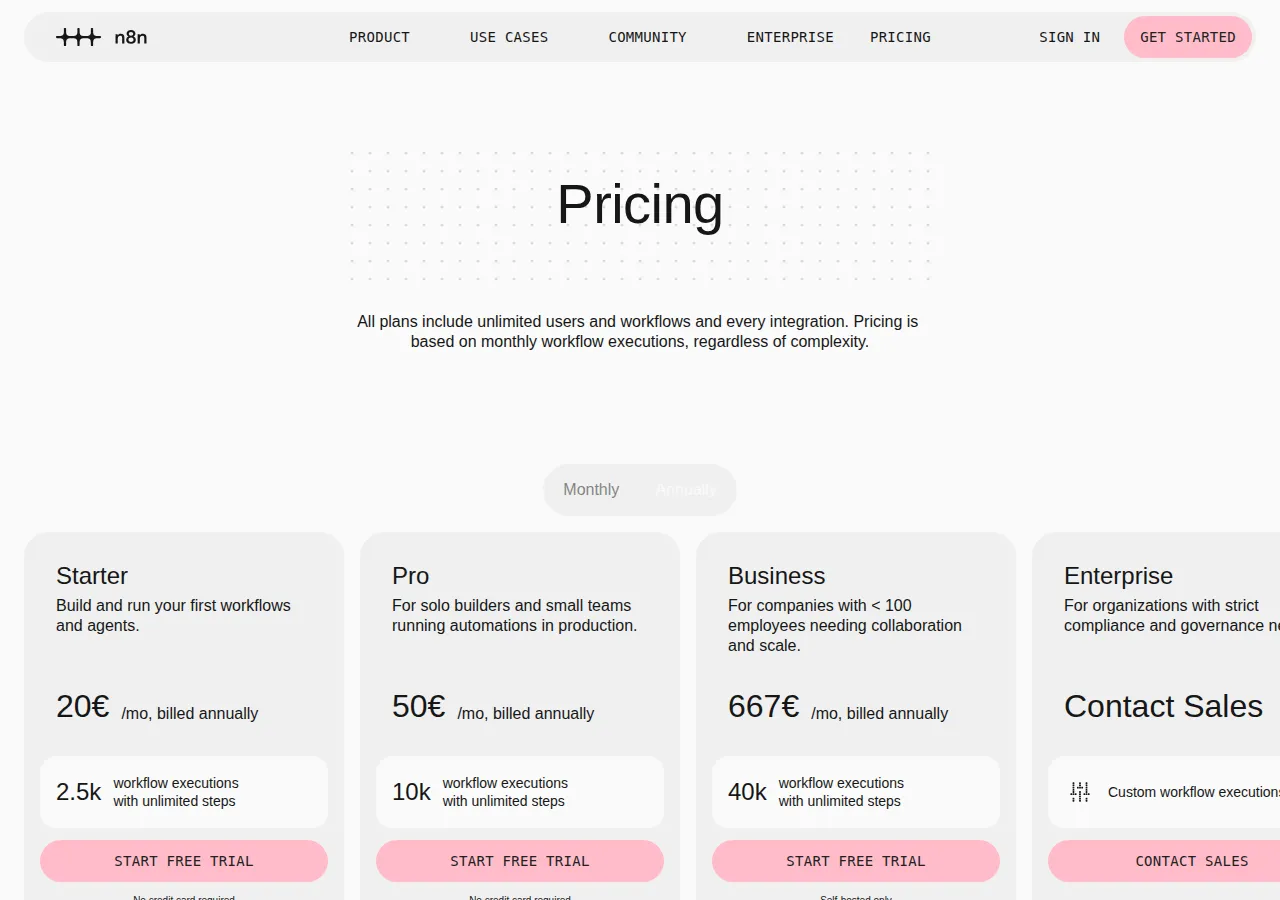
n8n Cloud pricing: Starter, Pro and Business tiers with included executions.
Zapier sells a plan and a task tier separately. Free gives 100 tasks a month with two-step Zaps only. Professional starts at 19.99 dollars a month on annual billing for 750 tasks, adding multi-step Zaps, unlimited premium apps, webhooks, API calls and AI fields. Team starts at 69 dollars a month for 2,000 tasks with 25 users, shared connections and SAML SSO. The ladder runs from 750 to 2,000,000 tasks a month, and annual billing is 33 percent cheaper. Zapier connects to more than 9,000 SaaS apps; its SDK and MCP tooling draw from the same task pool, one MCP call using two tasks, and connections use OAuth.
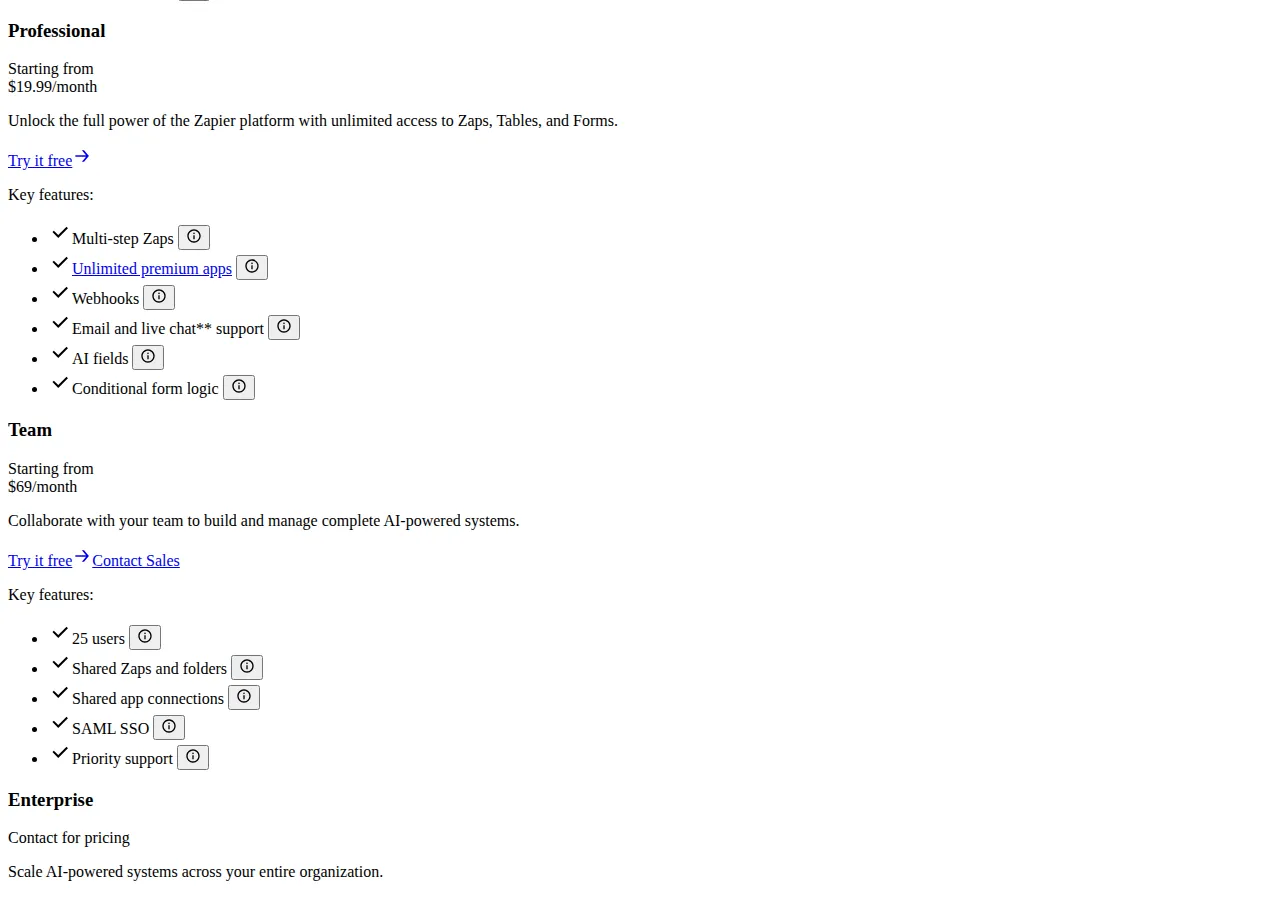
Zapier pricing: Free, Professional and Team plans with task tiers.
Make sells credits, called operations until August 2025. Free gives 1,000 credits a month, two active scenarios and a 15-minute minimum interval. Core starts at 12 dollars a month on annual billing for 10,000 credits, Pro at 21 dollars and Teams at 38 dollars, all starting at the same 10,000 credits. Older guides show Core at 9 dollars; the US list showed 12 dollars. Extra credits come in bundles of 1,000 or 10,000 at a 25 percent premium, and Core tops out at 300,000 credits a month.
| Platform | Pricing unit | Published entry tier | Ceiling | Authority |
|---|---|---|---|---|
| n8n | Execution per workflow run | Starter, 20 EUR/mo, 2,500 executions | Move up a tier; Cloud tops out at 50,000 executions | n8n.io/pricing, 19 Nov 2026 |
| Zapier | Task per successful action | Professional, 19.99 USD/mo, 750 tasks | Pay-per-task to 3x tier, then pause | zapier.com/pricing, 19 Nov 2026 |
| Make | Credit per module run | Core, 12 USD/mo, 10,000 credits | Scenarios stop; Core caps at 300,000 credits | make.com/en/pricing, 19 Nov 2026 |
The math at 10,000 runs a month
Ten thousand runs need 10,000 executions on n8n, 40,000 tasks on Zapier and 50,000 credits on Make.
On n8n the 10,000 executions fit Pro exactly, at 50 euros a month on annual billing, about 56 dollars converted.
On Zapier the 40,000 tasks match no tier, so you buy the next one up: the 50,000-task Professional tier at 289 dollars a month on annual billing.
On Make the 50,000 credits exceed the 40,000-credit Core tier at 29 dollars a month. Buy up to the 80,000-credit tier at 55 dollars, or stay on the 40,000-credit tier and buy 10,000 extra credits at the 25 percent premium. The extra-credit route is cheaper:
The math at 50,000 runs a month
Fifty thousand runs need 50,000 executions, 200,000 tasks and 250,000 credits.
On n8n the 50,000 executions fit the larger Pro tier at 1,450 euros a year, about 121 euros a month.
On Zapier the 200,000 tasks match a tier exactly: the 200,000-task Professional tier at 769 dollars a month on annual billing.
On Make the 250,000 credits fit inside Core's 300,000-credit ceiling. The cheapest verified route is the 150,000-credit Core tier at 99 dollars a month plus 100,000 extra credits at the 25 percent premium:
The math at 200,000 runs a month
Two hundred thousand runs need 200,000 executions, 800,000 tasks and 1,000,000 credits. This is where the published ladders run out.
On n8n there is no published Cloud tier above 50,000 executions. This workload is Enterprise pricing on request, or self-hosted Community Edition with no execution limit.
On Zapier the 800,000 tasks fall between tiers, so you buy the 1,000,000-task Professional tier at 2,199 dollars a month on annual billing.
On Make the 1,000,000 credits exceed Core's 300,000-credit ceiling, so the workload sits on Pro, whose ladder runs to 8 million credits. The Pro price at the 1,000,000-credit rung was not published in a form this guide could verify from the vendor's pages this cycle, so no figure is printed here: it is quote-only. Ask Make for the Pro price at 1,000,000 credits a month. What is verifiable is the requirement:
Ceilings: what happens when you hit the limit
A workflow checking every five minutes runs 8,640 times in a 30-day month:
One five-minute poller exceeds n8n Starter by three and a half times, but fits inside Pro's 10,000 executions. Zapier never charges for polling, only for actions that complete. Make charges one credit per trigger check, so the poller costs 8,640 credits before it processes a single record. Use a webhook trigger instead of polling wherever the source app supports it.
Zapier Free allows 100 tasks a month and two-step Zaps only, so the reference workflow cannot run on it at all. A four-action Zap would allow 25 runs:
Make Free allows 1,000 credits and two active scenarios, so the reference workflow runs 200 times:
Zapier's ceiling has a hard stop with a price attached. Pay-per-task billing is on by default for accounts opened after January 2024, and Zapier's own help pages put maximum usage at three times the plan's task limit, after which Zaps pause until the next period. On the Professional 750-task tier that is 750 plan tasks plus 1,500 pay-per-task tasks, or 2,250 tasks, which is 562 runs of the reference workflow:
Zapier's blog puts the pay-per-task rate at 1.25 times the base rate on annual billing, but the help pages defer to Billing settings, so treat that multiple as reported, not guaranteed. Make's ceiling is harsher: when the credits run out, scenarios stop until credits are added. There is no automatic overage; the automation just stops. That stop is the failure mode to plan for: a scenario that halts mid-month leaves new leads unprocessed until someone tops up the credits, and the pipeline lost in the gap costs more than the credits saved.
Make also has a multiplier the other two do not. A module runs once per bundle, so a run processing ten leads through four action modules costs 41 credits, not five:
If your workflows handle lists or batches, count bundles, not runs. The same batching is free on n8n and charged per action on Zapier.
Self-hosted n8n: the real cost math
Self-hosting n8n Community Edition removes the licence fee and the execution ceiling. It does not remove the cost: the honest comparison prices the server and the hours.
Assume a small VPS at 6 dollars a month and two hours of maintenance a month, valued at 50 dollars an hour.
That 106 dollars buys unlimited executions. At 10,000 runs, Cloud Pro is about 56 dollars a month, so self-hosting costs 50 dollars more once your time is counted. At 50,000 runs, Cloud Pro 50K is about 135.52 dollars a month, so self-hosting saves about 29.52 dollars a month. The break-even maintenance load against the 50,000-run Cloud tier is:
Against Zapier the comparison is not close: at 10,000 runs self-hosting saves 183 dollars a month against the 289 dollar Professional tier, and at 200,000 runs it costs 106 dollars against Zapier's 2,199 dollars, a factor of about twenty:
Run your own numbers through our ROI calculator; the break-even moves fast when either input changes. The same applies to agent workloads: our autonomous AI agents in B2B production analysis shows agent loops multiply executions, where a ceiling bites first.
How to decide in seven steps
- List every workflow you run now, with trigger type, step count, and monthly run count.
- Convert each workflow to billable units: one execution per run on n8n, one task per action on Zapier, one credit per module run per bundle on Make.
- Add the units up for a normal month, then again for your busiest month, and price the busiest month.
- Find the cheapest tier covering the busiest month on each platform, including the next tier up where volume falls between rungs.
- Check the ceiling behaviour against your tolerance: paused Zaps, stopped scenarios, or a forced tier jump.
- Price self-hosted n8n with your real hourly rate and a realistic maintenance load, and compare it with the Cloud tier at your volume.
- Run one workflow on the winner for thirty days with usage alerts on, then re-price on the real numbers before migrating the rest.
Execution checklist
- [x] Reference workflow documented with trigger type, step count and bundles per run
- [x] Monthly runs counted for a normal month and for the busiest month
- [x] Billable units converted on all three platforms from the same workflow list
- [x] Cheapest covering tier identified on each platform, including between-rung waste
- [x] Ceiling behaviour checked: Zapier 3 times cap, Make stop, n8n tier jump
- [x] Self-hosted n8n priced with server cost plus time at a stated hourly rate
- [x] One workflow trialled for thirty days with usage alerts on before full migration
Founder & CEO Insight — Enow A. Jovial
>
Count your own steps, bundles and busiest month: the right platform is the one whose billing unit matches your work.