One million records, one million searches a month. Meilisearch Cloud prices that workload at 29.28 dollars a month, Typesense Cloud at 51 dollars, Algolia Grow at 855 dollars. The gap between them is not quality — it is the meter. Meilisearch bills the instance, Typesense bills the RAM by the hour, Algolia bills every search and every record, and the record meter alone costs more than either rival's whole bill.
The three meters, in one table
| Vendor | What you pay for | Headline rate | The meter that surprises |
|---|---|---|---|
| Meilisearch Cloud | Instance size, fixed monthly | 14.88 dollars a month, XS, US East | Disk at 0.165 dollars per GiB beyond 32 GiB |
| Typesense Cloud | RAM and CPU by the hour | About 21.60 dollars a month, 0.5 GB burst node | The cluster bills every hour it runs, traffic or not |
| Algolia | Search requests and records | 0.50 dollars per 1,000 requests beyond 10,000, Grow | Records at 0.40 dollars per 1,000 beyond 100,000 |
All three rates come from the vendors' own pages as read on November 20, 2026: meilisearch.com/pricing, algolia.com/pricing, and Typesense's own published comparison page at typesense.org/typesense-vs-algolia — the Typesense pricing calculator is a JavaScript application that renders no prices in a plain fetch, so its figures come from that page, corroborated by independent 2026 reads of the same calculator.
Meilisearch: the instance is the bill
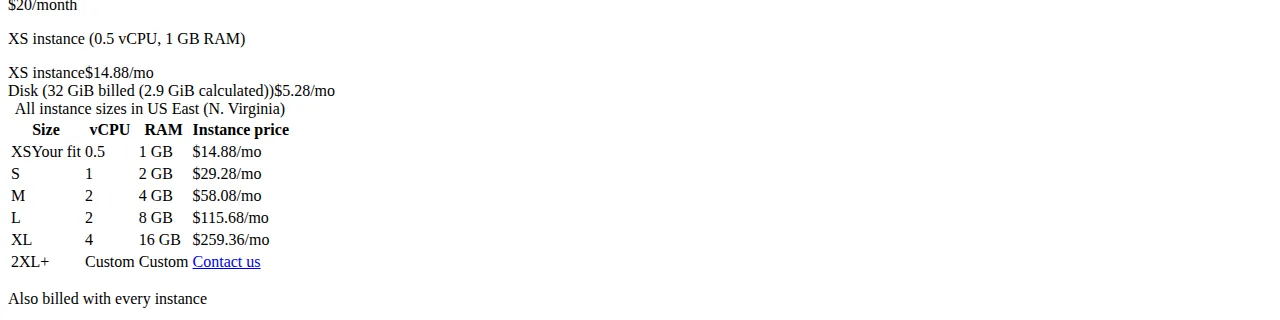
Meilisearch Cloud charges a fixed monthly price for the instance size, whatever the search volume. The ladder in US East runs XS at 14.88 dollars a month for 0.5 vCPU and 1 GB of RAM, S at 29.28 for 1 vCPU and 2 GB, M at 58.08 for 2 vCPU and 4 GB, L at 115.68 for 2 vCPU and 8 GB, and XL at 259.36 for 4 vCPU and 16 GB. The headline says "from 20 dollars a month" because prices vary by region — 14.88 dollars is the US East XS price. Instances are metered by the hour; XS through L share CPU while XL has dedicated cores.
Disk is the only meter that moves: 32 GiB is included, and every GiB beyond it costs 0.165 dollars a month. Outbound bandwidth is 0.15 dollars per GB. Team members are free — one bill for all projects, no per-seat fees. The cloud trial is 14 days with no credit card. The open-source engine is free to self-host: the license costs nothing, and the price becomes the server and the hours spent operating it.
The fixed price is the whole argument: a million searches cost the same as ten thousand on the same instance, so a viral week changes nothing on the invoice. The risk runs the other way: an idle instance still bills, and a catalog that outgrows the instance needs a resize. Run the vendor's cost estimator before you pick a tier.
Typesense: the RAM is the bill
Typesense Cloud charges for dedicated cluster resources by the hour, with no limits on records or operations and no per-search or per-record charge. The smallest configuration is a 0.5 GB burst node with two burst vCPUs at about 21.60 dollars a month, or 0.03 dollars an hour. A 2 GB burst single-node configuration is about 51 dollars a month; the same 2 GB with three-node high availability is about 153 dollars. An 8 GB burst single-node configuration is about 139 dollars a month. Bandwidth out is 0.09 dollars per GB in most regions after the first 10 GB. The free tier is one-time: 720 node-hours — roughly a month — plus 10 GB of bandwidth.
The index lives in RAM: memory is the data ceiling, and a cluster that is too small falls over on the first big import. The vendor's guidance is to allocate two to three times the dataset size in RAM. A catalog of one million records averaging 3 KB is about 3 GB of data, so the honest sizing starts at the 8 GB node — the workload table prices the 2 GB node only because Typesense's own published workload examples run multi-million-search workloads on it.
The cluster bills every hour it runs, traffic or not — an idle cluster is a 51-dollar-a-month heater — but a traffic spike costs nothing extra, because there is no per-request line. The 4.1-million-search month in Typesense's own comparison table costs the same 51 dollars as the 214,000-search month on the same node. High availability triples the compute line, so price the HA configuration you will actually run, not the single-node price on the landing page.
Algolia: every search and every record is the bill
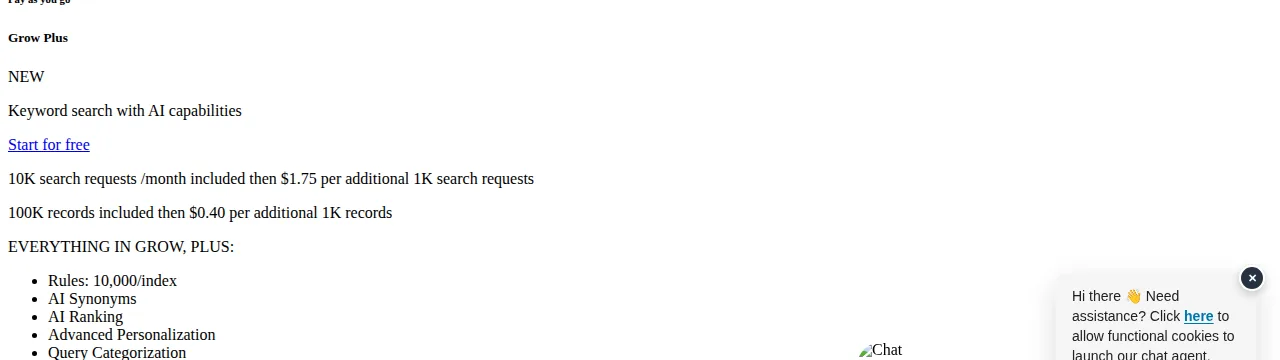
Algolia has no self-hosted option and no flat instance. Its Build plan is free for development and includes 10,000 search requests a month, 50,000 records, 5,000 recommendation requests, and 5,000 crawls. Grow includes 10,000 search requests a month, then charges 0.50 dollars per additional 1,000, and includes 100,000 records, then charges 0.40 dollars per additional 1,000. Grow Plus adds AI capabilities — AI synonyms, AI ranking, advanced personalization, query categorization — and charges 1.75 dollars per additional 1,000 search requests with the same 0.40-dollar record meter. Recommendations beyond 5,000 cost 0.60 dollars per additional 1,000 requests; crawls beyond 5,000 cost 0.80 dollars per additional 1,000.
The record meter is the trap, and it is easy to miss because the pricing page leads with requests. Algolia counts every record across all indices, and each pre-sort creates a copy that increases the total — a catalog pre-sorted three ways can count three times. Over-quota is billed on the maximum records reached in the month, and Algolia ignores only the three days with the most records. The same million products cost 360 dollars a month in records alone before a single shopper searches.
The same catalog, priced three ways
Three workloads, one catalog of one million records, disk inside the included 32 GiB for Meilisearch, and the 2 GB Typesense node per the vendor's own published workload examples. Records cost 360 dollars a month on Algolia at this catalog size, before any search is counted.
Workload 1 — 100,000 searches a month, one million records:
Workload 2 — one million searches a month, one million records:
Grow Plus at workload 2 costs 2,092.50 dollars: 990 times 1.75 is 1,732.50 for requests, plus the same 360 dollars for records. The AI tier costs 2.4 times the Grow tier for identical traffic — the question is whether AI ranking on your catalog earns 1,237.50 dollars a month more than keyword search.
Workload 3 — four million searches a month, one million records:
At workload 3, Algolia costs forty-six times the Typesense cluster and forty times the Meilisearch instance. Typesense's own comparison table shows the same shape: at 4.1 million searches a month, its 2 GB node costs 51 dollars against 2,033 dollars on Algolia Grow for the search line alone. The per-request meter is a tax on success.
The breakeven lines
Two breakevens decide this comparison. First, the record breakeven: Algolia's record meter alone passes the price of a 2 GB Typesense cluster at 227,500 records, where 127,500 billable records times 0.40 dollars per thousand equals 51 dollars. Second, the traffic breakeven does not exist: there is no search volume at which Algolia Grow becomes cheaper than a flat instance, because Algolia's request line only grows while the flat lines stay fixed.
Meilisearch against Typesense is decided by size: XS at 14.88 dollars beats the 0.5 GB Typesense node at 21.60 dollars, S at 29.28 beats Typesense at 51 dollars at 2 GB, and L at 115.68 beats Typesense at 139 dollars at 8 GB. Meilisearch is cheaper at every size on the published ladders — but the comparison is not only price. Typesense holds the index in RAM, which is faster for typo-tolerant search at scale, and its hourly meter lets a cluster run for a week of testing and stop. Meilisearch is disk-based, which is why the same data fits a smaller instance. Our Elasticsearch vs OpenSearch vs Algolia search pricing playbook prices the managed-infrastructure side of the same decision for teams whose search workload needs a cluster, not an engine.
The decision table
| Decision factor | Meilisearch Cloud | Typesense Cloud | Algolia | Authority |
|---|---|---|---|---|
| 1M searches, 1M records | 29.28 dollars a month | 51 dollars a month | 855 dollars a month | Vendor pricing pages, Nov 20 2026 |
| 4M searches, 1M records | 58.08 dollars a month | 51 dollars a month | 2,355 dollars a month | Vendor pricing pages, Nov 20 2026 |
| Free option | Self-hosted engine, free | 720 node-hours plus 10 GB bandwidth, one-time | Build plan, 10K requests, 50K records | Vendor pricing pages |
| Per-seat fees | None | None | None | Vendor pricing pages |
| Self-hosting | Yes, open source | Yes, GPL-3.0 | No | Vendor documentation |
| Best for | Spiky traffic on a fixed budget | Huge traffic on a small catalog | Tiny catalogs, thin traffic, no ops team | Editorial analysis of the three meters |
Who should not buy each one
Meilisearch is the wrong buy for a team with no appetite for sizing: picking XS for a ten-million-document catalog means a resize mid-launch. It is the right buy for a store or app whose traffic spikes — a launch, a sale, a viral post — because the bill does not move when the traffic does, and for teams that want the self-hosted exit.
Typesense is the wrong buy for a team that forgets clusters bill by the hour: an idle cluster is a 51-dollar-a-month heater, and a development cluster left running for a year costs 612 dollars for nothing. It is the right buy for a team with heavy search traffic on a modest catalog, where the absence of a per-request meter is worth more than any feature.
Algolia is the wrong buy for a catalog above roughly 227,500 records or traffic above a few hundred thousand searches a month — the meters compound, and the bill at workload 3 is forty times the flat alternatives. It is the right buy for a small catalog with thin traffic and no operations team: the Build plan is genuinely free at 10,000 requests and 50,000 records, the hosted service needs no server, and the merchandising tools are the best of the three. For teams whose search problem is vector-shaped, our Qdrant vs Pinecone vs pgvector architecture playbook covers the vector-database side of the same decision.
Execution checklist
- [x] Step 1: Count the catalog the vendor's way. List every product, then multiply by the number of pre-sorts and indices — the vendor's record count is the number that bills.
- [x] Step 2: Price Meilisearch on the estimator. Run the vendor's cost estimator with your documents, searches, and document size, pick the smallest instance that fits, then add disk at 0.165 dollars per GiB beyond 32 GiB.
- [x] Step 3: Price Typesense on RAM, not requests. Size the cluster at two to three times the dataset size in RAM, price the hourly rate times 730 hours, and add bandwidth at 0.09 dollars per GB beyond the first 10 GB.
- [x] Step 4: Price Algolia on both meters. Requests at 0.50 dollars per 1,000 beyond 10,000, records at 0.40 dollars per 1,000 beyond 100,000 — and solve the 227,500-record crossover first.
- [x] Step 5: Trial on production-shaped data. Index the real catalog, not a sample, and measure the index size, record count, and search volume the trial actually consumes.
- [x] Step 6: Re-price quarterly. Catalogs grow with every import, traffic with every launch, and a pre-sort added by merchandising is a price increase. A 200,000-record catalog becomes a million-record catalog in a year of growth.
Founder & CEO Insight — Enow A. Jovial