Brazil's data protection law reaches further than most American operators assume. The Lei Geral de Proteção de Dados Pessoais — Lei 13.709/2018, the LGPD — applies to processing carried out in Brazil, processing aimed at offering goods or services to people in Brazil, and data collected in Brazil, wherever the company sits or its servers live. There is no revenue threshold, no headcount threshold, and no small-business exemption. A two-person SaaS with Brazilian users, a Shopify store shipping to São Paulo, a U.S. employer with a contractor in Recife — all inside Article 3. In force since September 18, 2020, sanctions since August 1, 2021; its regulator, the ANPD, became an independent regulatory agency on February 25, 2026. This playbook works the law article by article — the deadlines and the fine math.
Who is inside the law — and who is not
Article 3 sets the scope in three triggers — any one is enough; Article 4 carves out what the law does not touch. Most foreign operators argue themselves out of scope on the wrong test: they check where the company is incorporated, while the law checks where the processing happens and whose data it is.
| Test | LGPD position | Authority |
|---|---|---|
| Processing in Brazil | Covered, wherever the company is based | Art. 3, I |
| Offering goods or services to people in Brazil | Covered with no Brazilian presence | Art. 3, II |
| Data collected in Brazil | Covered even if processed abroad | Art. 3, III |
Article 4 excludes purely personal use; journalistic and artistic purposes; academic purposes (Arts. 7 and 11 still apply); public security and criminal investigation; and transit data not shared with Brazilian agents, if the origin country provides adequate protection.
The ten legal bases: no processing without one
Article 7 lists ten hypotheses, and processing is lawful only under one of them; consent is first on the list and the most misused. Article 8 requires consent in writing or by another means demonstrating the subject's will, in a highlighted clause separate from other contractual terms, for specific purposes — generic authorizations are void — revocable at any time by a free and facilitated procedure, with the burden of proof on the controller. A pre-ticked box or a consent buried in a EULA is not consent under this law.
| Basis | When it fits | Authority |
|---|---|---|
| Consent | The subject agreed, specifically and in a highlighted clause | Art. 7, I; Art. 8 |
| Legal or regulatory obligation | Tax, employment, and anti-money-laundering filings | Art. 7, II |
| Public administration | Executing public policies under laws, regulations, or agreements | Art. 7, III |
| Research | Studies by a research body, anonymized where possible | Art. 7, IV |
| Contract | Performance of a contract, or pre-contractual steps at the subject's request | Art. 7, V |
| Legal proceedings | Exercising rights in judicial, administrative, or arbitral proceedings | Art. 7, VI |
| Life or physical safety | Protecting the life or physical safety of the subject or a third party | Art. 7, VII |
| Health protection | Procedures by health professionals, services, or authorities | Art. 7, VIII |
| Legitimate interests | Necessary for the controller's or a third party's legitimate interests | Art. 7, IX; Art. 10 |
| Credit protection | Credit protection | Art. 7, X |
Legitimate interests is the basis most operators reach for, and Article 10 fences it: only legitimate purposes from concrete situations, only the data strictly necessary, and only with transparency measures in place. The ANPD may demand a data protection impact report (a relatório de impacto, the Brazilian DPIA) when processing rests on it. An operator that cannot name the concrete purpose, list the exact fields, and show the balancing test has no basis.
Sensitive data is a separate gate. Article 11 permits processing of sensitive personal data — racial or ethnic origin, religious conviction, political opinion, union membership, health or sex-life data, genetic or biometric data — only on specific highlighted consent or in the listed exceptions, such as legal obligation, research, or protection of life. Sharing sensitive health data between controllers for economic advantage is prohibited, except for portability and health-service transactions. Article 11, § 5 forbids private health-plan operators from using health data for risk selection in contracting or excluding beneficiaries. A health-tech product that treats health data like any other field is building on a violation.
Article 14 governs children's data: processing of children's and adolescents' data must be in their best interest, and children's data requires specific highlighted consent from at least one parent or legal guardian. Since March 17, 2026, the Digital ECA (Lei 15.211/2025) adds age-assurance and child-safety duties for digital services children use.
The nine rights and the 15-day clock
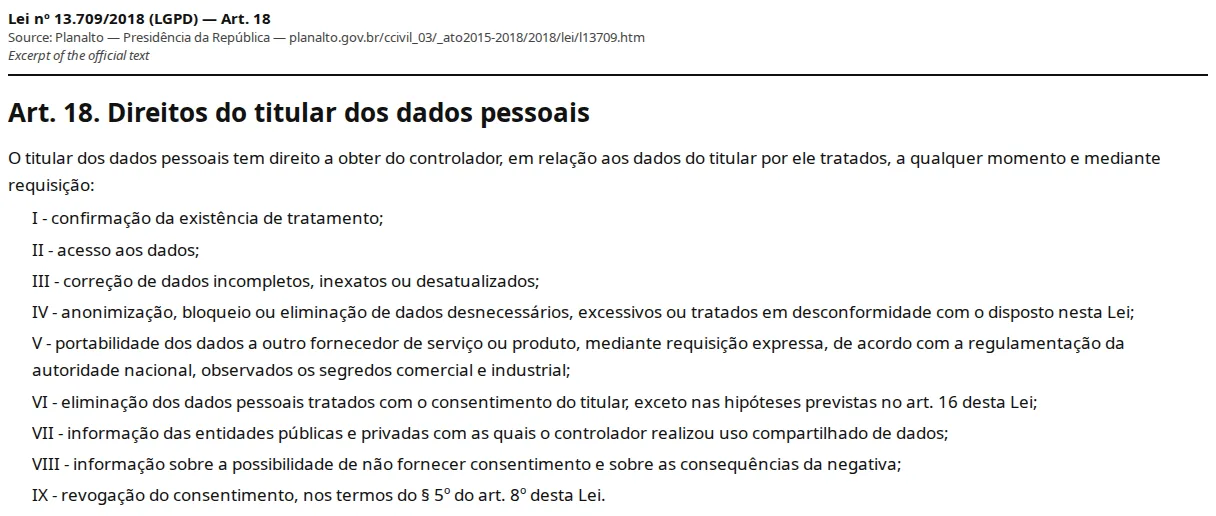
Article 18 gives the data subject nine rights, exercisable at any time, free of charge. Article 19 sets the clock: confirmation and access come in simplified form immediately, or by a clear and complete declaration within 15 days, stating the origin of the data, the absence of a record, the criteria used, and the purpose. Article 20 adds a tenth right in substance: review by a natural person of decisions taken solely on automated processing.
| Right | What the subject can demand | Authority |
|---|---|---|
| Confirmation | Confirmation that processing exists | Art. 18, I |
| Access | Access to the data | Art. 18, II |
| Correction | Correction of incomplete, inaccurate, or outdated data | Art. 18, III |
| Anonymization, blocking, deletion | Unnecessary, excessive, or unlawfully processed data | Art. 18, IV |
| Portability | Ported to another provider, on express request, subject to trade secrets | Art. 18, V |
| Deletion of consent-based data | Deletion of consent-based data, except where Art. 16 allows retention | Art. 18, VI |
| Sharing information | The entities the controller shared the data with | Art. 18, VII |
| Consent information | Whether consent may be refused, and the consequences | Art. 18, VIII |
| Revocation | Revocation of consent at any time | Art. 18, IX |
Three points decide whether a rights process survives a real request. First, the 15-day clock runs from the request, and a missed deadline is itself a violation. Second, Article 18, § 1 lets the subject petition the ANPD directly, and § 8 lets the same right be exercised before consumer-protection bodies. Third, when data was shared, Article 18, § 6 requires the controller to inform the recipients of any correction, deletion, anonymization, or blocking immediately. A rights request that ends at your own database is incomplete by statute.
The 15-day sequence runs the same way:
- Day 0 — log and verify. Record the request, verify the requester's identity, and find which systems hold the data.
- Immediately — simplified response. Confirm whether processing exists and give access.
- By day 15 — full declaration. Deliver the complete declaration: origin, criteria, and purpose.
- Same day — propagate. Inform every recipient of any correction, deletion, anonymization, or blocking.
- Close the file. Record the request, the response, and the dates.
The officer, the records, and the incident clock
Article 41 requires the controller to appoint an encarregado — the data protection officer — and to publish the officer's identity and contact publicly, preferably on the website. The officer receives complaints from data subjects, receives communications from the ANPD, guides employees and contractors, and performs the other duties the controller assigns. The default is appointment; a foreign operator with Brazilian users should assume it applies.
Article 37 requires the controller and the operator to keep records of the processing operations they carry out, especially on legitimate interests. Article 38 lets the ANPD demand a data protection impact report covering the data types, the collection methodology, the security measures, and the mitigation analysis. Article 46 requires technical and administrative security measures from the design phase through execution.
The incident clock is the sharpest deadline in the law. Article 48 requires the controller to notify the ANPD and the data subject of any security incident that may cause relevant risk or damage, in a reasonable time defined by the ANPD. Resolution CD/ANPD 15/2024, adopted April 24, 2024, defines that time: three business days from the moment the controller learns the incident affected personal data, for both the ANPD and the subjects, with a supplement allowed within twenty business days. Every incident must be recorded, and the record kept for at least five years. An incident is reportable when it may significantly affect the subjects' fundamental rights and involves sensitive, children's, financial, or authentication data; data protected by legal or contractual secrecy; or large-scale data.
Moving data out of Brazil
Article 33 permits international transfers only in nine cases. In practice, two matter: adequacy — the ANPD has recognized the destination as providing adequate protection — and safeguards, where the controller proves guarantees through specific contractual clauses, standard contractual clauses, global corporate rules, or seals, certificates, and codes of conduct.
Resolution CD/ANPD 19/2024, published August 23, 2024, regulates the mechanisms. Its standard contractual clauses, in Annex II, must be adopted without changes, and the twelve-month grace period to incorporate them ended on August 23, 2025. Transfers after that date are valid only if the clauses are in place or another approved mechanism covers them. In January 2026 the ANPD recognized the European Union as adequate (Resolution CD/ANPD 32/2026), and the European Commission adopted a reciprocal adequacy decision for Brazil — the only adequacy recognition in force. Every other destination still needs the standard clauses.
Two traps catch foreign operators. First, collecting data directly from a person in Brazil is not a transfer, but the LGPD still applies under Article 3. Second, sending data from a Brazilian entity to a U.S. recipient is a transfer and needs a mechanism. A U.S. company receiving Brazilian user data from its own Brazilian subsidiary, processor, or partner without standard clauses in the contract is transferring without a mechanism.
The fine math
Article 52 lists twelve sanctions, applied after an administrative procedure with full defense rights, gradated, isolated or cumulative, according to the gravity, good faith, advantage obtained, economic condition, recidivism, damage, cooperation, compliance mechanisms, good-practice policies, and prompt corrective measures. The headline sanction is the simple fine: up to 2% of the private legal entity's revenue in Brazil in its last fiscal year, excluding taxes, capped at R$50 million per infraction. Resolution CD/ANPD 4/2023 supplies the methodology — minor, medium, or serious, with aggravating factors of 5% to 90%.
The fine is not the ceiling. The ANPD may also impose a daily fine within the same total limit, publicize the infraction, block or delete the data, suspend the database or processing for up to six months, or prohibit processing in part or in full. Suspension and prohibition may be applied only after at least one of the warning, fine, publicizing, blocking, or deletion sanctions has already been imposed for the same case. Enforcement is not reserved for large companies: the ANPD's first fine went to the micro-enterprise Telekall Infoservice for processing without a legal basis and without a DPO. Article 42 adds civil liability: a controller or operator that causes patrimonial, moral, individual, or collective damage must repair it, controllers involved in the same processing are jointly liable, and the judge may reverse the burden of proof. Model the exposure with our ROI calculator before deciding that Brazilian revenue is too small to matter: a R$5 million fine on R$250 million of Brazilian revenue is 2% of the local business.
Founder & CEO Insight — Enow A. Jovial
Who this playbook is for — and who should skip it
This is for any operator with Brazilian users, customers, or employees — SaaS, e-commerce, fintech, health-tech, employers with Brazilian contractors — and for the U.S. company receiving data from a Brazilian subsidiary or partner that has never checked whether its contracts carry the ANPD standard clauses. The August 23, 2025 deadline has passed: the transfer is either covered or it is not.
Skip it if you have no Brazilian data subjects and no Brazilian processing — but verify that claim against Article 3. Our CCPA deletion playbook covers the California operation, and our GDPR analytics comparison covers the European tooling side.
The 90-day LGPD build checklist
- [x] Map the data. List every processing operation, its Article 7 basis, and the exact fields.
- [x] Name the encarregado. Appoint the officer under Article 41 and publish the identity and contact.
- [x] Build the 15-day rights process. Intake, identity verification, the simplified immediate response, and the full declaration inside 15 days, with the shared-recipient notice.
- [x] Fix the transfers. Adopt the ANPD standard clauses for every destination that is not the EU, or stop the transfer.
- [x] Write the incident plan. Detection, triage, and the 3-business-day notice to the ANPD and the subjects, with the 20-business-day supplement and 5-year register.
- [x] Set the fine model. Calculate 2% of Brazilian revenue against the R$50 million cap, and price in suspension risk.
- [x] Record everything. Keep the Article 37 records and incident register.