A $250,000 supplier wire left a US bank on the morning of July 15, 2025, and came back the same day: rejected, invalid format. Nothing about the payment had changed — same sender, same beneficiary, same amount, same value date. What changed overnight was the language the payment was written in. On July 14, 2025, the Federal Reserve's Fedwire Funds Service stopped accepting its old proprietary format and started speaking ISO 20022 only. ISO 20022 is a messaging standard, not a settlement system, not a currency, not a blockchain: it changes the envelope a payment travels in, on hard dates set by the operators of the world's payment rails. By November 22, 2025, the SWIFT network ended 32 months of coexistence between the old MT format and ISO 20022 for cross-border payment instructions. Fedwire had already cut over in July. The remaining work is the tail: structured addresses, exceptions and investigations, and the conversion charges that started on January 1, 2026 for anyone still sending the old format.
What ISO 20022 is — and what it is not
ISO 20022 is the international standard for financial messaging, maintained by the International Organization for Standardization with SWIFT as the registration authority for its message catalogue. A payment instruction under ISO 20022 is an XML message built from a shared dictionary of business components: debtor, creditor, amounts, charges, remittance information, and the postal address of each party, each in its own structured element.
The old SWIFT MT format was the opposite design. An MT103 — the single customer credit transfer that carried cross-border payments for decades — packed the payment into fixed fields, with the critical detail squeezed into field 70 (remittance information, four lines of 35 characters) and field 72 (sender-to-receiver information, six lines of 35 characters). Anything that did not fit was truncated or dropped. A beneficiary's full legal name, a structured address, an invoice number, and a legal entity identifier competed for the same 210 characters.
The new format replaces guessing with structure. The cross-border equivalent of the MT103 is pacs.008, in which debtor and creditor each carry a structured postal address, the ultimate debtor and ultimate creditor are separate parties, and remittance information travels in its own block. ISO 20022 does not make a payment faster or cheaper by itself; what it makes possible is straight-through processing — a message a receiving system can read, screen, and post without a human re-keying an address or chasing a missing invoice reference.
Three confusions to clear up. First, ISO 20022 is not a cryptocurrency or a settlement asset: no value moves onto any ledger because the message format changed. Second, it is not optional for banks that move cross-border money through SWIFT: after coexistence ended, old MT payment instructions are no longer delivered over FIN between financial institutions. Third, it is not finished — reporting, cash management, payment initiation, and exceptions and investigations follow on later timetables.
The cutover calendar: every hard date that matters
The table below is the record as the operators published it, with the deferral flagged where it applies — several announced dates were later moved.
| Milestone | Date | Authority |
|---|---|---|
| TARGET2 (ECB) moves; SWIFT CBPR+ coexistence begins | March 2023 | ECB / SWIFT |
| Fedwire Funds Service cuts over to ISO 20022; FAIM retired | July 14, 2025 | Federal Reserve Financial Services |
| SWIFT CBPR+ coexistence ends; MT payment instructions retired | November 22, 2025 | SWIFT |
| SWIFT auto-conversion of remaining MT instructions becomes chargeable | January 1, 2026 | SWIFT |
| Structured-address enforcement (unstructured addresses removed) | Listed as November 14, 2026 — deferred, no replacement date announced | SWIFT roadmap; industry reporting, September 2026 |
| Fedwire hybrid-address release; SWIFT exceptions and investigations migrate | November 2027 | FRFS / SWIFT CBPR+ roadmap |
Two dates still trip up planning meetings. The Fedwire date moved once: the plan announced in June 2022 was a single-day cutover on March 10, 2025, postponed on February 13, 2025 to July 14, 2025 after an industry readiness review — and the new date held. The Fed's go/no-go call was made on demonstrated readiness.
The second is the November 2026 structured-address milestone. SWIFT's roadmap still lists November 14, 2026 as the date after which only structured or hybrid postal addresses will be accepted, but industry reporting in September 2026 says SWIFT deferred that release in August 2026 with no replacement date announced. Structured addresses are coming either way — only the enforcement date is open.
The Fedwire cutover: one day, no safety net
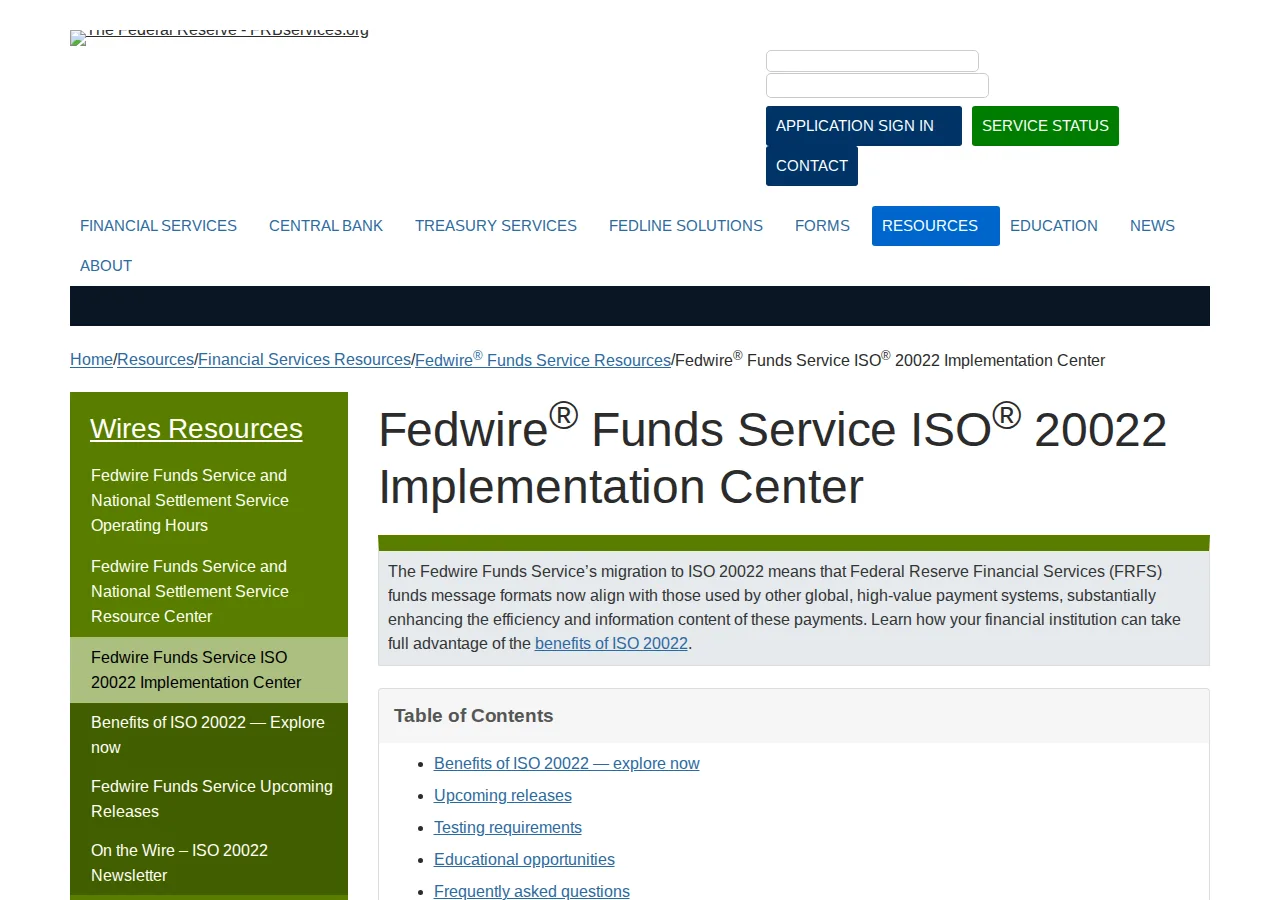
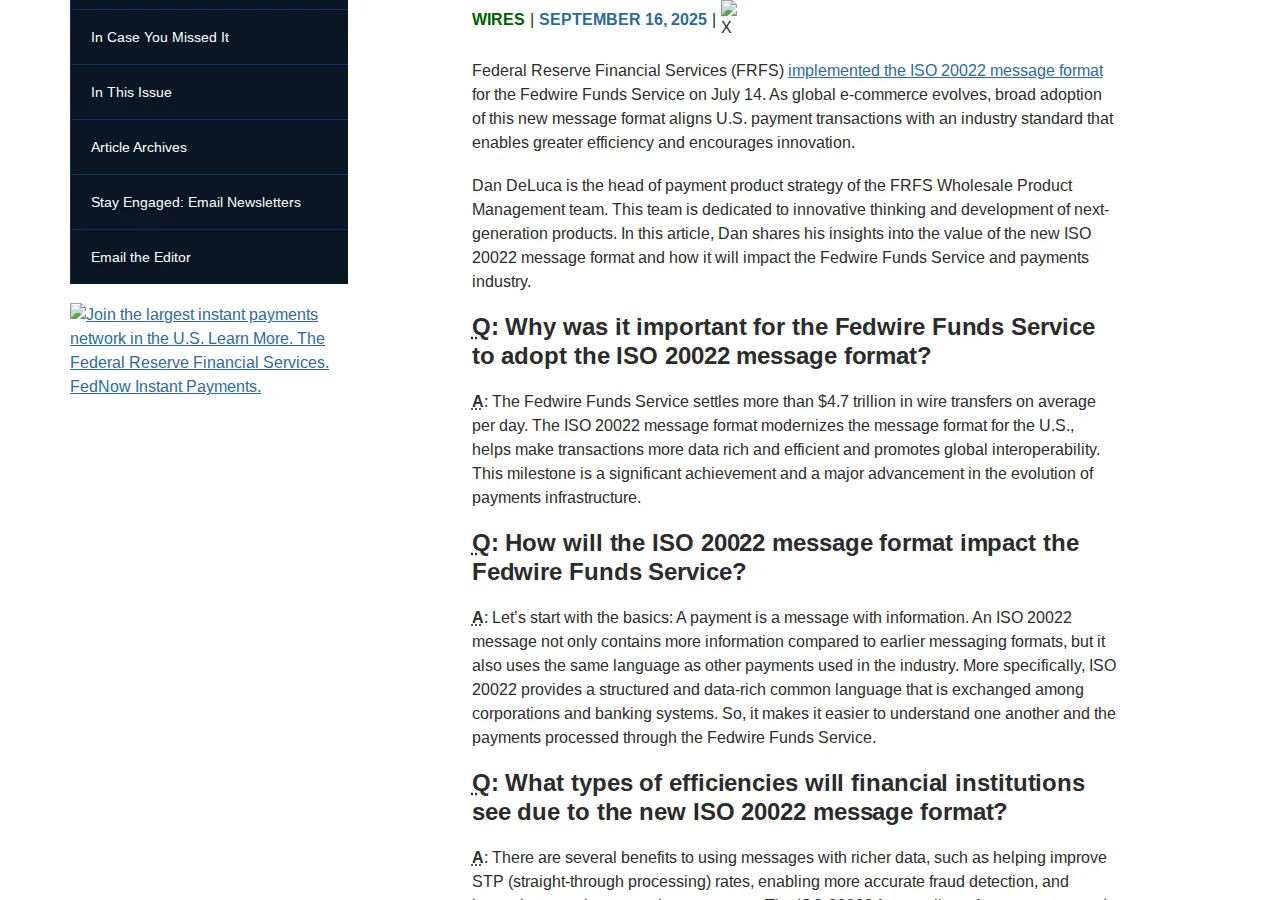
Fedwire is the Federal Reserve Banks' real-time gross settlement system. It settles more than $4.7 trillion in wire transfers on average per day, according to the Federal Reserve's interview with Dan DeLuca, head of payment product strategy for the FRFS Wholesale Product Management team. On July 14, 2025, that entire volume moved to a new message format in a single day, with no coexistence phase and no translation service.
The old format was FAIM, the Fedwire Application Interface Manual — a proprietary, tag-based format built around the routing transit number. The Federal Reserve retired FAIM at the close of business on Friday, July 11, 2025; when it opened on Sunday, July 13 at 9 p.m. ET, the new format was the only format, and any wire not updated to comply was rejected.
The Federal Reserve had spent years preparing the industry. Customer testing ran from March to June 2025, with ISO 20022 messages used for planned wire transfers in commercial settings. Peer testing in the DIT2 environment let more than 270 institutions exchange production-like test messages before the migration.
At more than $4.7 trillion per day, across roughly 250 business days a year, Fedwire carries on the order of:
A translation layer in front of $1.18 quadrillion a year would be a single point of failure. The Federal Reserve chose the risk of a hard cutover over the risk of a permanent translation dependency, and the cutover completed without a major disruption.
What changes inside the message
For a payments operator, the practical change is in the fields. The table compares the old and new formats on the points that decide whether a payment posts automatically or lands in an exceptions queue.
| Attribute | MT (legacy) | ISO 20022 (MX) | Authority |
|---|---|---|---|
| Customer credit transfer | MT103 | pacs.008 | SWIFT CBPR+ |
| Remittance detail | Field 70, 4 lines of 35 characters | Structured block, full invoice detail | SWIFT CBPR+ |
| Sender-to-receiver notes | Field 72, 6 lines of 35 characters | Structured elements | SWIFT CBPR+ |
| Postal address | Free text | Structured or hybrid elements | SWIFT / FRFS |
| Ultimate debtor / creditor | Not separately identified | Separate parties | SWIFT CBPR+ |
| Payment tracking | Opaque after sending | UETR tracking under SWIFT gpi | SWIFT gpi |
| Screening input | Free text, guessed by engines | Structured, machine-readable | SWIFT |
| Fedwire status | Retired July 11, 2025 | Sole format since July 14, 2025 | FRFS |
Two features carry the whole business case. The first is the structured postal address: under the old format an address was a block of text a screening engine had to parse and hope the sender had not abbreviated it differently this time; under ISO 20022, town name and country sit in their own elements — which is why the structured-address enforcement matters most. The second is the travel rule. The Bank Secrecy Act travel rule, at 31 CFR 1010.410(f), requires a US bank sending a wire of $3,000 or more to include the originator's name, address, and account number, the amount, the date, the beneficiary's bank, the beneficiary details it received, and its own identity, with each intermediary passing it on. Under MT, that information degraded at each hop; under ISO 20022 it travels in structured elements that survive the chain intact.
Founder & CEO Insight — Enow A. Jovial
The conversion charge: what the tail costs
SWIFT put a conversion service in place that automatically converts remaining MT instructions to ISO 20022, so payments keep flowing — and from January 1, 2026, that service became chargeable. SWIFT reports more than 98% of payment instructions are now sent in ISO 20022, with a 97% adoption rate on the cutover weekend itself. The remaining few percent pay for not having migrated.
The per-message fee is set by SWIFT and passed through by your bank — confirm it in writing, because it is the one number in this formula that varies by institution. The worked example below uses the 97% adoption figure SWIFT published for the cutover weekend:
Scenario: a regional bank sending 50,000 cross-border instructions a month. At SWIFT's published 97% adoption rate, 3% — 1,500 a month — still arrive in the old format. At a $2 per-message conversion fee, that is $3,000 a month, $36,000 a year, for messages that would cost nothing extra if they were native. At a 10% unconverted share, the same arithmetic gives $120,000 a year. The variable that decides the bill is your own unconverted share — which is why the first step of any migration plan is counting it.
Every payment template that still carries an unstructured address is a template that will be rejected when enforcement lands. Count the templates and the hours per template:
A bank with 400 templates at 3 hours each and a $120 blended rate faces $144,000 of remediation work — a reason to start, not to delay.
Who should not use this playbook as written
This playbook is for banks, payment service providers, fintechs moving cross-border US dollars, and corporates that send high-value wires through Fedwire or SWIFT.
A business that only moves money domestically on ACH does not need an ISO 20022 programme; the standard does not touch ACH, and the right investment is in ACH returns and currency conversion for the occasional foreign invoice. A small institution sending a handful of cross-border wires a month should not build a native stack either: buy the translation service and spend the engineering budget on structured-address remediation. A crypto-native business settling entirely on-chain does not need it either — but the moment it touches a bank rail to off-ramp, the bank's ISO 20022 requirements apply to that leg; the stablecoin leg is covered in the stablecoin payments playbook.
The operator sequence
- Count the tail — Pull 30 days of outbound instructions; split native ISO 20022 from converted MT and record the share and the monthly charge.
- Map the message types — List every MT type you still send (MT103, MT202, MT101, 9xx reporting) against its ISO 20022 equivalent (pacs.008, pacs.009, pain.001, camt.053) and the deadline for each family.
- Audit the addresses — Extract the postal address from every payment template and flag every unstructured address; that list is the remediation backlog.
- Fix the travel-rule fields — Confirm the 31 CFR 1010.410(f) data is populated from structured fields, not pasted into free text.
- Test in DIT2 — Exchange production-like test messages with peers in the Federal Reserve's DIT2 environment first.
- Kill the translation dependency — Set a date to stop sending MT, then verify the conversion charge falls to zero the following month.
- Watch the two 2027 dates — The Fedwire hybrid-address release and the SWIFT exceptions-and-investigations migration both land in November 2027.
Operator checklist
- [x] Unconverted share counted — 30 days of outbound instructions split native vs converted, with the monthly charge in dollars.
- [x] Message-type map complete — Every MT type mapped to its ISO 20022 equivalent, with the deadline for that family.
- [x] Address backlog listed — Every template with an unstructured address flagged, with hours and cost estimated.
- [x] Travel-rule fields structured — 31 CFR 1010.410(f) data populated from structured elements, verified live.
- [x] DIT2 testing done — Production-like test messages exchanged with peers first.
- [x] Translation exit dated — A date set to stop sending MT, with the charge at zero the month after.
The migration is over in the sense that matters most: the old formats are retired, the new format is the only one the rails accept, and SWIFT's numbers — 97% adoption on the cutover weekend, more than 98% of instructions native today — say the industry got there. What remains is the tail: conversion charges on unconverted messages, exceptions on unstructured addresses, repairs on dirty data. Count the tail, price it with the formulas above, and close it. For what correspondent chains do to a payment in transit, see the correspondent banking playbook, and for the same decision across the US real-time rails, the ACH vs FedNow vs wire comparison.