IRS Form 6251: The Alternative Minimum Tax Playbook for 2026
The alternative minimum tax is a second tax system. Form 6251 decides whether a bill exists. This playbook runs the form as an operation — taxable income to AMTI, exemption and phaseout, tentative minimum tax, and the credit that can claw the payment back later — every figure from the statute, the 2025 Form 6251 instructions, or Rev. Proc. 2025-32.
What Form 6251 actually does
Section 55(a) imposes a tax equal to the excess, if any, of tentative minimum tax over regular tax. Tentative minimum tax is the tax on a parallel base — alternative minimum taxable income, or AMTI — at two flat rates. If it is higher, the difference is the AMT, added to the regular tax; if lower, the AMT is zero.
Per the IRS instructions, the AMT applies to taxpayers whose income receives favorable treatment under the regular tax. The form takes those deductions and exclusions back, one adjustment at a time.
> [!KEY TAKEAWAY]
> The AMT is not a penalty for doing something wrong. It is a floor. A return can be entirely correct under the regular tax rules and still owe AMT, because the two systems measure income differently by design.
Who this catches, and who it does not
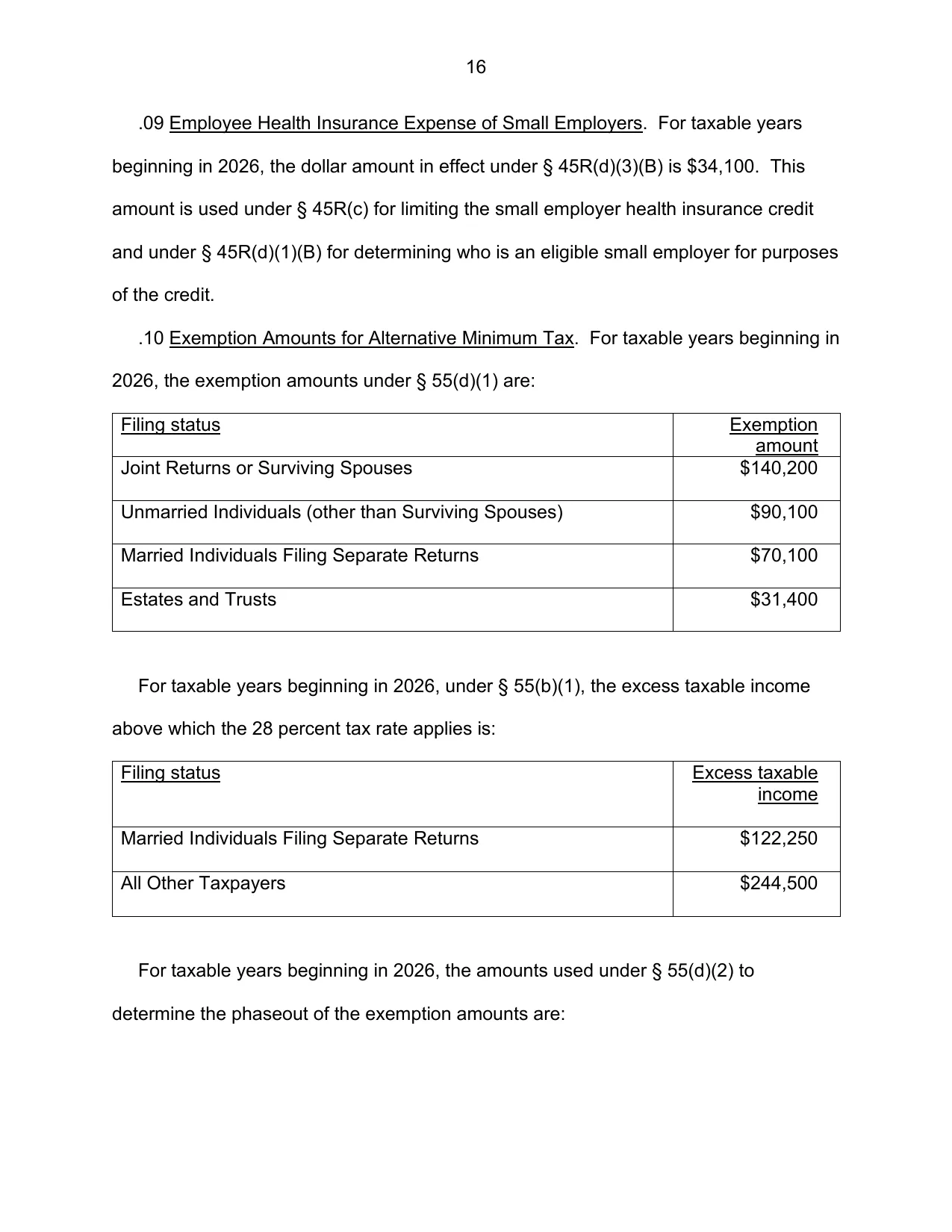
For 2026 the exemption is $140,200 joint, $90,100 unmarried, $70,100 married filing separately, and $31,400 for estates and trusts (Rev. Proc. 2025-32) — so a typical wage earner will never see Form 6251.
The people who do see it: employees who exercise incentive stock options and hold the shares; high earners in high-tax states deducting large state and local taxes; taxpayers with large private-activity bond interest, depreciation differences, or NOLs; and estates and trusts, whose phaseout starts at $104,800 of AMTI.
The operation, step by step
Part I builds AMTI, Part II computes the tax, Part III applies the maximum capital-gains rates — following the 2025 form; the 2026 form carries the same architecture.
Step 1 — Taxable income. Line 1 begins with Form 1040 taxable income.
Step 2 — Adjustments. Lines 2a through 2k reverse what the AMT does not allow, under section 56: standard deduction, miscellaneous itemized deductions, and personal exemptions disallowed; state and local taxes added back; depreciation recomputed; the alternative tax NOL deduction capped at 90 percent of AMTI.
Step 3 — Preferences. Line 3 adds the section 57 preferences, headed by tax-exempt interest on specified private activity bonds — income the regular system excludes and the AMT counts.
Step 4 — AMTI and exemption. Line 4 is taxable income plus adjustments plus preferences. Line 5 is the worksheet exemption, reduced by the phaseout where it applies; line 6, taxable excess, is AMTI minus the exemption.
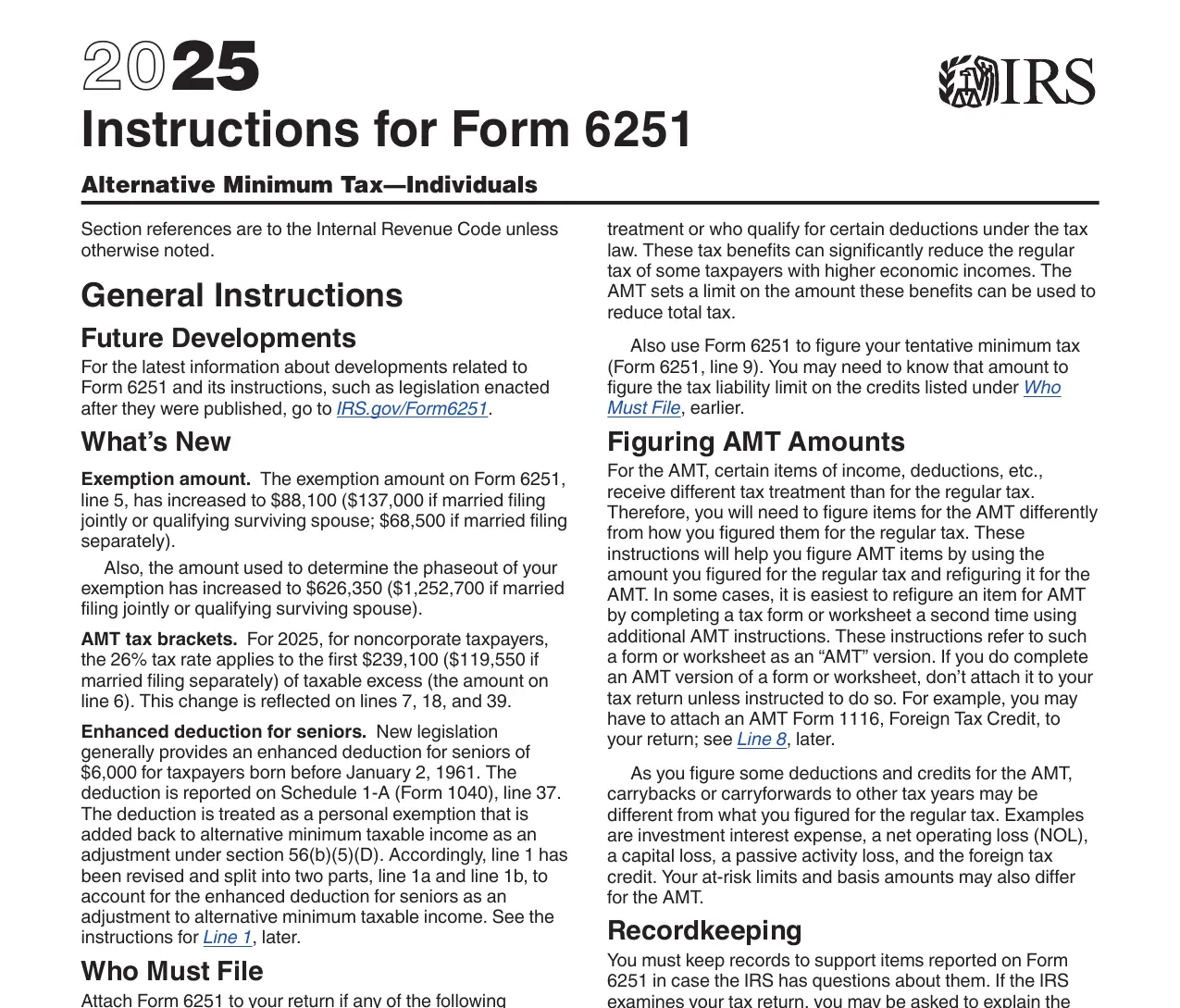
Step 5 — Tentative minimum tax and the comparison. Line 7 applies 26 percent up to the bracket threshold, 28 percent above it: $239,100 for 2025 ($119,550 MFS), $244,500 for 2026 ($122,250 MFS). Line 8 subtracts the AMT foreign tax credit (AMT Form 1116); line 9 is tentative minimum tax after that credit. Line 10 is regular tax; line 11, the AMT, is line 9 minus line 10, if positive, flowing to Schedule 2, line 2.
!Instructions for Form 6251, 2025, What's New
The adjustments that matter most
| Adjustment | Regular-tax treatment | AMT treatment | Authority |
| :--- | :--- | :--- | :--- |
| Standard deduction | Deducted from AGI | Not allowed; added back | § 56(b)(1)(D) |
| State and local taxes | Deducted (subject to cap) | Added back in full | § 56(b)(1)(A)(ii) |
| Miscellaneous itemized deductions | Deducted where allowed | Not allowed | § 56(b)(1)(A)(i) |
| ISO exercise spread | Not income at exercise (§ 421) | Added to AMTI | § 56(b)(3) |
| Private activity bond interest | Excluded from income | Tax preference | § 57(a)(5) |
| Net operating loss | § 172 deduction | ATNOL capped at 90% of AMTI | § 56(a)(4), (d) |
The 2026 exemption and phaseout
| Filing status | 2026 exemption | Phaseout begins | Exemption reaches zero |
| :--- | :--- | :--- | :--- |
| Joint / surviving spouse | $140,200 | $1,000,000 | $1,280,400 |
| Unmarried | $90,100 | $500,000 | $680,200 |
| Married filing separately | $70,100 | $500,000 | $640,200 |
| Estates and trusts | $31,400 | $104,800 | $167,600 |
Compare 2025: the exemption was $137,000 joint and $88,100 single, and the phaseout began at $1,252,700 joint. The One, Big, Beautiful Bill Act (Pub. L. 119-21, July 4, 2025) made the increases permanent.
The two published columns reveal the phaseout rate: for joint filers the gap between threshold and complete phaseout is $280,400, half of which is $140,200 — exactly the exemption. The same holds for every status, so the exemption phases out at 50 cents per dollar of AMTI above the threshold for 2026.
!Rev. Proc. 2025-32 AMT exemption amounts for 2026
> [!WARNING]
> The 2026 phaseout threshold is $252,700 lower for joint filers than in 2025. Re-run the exemption worksheet for 2026; do not carry the 2025 answer forward.
The ISO trap: where the AMT still bites
Under section 421, exercising an incentive stock option is not taxable for regular tax purposes — no income at exercise, tax deferred until sale. For AMT purposes, section 421 does not apply: the spread between fair market value at exercise and the exercise price is added to AMTI in the year of exercise, whether or not the shares are sold.
That creates the classic trap. An employee exercises at $50, pays $20 per share, and holds; the $30 spread is AMT income. If the stock falls to $25 before sale, the employee has paid AMT on $30 of gain that no longer exists, while the AMT basis is $50, not $20. The only remedy is the minimum tax credit in a later year — which only helps if regular tax then exceeds tentative minimum tax. The defenses are timing and sizing: exercise when other income is low, tranche across tax years, run Form 6251 first, never exercise on margin.
Worked example 1: ISO exercise, single filer, 2026
Stated assumptions, from verified 2026 amounts: a single filer with taxable income of $180,000, who exercises 5,000 ISO shares at $20 when the fair market value is $50, deducted $10,000 of state and local taxes, and claimed the $16,100 standard deduction.
The ISO spread is 5,000 shares times $30, or $150,000. AMTI is taxable income plus the spread, the $10,000 of state taxes, and the $16,100 standard deduction:
$
\text{AMTI} = 180{,}000 + 150{,}000 + 10{,}000 + 16{,}100 = \$356{,}100
$
AMTI is below the $500,000 single phaseout threshold, so the full $90,100 exemption applies; taxable excess is $266,000. Tentative minimum tax applies 26 percent to the first $244,500 and 28 percent to the remainder:
$
\text{TMT} = 0.26 \times 244{,}500 + 0.28 \times (266{,}000 - 244{,}500) = 63{,}570 + 6{,}020 = \$69{,}590
$
With regular tax of $35,000 as computed on the return, the AMT is $69,590 minus $35,000, or $34,590. The $150,000 spread produced no regular tax — and $34,590 of AMT.
> [!TIP]
> Before exercising ISOs, put the spread on a draft Form 6251 and check it against cash on hand. If the AMT exceeds available cash, exercise fewer shares or split the exercise across December and January.
Worked example 2: phaseout and the minimum tax credit, joint filers, 2026
Joint filers with AMTI of $1,100,000: the exemption is $140,200, but the phaseout threshold is $1,000,000, so $100,000 sits above it. At 50 cents per dollar the exemption falls by $50,000 to $90,200, and taxable excess is $1,009,800. Tentative minimum tax is:
$
\text{TMT} = 0.26 \times 244{,}500 + 0.28 \times (1{,}009{,}800 - 244{,}500) = 63{,}570 + 214{,}284 = \$277{,}854
$
The $34,590 of AMT in Example 1 was caused by a deferral item — the ISO spread, timing rather than a permanent exclusion. Section 53 allows a minimum tax credit for that kind of AMT: the adjusted net minimum tax imposed in prior years after 1986, less credits already used, claimed on Form 8801 and limited to the excess of regular tax over tentative minimum tax in the year used. If, in a later year, that excess is $40,000, the full credit can be used and the carryforward falls to zero.
The distinction in section 53(d)(1)(B) is the part most filers miss: AMT from exclusion preferences — the section 56(b)(1) adjustments and section 57(a)(1), (5), and (7) preferences — generates no credit. Only AMT from deferral items, such as the ISO spread, creates one. State taxes and the standard deduction add-back buy no future credit; the ISO spread does. Track it by year: composition, not just amount, decides what comes back.
> [!FOUNDER]
> "The AMT is the tax system's way of charging rent on timing. You deferred the income, you pay the floor now, and the credit is the receipt — keep it, because the system will not remind you it owes you."
> — Enow A. Jovial, Founder & Chief Executive Officer
The decision table: regular tax vs. AMT
| Situation | Regular tax | AMT exposure | Correct move | Authority |
| :--- | :--- | :--- | :--- | :--- |
| ISO exercise, hold shares | No income at exercise | Spread added to AMTI | Pre-compute Form 6251; tranche exercises | § 56(b)(3); § 421 |
| SALT-heavy return, high-tax state | Deducted subject to the SALT cap | Added back in full | Model the add-back before prepaying tax | § 56(b)(1)(A)(ii) |
| Private activity bond interest | Excluded from income | Tax preference added to AMTI | Price the yield after AMT, not before | § 57(a)(5) |
| Large NOL carryforward | § 172 deduction | ATNOL capped at 90% of AMTI | Keep a separate AMT loss schedule | § 56(a)(4), (d) |
| Standard deduction filer, no adjustments | Deducted from AGI | Added back; usually still below exemption | File Form 6251 only if TMT exceeds regular tax | § 56(b)(1)(D); § 55(d) |
Risk layer: penalties and failure modes
The AMT has no separate penalty regime; it borrows the ordinary ones. Failure to file carries 5 percent of the tax per month, up to 25 percent, under section 6651(a)(1); failure to pay adds 0.5 percent per month, also capped at 25 percent. An accuracy-related penalty of 20 percent applies under section 6662 for negligence or a substantial understatement. Omitting Form 6251 entirely is an understatement like any other.
The failure modes are operational, each with a cheap fix. First, the missing Form 6251: a prior-year answer carried forward in software. Second, the stale exemption: 2025 figures on a 2026 return. Third, the lost credit: AMT paid in a prior year, never tracked or claimed on Form 8801. Fourth, the AMT basis error: selling ISO shares on the regular-tax basis, overstating the AMT gain. Keep records of every item figured differently for AMT — separate carryforwards, basis amounts, and loss limitations.
Cross-border and entity context
A nonresident filing Form 1040-NR uses the same Form 6251, starting from Form 1040-NR line 14 and refiguring capital gains and losses for AMT purposes first. Foreign tax credits are recomputed on an AMT Form 1116, so foreign-source income can produce AMT even when the regular credit zeroes out regular tax.
The identifiers on the return decide which system applies. A return filed under an SSN or an ITIN is an individual return, and Form 6251 is the individual's form. An EIN belongs to the entity, and a C-Corp does not file Form 6251 at all — corporations face a separate 15 percent corporate alternative minimum tax on adjusted financial statement income for applicable corporations under section 55(b)(2). An LLC taxed as a sole proprietorship flows everything to the owner's return. An S-Corp passes its items through on Schedule K-1, and the shareholder takes the AMT adjustments into the shareholder's own Form 6251. Payroll taxes are outside this form: FICA applies to wages and SECA to self-employment earnings. A CPA works from GAAP-basis books, but the AMT adjustments are tax-basis computations — the AMT uses the tax number.
The 5-step workflow
1. Assemble the AMT inputs. Pull ISO exercise statements with fair market value at exercise, state tax records, private activity bond interest, and K-1s. Confirm filing status — the exemption and thresholds turn on it.
2. Build a draft Form 6251. Start from taxable income, add section 56 adjustments and section 57 preferences, subtract the worksheet exemption, and compute tentative minimum tax at 26 and 28 percent — before any transaction that can still be timed.
3. Decide the transactions against the draft. If the draft shows AMT, tranche the ISO exercise, defer the state tax prepayment, or shift income across the year boundary — and re-run the draft after each change, because the phaseout makes the result nonlinear near $1,000,000 joint and $500,000 single.
4. File with the credit tracked. Attach Form 6251, enter the AMT on Schedule 2, and open a credit schedule: total AMT paid, the deferral-item share, and the Form 8801 carryforward. Keep the AMT basis of ISO shares in the same file.
5. Revisit in the following year. Each later year, compute regular tax minus tentative minimum tax first; that gap is the ceiling for the section 53 credit. File Form 8801 whenever the gap is positive and a credit remains.
Action checklist
The AMT rewards the taxpayer who computes it early and punishes the one who discovers it in April. Run Form 6251 before the transactions that trigger it and keep the credit schedule after the years that create it. See /article/irs-form-1040-schedule-2-additional-taxes-playbook and /article/irs-form-1040-schedule-3-additional-credits-playbook; capital-gain rates follow /article/irs-form-1040-schedule-d-capital-gains-playbook. Test an ISO exercise at /article/profit-calculator.