Influencer Marketing ROI Measurement and Attribution Playbook: The Math, the Holdout, and the Disclosure Rules
A brand approves a $48,000 influencer test, twelve creators post for eight weeks, and the agency report comes back glowing: 1.9 million views and a 1.79 return on ad spend. The chief financial officer asks how much of that revenue would have arrived without the creators — and the room goes quiet. Influencer ROI is the revenue you can attribute to a creator, minus the fully loaded cost, adjusted for sales that would have happened anyway, and defended against the disclosure rules that decide whether the spend was lawful.
What ROI measurement actually means
Return on investment in influencer marketing has three meanings, and most reporting swaps between them: engagement return (views, likes, comments, saves), attributed return (revenue tied to a creator through a code, a link, or a survey), and incremental return (revenue that would not have existed without the creator). Only the third is ROI in the sense a finance team recognises; the first is a receipt for attention.
The five rates that decide a campaign — cost per mille, cost per engagement, cost per click, cost per acquisition, return on ad spend — are each computed on the fully loaded cost, not the creator fee: creator fees, gifted product at cost, the platform subscription, the platform's management fee on the money flowing through it, and paid distribution. A fee-only CPA is a vanity metric with a denominator chosen to flatter the buyer.
Two thresholds govern every decision that follows. Break-even CPA is the average order value multiplied by the gross margin: spend more per order and the campaign loses money on contribution before overhead. Break-even ROAS is one divided by the gross margin — a brand with a 62 percent margin breaks even at 1.61, not 1.00, so a campaign reporting a 1.30 ROAS as a win is reporting a loss.
The $48,000 test, worked end to end
Our editorial analysis builds the worked example below from stated inputs, so every number in it can be recomputed. A direct-to-consumer skincare brand approved a $48,000 test budget for eight weeks with twelve creators — eight micro, three mid-tier, one macro — and two missed their deadlines, leaving $6,980 unspent. The loaded cost was:
| Cost line | Amount | Authority |
|---|---|---|
| Creator fees, 12 creators | $36,000 | Contracts on file |
| Gifted product at cost, 12 × $85 | $1,020 | Cost of goods |
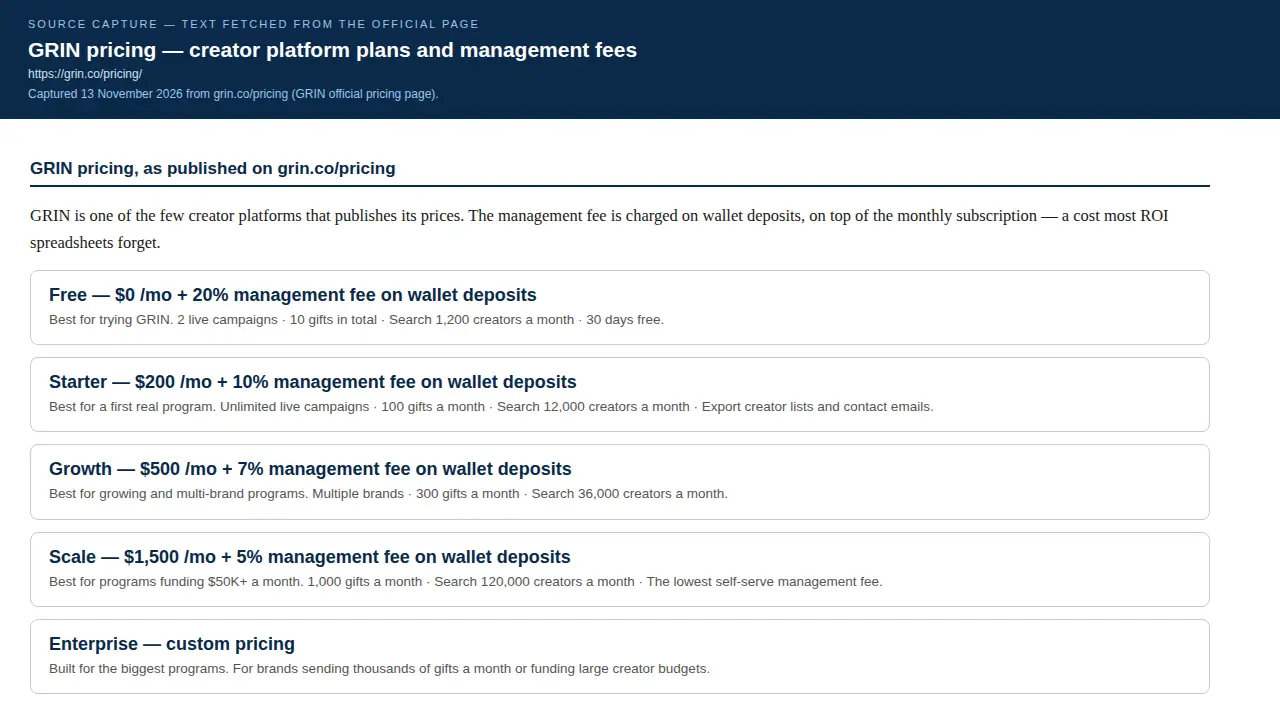
| Platform, Starter plan, 2 months | $400 | GRIN pricing, $200/month |
| Management fee, 10% of $36,000 wallet deposits | $3,600 | GRIN pricing, Starter tier |
| Loaded cost | $41,020 | Sum of the four lines |
GRIN publishes its prices: Starter is $200 per month plus a 10 percent management fee on wallet deposits, Growth is $500 per month plus 7 percent, and Scale is $1,500 per month plus 5 percent for programs funding $50,000 or more a month. On $36,000 of creator payments, the Starter fee is $3,600 — nine times the subscription — while the Free plan's 20 percent fee would be $7,200. Platform fees are the most commonly omitted line in influencer ROI reporting, and the easiest to verify, because the price is published.
The results were 1,920,000 views, 96,000 engagements, 12,000 tracked link clicks, and 612 attributed orders at a $120 average order value. Attributed revenue was $73,440:
On last-click numbers the campaign clears both bars: the $67.03 CPA sits below the $74.40 break-even, and the 1.79 ROAS sits above the 1.61 break-even. Contribution was $73,440 × 62% = $45,532.80 against $41,020 of loaded cost, a contribution ROI of 11.0 percent. That is a pass — and where most teams stop measuring, though none of these numbers answers whether the creators caused the orders.
Attribution: reconciling the code, the link, and the survey
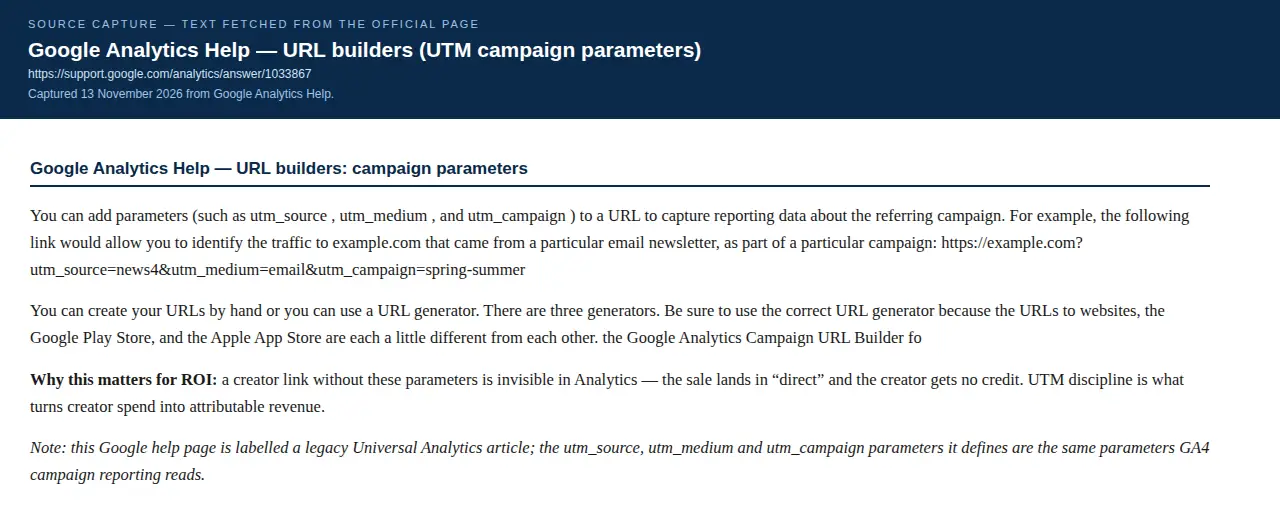
Attribution assigns each order to a cause without counting it twice. Three instruments do the work, each with a blind spot. Promo codes are the most reliable: a code redeemed at checkout is a direct claim by the buyer. UTM parameters are the second: Google's Analytics help defines utm_source, utm_medium, and utm_campaign as the parameters that identify the traffic a link brings. The third is the post-purchase survey — "how did you hear about us?" — which catches the buyer who saw a creator, never clicked, and typed the URL directly.
The 612 attributed orders reconciled as follows: 480 carried a creator promo code, and 132 arrived through a UTM-tagged creator link without a code. Forty-one carried both a code and a UTM click; they were counted once, inside the 480. The survey identified buyers who named a creator but used neither instrument — recorded as influenced, not attributed. The rule is simple to state and easy to violate: an order is attributed once, to one instrument, in a fixed priority order — code first, then UTM click, then survey — written down before the campaign starts, not chosen after the results arrive.
| Method | What it proves | What it misses | Authority |
|---|---|---|---|
| Promo code | Buyer used the creator's code | Buyers without the code | Brand's order data |
| UTM link | Buyer clicked the creator's link | View-through buyers | Google Analytics Help |
| Post-purchase survey | Buyer names the creator | Recall bias; misattribution | Brand's checkout data |
Two failure modes. Code leakage: a creator's code ends up on a coupon site, and orders from strangers who never saw the post are credited to the creator. The defence is a redemption audit — compare redemptions against the creator's tracked clicks, and investigate any code whose redemptions exceed its clicks by a wide margin. Last-click theft: an affiliate or retargeting ad takes credit for an order the creator caused, because the last click wins in the analytics tool. The defence is the priority order above, plus a rule excluding creator-attributed orders from the affiliate's commission report. Without both, the same order is paid for twice, and the ROI is overstated by exactly the overlap.
Incrementality: the number that kills the headline
Last-click attribution answers "who touched the order last." Incrementality answers "would the order exist without the creator." The difference is measured with a holdout: a matched group or region that does not see the creator content. The $48,000 test ran a geo-holdout — two comparable regions, one exposed, one held back — plus a survey asking attributed buyers whether they would have bought anyway. Both agreed: 34 percent would have purchased without the creator.
The headline said 1.79 ROAS and an 11.0 percent contribution return. The incrementality-adjusted truth is a 1.18 ROAS and a 26.7 percent loss on contribution. The campaign did not make money; it bought $48,480 of revenue that would not otherwise exist, at a cost of $41,020, on a product whose margin could not carry the acquisition cost. The fix is cheaper creators or a higher-margin bundle, not more spend. A team that reports only the 1.79 would scale a loss — which is why the holdout belongs in the contract with the agency, not in the appendix of the report.
Creator whitelisting: the same creative, paid distribution
Whitelisting — running a creator's post as a paid ad from the creator's handle — is where influencer spend meets media buying, and the one place where a clean comparison is possible, because the same creative runs both ways. The three best videos from the $48,000 test were put behind $12,000 of paid spend, buying 310,000 additional views and 204 orders at the same $120 average order value, for $24,480 of revenue.
The whitelisted CPA of $58.82 beats the organic blended CPA of $67.03 — but only part of that gap is real. The three videos chosen were the three best performers, so selection bias flatters the comparison. The honest statement is narrower: for the best creative, paid distribution acquired orders more cheaply than the blended organic rate. Price that right into the contract: 90 days of paid usage is worth the CPA advantage times the orders the paid run is expected to produce.
TikTok's Creator Marketplace now lives inside TikTok One: the brand pays after the creator accepts, TikTok holds the funds until the video is approved and published, and the Branded Content disclosure switches on automatically. On Meta, the creator adds the paid partnership label and turns on "Allow brand partner to boost." On YouTube, the hub formerly called BrandConnect is now YouTube Creator Partnerships, inside YouTube Studio: the brand negotiates and pays the creator directly, and needs the creator's opt-in to run the video as an ad. In all three cases, the disclosure duty stays with the brand and the creator.
Disclosure: the rule that makes the math legal
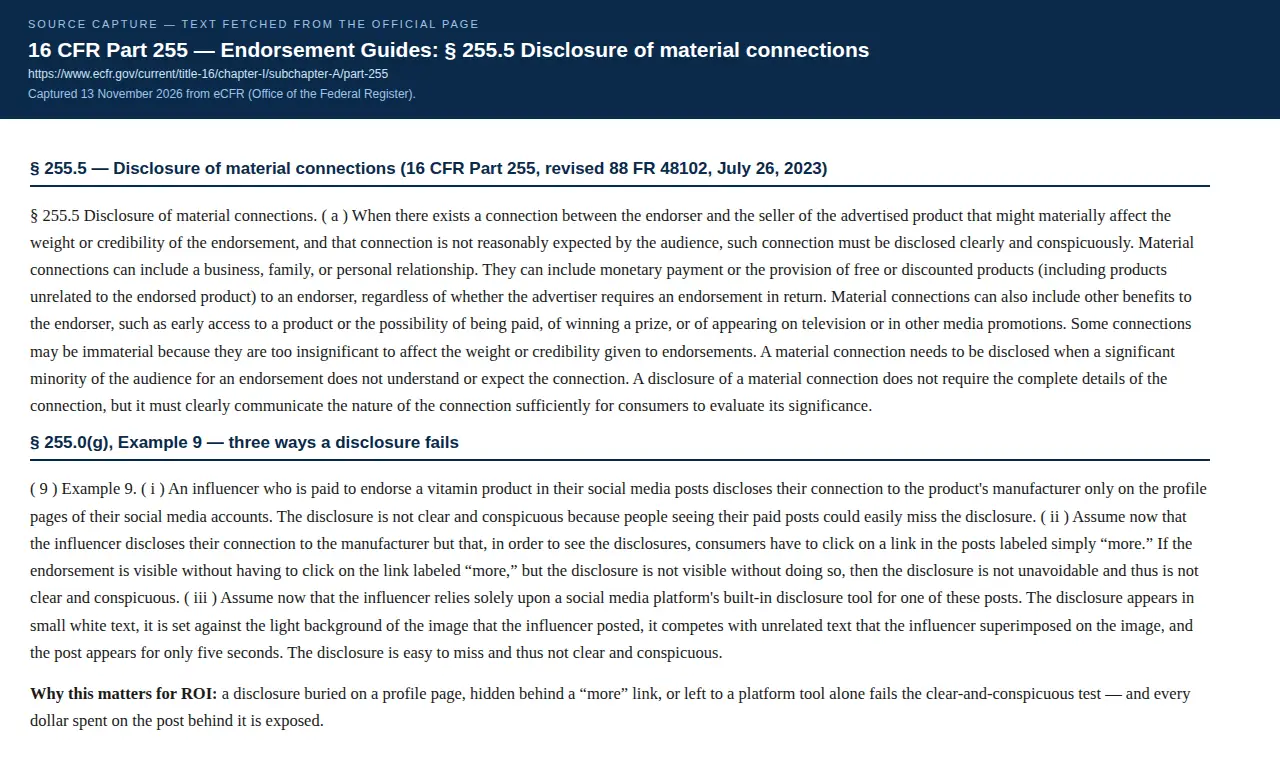
The FTC's Endorsement Guides, 16 CFR Part 255, revised in 2023, require a creator to disclose any material connection — payment, free or discounted products, even unrelated products, and the mere possibility of being paid. The disclosure must be clear and conspicuous: unavoidable, in the same language as the endorsement, never hidden behind a "more" link or a profile bio.
Enforcement is not theoretical. The FTC's civil penalty maximum is $53,088 per violation for penalties assessed after January 17, 2025, and twelve creators posting without disclosure is twelve exposures, not one. The FTC's 2024 rule on fake reviews, 16 CFR Part 465, also prohibits buying reviews conditioned on sentiment, suppressing negative reviews, and faking influence — followers, views, or likes from bots or hijacked accounts. Results claims are governed too: an atypical result must be disclosed as atypical, and the FTC has tested "results not typical" disclaimers and found them ineffective — use the median, not the mean.
The rules travel. U.S. law applies to endorsements made from abroad where it is reasonably foreseeable they will affect U.S. consumers, and platforms apply their own branded-content policies globally. Hold every creator to the strictest applicable standard in every market.
Who should — and should not — buy influencer spend
This playbook is for a brand with a tracked checkout, a known contribution margin, and at least $10,000 of test budget it can afford to lose. It is not for a brand without attribution infrastructure — no unique codes, no UTM discipline, no holdout — which cannot tell a good creator from a lucky one.
Founder & CEO Insight — Enow A. Jovial
Kill, keep, scale: the creator decision table
The $48,000 test ended with three creators and one decision each. The break-even CPA of $74.40 is the line: above it, a creator loses money on every order; below it, headroom.
| Creator | Fee | Orders | CPA | Decision |
|---|---|---|---|---|
| A — mid-tier beauty | $2,400 | 38 | $63.16 | Keep |
| B — macro lifestyle | $4,800 | 22 | $218.18 | Kill |
| C — micro skincare | $1,200 | 71 | $16.90 | Scale |
Creator B cost $218.18 per order against a $74.40 break-even — nearly three times the line — and the decision is to kill the relationship regardless of audience size. Creator C returned a $16.90 CPA with $57.50 of headroom per order: scale, with more budget, a longer contract, and whitelisting rights. For the pricing behind these fees, see the influencer marketing rate card and micro-influencer pricing playbook; for the paid-media comparison, TikTok Ads vs Meta Ads and YouTube Ads vs TikTok Ads.
The execution checklist
- [x] Write the priority order — code, then UTM click, then survey — before the first post.
- [x] Give every creator a unique code and a unique UTM campaign value.
- [x] Load the cost fully: fees, gifted product at cost, platform fees, paid distribution.
- [x] Set the break-even CPA from contribution margin and write it into the brief.
- [x] Contract the disclosure: "ad" or "sponsored," unavoidable, in the endorsement's language.
- [x] Audit code redemptions against clicks weekly; investigate any code that outruns its clicks.
- [x] Run a holdout before any scale decision, and report incremental ROAS beside attributed ROAS.
Run your own numbers before the next creator contract: the Marketing & Capital ROI Calculator turns your spend, margin, and attributed orders into the same break-even CPA, ROAS, and contribution figures above. Measurement is not the report after the campaign — it is the contract before it.