HIPAA Compliance for SaaS Operators: the Business Associate Playbook
A clinic signs up for your scheduling platform or your patient-messaging tool, and on day one your servers hold protected health information. From that moment HIPAA stops being a healthcare problem and becomes your operating problem: if you create, receive, maintain, or transmit protected health information on behalf of a covered entity, you are a business associate, directly liable under the HIPAA Rules. This playbook is for the founder, the CTO, and the operations lead who must sign the agreement, build the safeguards, and survive the breach clock.
Who HIPAA actually regulates
HIPAA's Privacy Rule, at 45 CFR Part 164, Subpart E, regulates three kinds of covered entity: a health plan, a health care clearinghouse, and a health care provider that transmits health information electronically in connection with a standardised transaction. Your customers are usually the third kind. A business associate is a person or entity, other than a member of the covered entity's workforce, who performs a function or activity on behalf of a covered entity that involves access to protected health information. The Department states it plainly: a business associate is also a subcontractor that creates, receives, maintains, or transmits protected health information on behalf of another business associate.
Since the 2013 Omnibus Rule, business associates are directly liable for unauthorised uses and disclosures, Security Rule failures, and missed breach notices — and the covered entity must obtain satisfactory assurances from you before disclosing the data, under 45 CFR 164.308(b)(1).
| Role | What it does | Direct liability | Authority |
|---|---|---|---|
| Covered entity | Treats, pays, operates on patients | Full Privacy, Security, Breach Rules | 45 CFR 160.103 |
| Business associate | Processes data for a covered entity | Unauthorised uses, Security Rule, breach notice | 45 CFR 164.502(e) |
| Subcontractor | Processes data for a business associate | Same as a business associate | 45 CFR 164.308(b)(2) |
The conduit exception is the narrowest escape in the regime and the most abused: a pure conduit — a carrier that moves encrypted packets it cannot open — is not a business associate, but the moment your service stores, indexes, or backs up the data, you are not a conduit.
The business associate agreement: ten terms you cannot skip
A covered entity may disclose protected health information to you only under a written contract satisfying 45 CFR 164.502(e) and 164.504(e). The Department publishes sample provisions, dated January 25, 2013, listing ten requirements the contract must carry. The contract must establish the permitted and required uses and disclosures; forbid any use or disclosure beyond what the contract permits or the law requires; require appropriate safeguards, including the Security Rule; require reporting of any use or disclosure the contract does not provide for, including breaches; support individual access, amendment, and accounting rights; require Privacy Rule compliance where you carry out a covered entity obligation; make books and records available to the Secretary; require return or destruction at termination if feasible; and authorise termination for a material breach.
Three terms are where SaaS contracts break. The reporting term: the sample invites a stricter breach-reporting deadline than the regulation's 60 days, and hospital customers take it — 72, 48, or 24 hours from discovery are common asks. Negotiate against your detection capability, not your optimism. The subcontractor term: every subcontractor that touches the data must agree to the same restrictions that apply to you, under 45 CFR 164.502(e)(1)(ii) and 164.308(b)(2). The termination term: return-or-destroy collides with backups, and the honest answer is a retention schedule — live data returned or destroyed within 30 days, backups purged on rotation.
The three safeguard families
The Security Rule, at 45 CFR Part 164, Subpart C, protects electronic protected health information through administrative, physical, and technical safeguards. Section 164.306 states the general rule: ensure the confidentiality, integrity, and availability of the data, protect against reasonably anticipated threats, and ensure workforce compliance — with measures reasonable and appropriate to your size, complexity, capabilities, and costs.
Administrative safeguards, at 45 CFR 164.308, are the management layer, and they are where most SaaS operators fail first. The standard is a security management process: policies and procedures to prevent, detect, contain, and correct security violations. Its required specifications are a risk analysis — an accurate and thorough assessment of risks and vulnerabilities to the data — and risk management, the measures that reduce those risks to a reasonable level. A risk analysis is not a questionnaire you buy and file; it is a documented inventory of where the data lives and who can reach it. The same section also requires a sanction policy, audit-log review, an identified security official, workforce security and termination procedures, security training, incident procedures, and a contingency plan.
Physical safeguards, at 45 CFR 164.310, govern facility access, workstation use and security, and device and media controls — mostly inherited from your hosting provider, which is why the provider must be a contracted business associate, not an informal vendor.
Technical safeguards, at 45 CFR 164.312, are the engineering layer, and this is where your API design becomes a compliance document. Access control must allow access only to persons or software programs granted access rights, with unique user identification and an emergency access procedure both required. Automatic logoff and encryption are addressable, not optional: no SaaS operator with production access to health data can document a credible reason to skip encryption. Audit controls must record activity in systems that contain the data, integrity controls must protect it from improper alteration, authentication must verify identity, and transmission security must guard data in transit.
The breach clock: 60 days, and discovery starts it
A breach is generally an impermissible use or disclosure that compromises the security or privacy of protected health information. Under 45 CFR 164.402, it is presumed to be a breach unless the entity demonstrates a low probability that the data was compromised, on four factors: the data and the likelihood of re-identification; the unauthorised person; whether it was actually acquired or viewed; and how far the risk has been mitigated. Three narrow exceptions cover good-faith workforce conduct. Only unsecured data triggers notification — data not rendered unusable, unreadable, or indecipherable by a method the Secretary specifies.
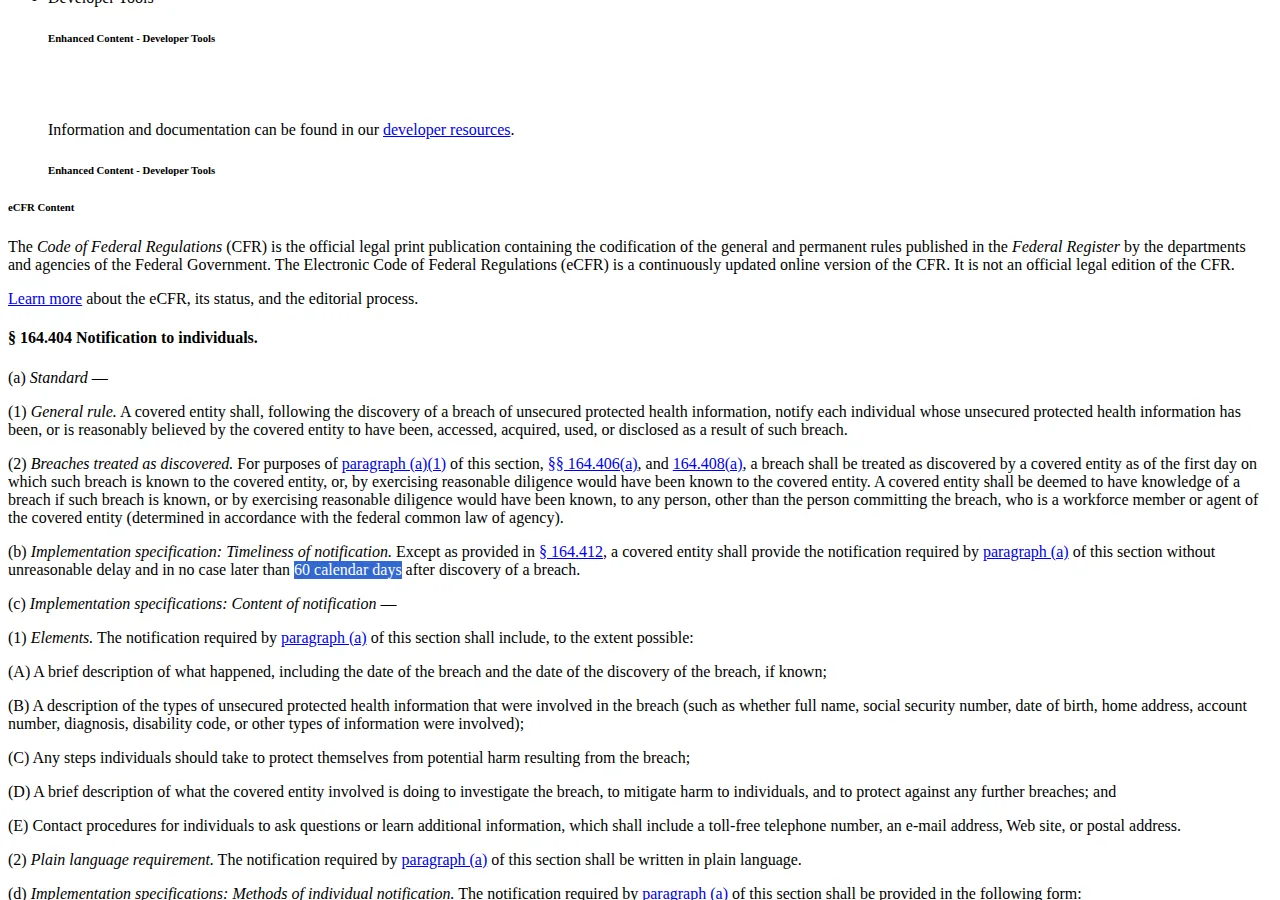
When notification is required, the clock in 45 CFR 164.404 is unforgiving: individual notice without unreasonable delay and in no case later than 60 calendar days after discovery. Discovery is the first day the breach is known, or by exercising reasonable diligence would have been known — and a workforce member's knowledge counts as the entity's. A breach affecting more than 500 residents of a state also requires notice to prominent media outlets serving that state, on the same 60-day deadline, under 45 CFR 164.406. Notice to the Secretary follows 45 CFR 164.408: 500 or more, within 60 days; fewer than 500, annually within 60 days after year-end. Under 45 CFR 164.410, a business associate must notify the covered entity without unreasonable delay and no later than 60 days from discovery.
Worked from a real calendar: a breach discovered Monday, November 2, 2026, gives 28 days remaining in November, then 31 in December, landing on day 59 at December 31 — so day 60 is Friday, January 1, 2027.
The penalty tiers: read the statute, not the headline
Civil money penalties sit in 42 U.S.C. section 1320d-5. Four tiers turn on culpability. The per-violation maximum is 50,000 dollars in every tier; what changes is the per-violation minimum and the annual cap on all violations of an identical requirement or prohibition in a calendar year. The tiers, as written in section 1320d-5(a)(3): no knowledge, 100 minimum, 25,000 cap; reasonable cause, 1,000 minimum, 100,000 cap; willful neglect corrected within 30 days, 10,000 minimum, 250,000 cap; willful neglect not corrected, 50,000 minimum, 1,500,000 cap. Amounts are adjusted annually for inflation.
| Tier | Culpability | Minimum per violation | Maximum per violation | Annual cap, identical requirement |
|---|---|---|---|---|
| 1 | Did not know | $100 | $50,000 | $25,000 |
| 2 | Reasonable cause, not willful neglect | $1,000 | $50,000 | $100,000 |
| 3 | Willful neglect, corrected within 30 days | $10,000 | $50,000 | $250,000 |
| 4 | Willful neglect, not corrected | $50,000 | $50,000 | $1,500,000 |
Worked scenario — suppose a scheduling platform's backup job stops encrypting, and the regulator counts 40 identical violations of the same encryption requirement in one calendar year, all tier 2. The cap is what matters, because it binds fast:
The range is 40,000 to 100,000 dollars for one identical requirement in one year — a second requirement breached in the same year starts a second cap. At tier 4 the cap binds immediately: 30 uncorrected willful-neglect violations at 50,000 dollars each equal 1,500,000 dollars, exactly the annual cap. Two further points: section 1320d-5(b)(2) imposes no penalty where a failure due to reasonable cause is corrected within 30 days of when the person knew, or should have known, of it — but that safe harbour does not extend to willful neglect. Section 1320d-5(b)(1) bars a civil penalty for an act already punished criminally.
The criminal track, 42 U.S.C. section 1320d-6, reaches individuals, including employees. A person who knowingly uses a unique health identifier, obtains individually identifiable health information, or discloses it in violation of the rules faces a fine of not more than 50,000 dollars, imprisonment of not more than one year, or both; under false pretenses, 100,000 dollars and five years; with intent to sell, transfer, or use it for commercial advantage, personal gain, or malicious harm, 250,000 dollars and ten years.
What this playbook costs, and who should not use it
Compliance spend is a budget line before it is a legal argument. Recurring costs are the risk analysis and its annual refresh, workforce training, the security official's time, audit-log review, penetration testing, and the agreements across the subcontractor chain; one-off costs are the gap assessment, the encryption build, and the incident-response plan. Run the total through the profit calculator against your gross margin before you sign a healthcare customer: if annual compliance cost exceeds the margin on that customer, raise the price or narrow the scope. Under GAAP, work that builds a durable control is often capitalised while monitoring and training are expensed, so have a CPA confirm the treatment.
Get the entity details right at the same time. Most operators in this market run as a single-member LLC or a Delaware C-Corp, and the EIN on the business associate agreement must match the legal name on the entity's formation documents, not the brand on the website. Your B2B contracts should carry the same legal name everywhere — master agreement, business associate agreement, data processing terms. Do not confuse an uptime SLA with a business associate agreement.
Who should not follow this playbook: a consumer wellness app with no covered-entity customer and no health-plan data is not regulated by HIPAA at all — its exposure, if any, sits under the Federal Trade Commission's health breach notification rule for vendors of personal health records. A SaaS operator that stores no protected health information is likewise outside the regime, but only if that claim survives a data-flow audit. No playbook replaces counsel.
Operators keep importing the wrong regime's deadline. The European rule is the GDPR data subject access request, answered in 30 days under Articles 12 and 15 — see the GDPR data subject access request 30-day playbook. The California rule is the CCPA and CPRA deletion request — see the CCPA and CPRA consumer deletion request playbook.
Founder & CEO Insight — Enow A. Jovial
The operator checklist
- [x] Step 1: Map the data: inventory every store, log, backup, and queue that can hold protected health information.
- [x] Step 2: Classify every counterparty: label each vendor covered entity, business associate, subcontractor, or conduit.
- [x] Step 3: Execute the agreements: sign a business associate agreement with every customer and subcontractor before the first record flows.
- [x] Step 4: Name the security official: assign one person, in writing, with responsibility for the Security Rule programme.
- [x] Step 5: Run the risk analysis: complete an accurate and thorough assessment and fund the remediation.
- [x] Step 6: Build the technical controls: unique user identification, audit logging, encryption in transit and at rest, authentication on every API and SDK surface.
- [x] Step 7: Train the workforce: security awareness and training for every workforce member including management, with sanctions for non-compliance.
- [x] Step 8: Write the incident plan: a dated discovery log, a notification procedure that meets the 60-day ceiling, a named decision-maker for the breach assessment.
- [x] Step 9: Test and evaluate: backups restored on a schedule, a disaster recovery run, an emergency-mode operation test, and a periodic technical and nontechnical evaluation.