Gong, Chorus and Avoma all record sales calls and turn them into coaching, but they charge for that in three different shapes. Avoma publishes its price: $19 to $39 per recorder seat a month, billed annually. Chorus sells a base package: $8,000 a year including three seats, plus $1,200 for each additional seat, on buyer-reported figures. Gong publishes no price at all: its own pricing page says only that licences are priced per user and that a platform fee applies, and buyer-reported figures put the core licence at about $1,600 per user a year, plus a $5,000 to $50,000 platform fee and $7,500 to $65,000 of onboarding. The cheapest per-seat rate in this comparison is 40 times cheaper than the most expensive one, and the gap is the whole story.
The three products are not the same purchase. Gong is revenue intelligence for an enterprise sales organisation: recording, transcription, deal tracking, forecasting and coaching, sold as a platform with separately priced modules. Chorus, owned by ZoomInfo since its $575 million acquisition in July 2021, is conversation intelligence inside a go-to-market data suite, and ZoomInfo's sales team would much rather sell the bundle than the standalone product. Avoma is an AI meeting assistant that grew into conversation intelligence: recording and notes first, coaching and forecasting as add-ons, priced per recorder seat with viewers free. The buyer chooses between a platform, a bundle and a tool — and the price follows that choice.
The three meters, side by side
| Platform | What you pay for | Entry price | Ceiling that matters | Authority |
|---|---|---|---|---|
| Gong | Per-user licence + platform fee + onboarding | Quote only; ~$1,600/user/yr reported | Platform fee $5,000–$50,000/yr, onboarding $7,500–$65,000 | gong.io/pricing (quote-only, read Nov 20, 2026); Avoma Gong Pricing guide, Nov 16, 2026 |
| Chorus | Base package + per-seat | Quote only; $8,000/yr for 3 seats reported | 2-year standard contract; bundle push to $25,000+/yr | zoominfo.com/products/chorus/pricing (quote-only, read Nov 20, 2026); ItsConvo + Prospeo, 2026 |
| Avoma | Per recorder seat | Startup $19, Organization $29, Enterprise $39/seat/mo annual | Add-ons $19–$29/seat/mo; viewers free | avoma.com/pricing, read Nov 20, 2026 |
Gong and Chorus publish no prices, so every Gong and Chorus figure here is buyer-reported, labelled as such, and corroborated across at least two independent 2026 reads. Avoma's figures are from Avoma's own pricing page, fetched this cycle. That asymmetry is itself a buying signal: the vendor that publishes its price can be checked, and the vendor that hides its price is negotiated.
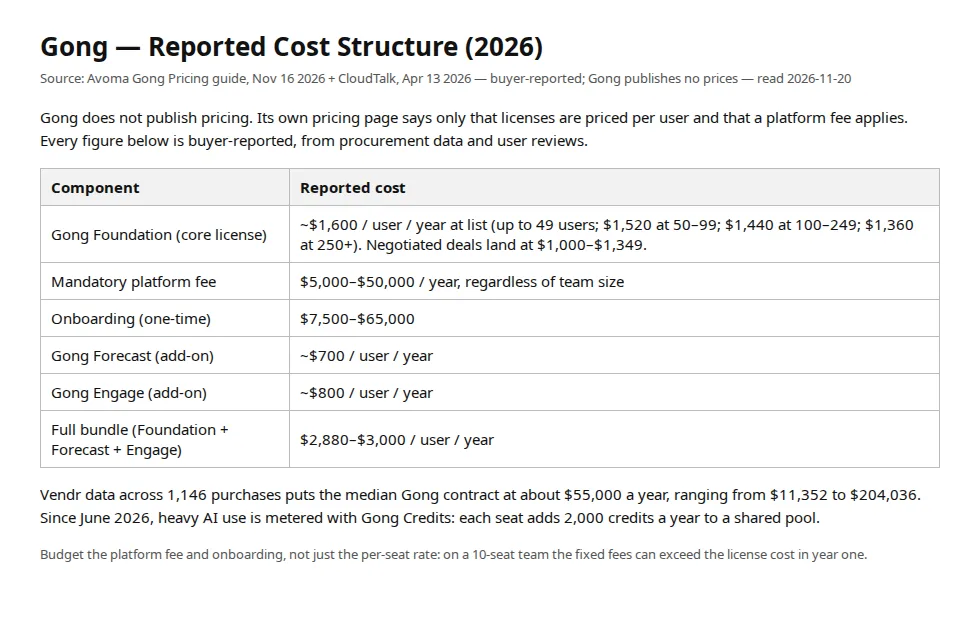
Gong: the licence is the smallest line on the invoice
Gong's pricing has four layers, and the per-seat rate buyers quote first is the smallest of them. The core licence, Gong Foundation, runs about $1,600 per user a year at list for teams up to 49 users, falling to $1,520 at 50 to 99, $1,440 at 100 to 249 and $1,360 at 250 or more. Negotiated deals land at $1,000 to $1,349. That is the number on the slide. Then the mandatory platform fee arrives: $5,000 to $50,000 a year, regardless of team size. Then onboarding: $7,500 to $65,000 one-time for implementation, admin training and CRM setup. Then the modules: Gong Forecast at about $700 per user a year, Gong Engage at about $800, with the full bundle at $2,880 to $3,000 per user a year.
The year-one math for a 10-seat team at the lowest reported fees shows why the fixed fees dominate:
ext{Gong year one (10 seats)} = 10 imes $1{,}600 + $5{,}000 + $7{,}500 = $28{,}500
The licences are $16,000 of that $28,500. The platform fee and onboarding are $12,500 — 44% of the year-one bill — and neither scales down for a small team. A 25-seat team pays $52,500 in year one at the same fees. Vendr's transaction data across 1,146 Gong purchases puts the median contract at about $55,000 a year, ranging from $11,352 to $204,036. Since June 2026, heavy AI use is metered with Gong Credits: each seat adds 2,000 credits a year to a shared pool, drawn on by AI trackers, MCP and API workflows. A team that bought Gong for unlimited AI analysis now has a meter to watch.
Gong suits the enterprise sales organisation with 50 or more reps, a CRM already in place, and a revenue operations team that will use the forecasting module. It is the wrong buy for a 10-person team: the platform fee alone is $500 per user a year before a single call is recorded, and the onboarding fee exceeds Avoma's entire annual cost for the same team. The Salesloft vs Outreach vs Apollo sales engagement pricing playbook covers the sequencing tools that feed Gong's pipeline — the same buyer, the same budget, and the same mistake to avoid, which is buying the platform before the process exists.
Founder & CEO Insight — Enow A. Jovial
Chorus: the base package is the price, and the bundle is the pitch
Chorus publishes no price either, and its pricing page now redirects to ZoomInfo, which sells custom plans. The buyer-reported structure is consistent across independent 2026 reads: a base package of $8,000 a year including three seats, plus $1,200 for each additional seat, on a standard two-year contract. The effective per-seat cost falls as the team grows, because the base fee spreads across more seats:
ext{Chorus annual cost} = $8{,}000 + $1{,}200 imes ( ext{seats} - 3)
Three seats cost $8,000 a year, about $222 per seat a month. Ten seats cost $16,400, about $137. Twenty-five cost $34,400, about $115. Fifty cost $64,400, about $107. Volume and multi-year discounts of 10% to 35% are reported, but the effective rate is not reported to fall below about $100 per seat a month. A second reading puts standalone Chorus at about $50 per user a month when negotiated hard — treat that as a floor to push toward, not the price on the quote.
The real Chorus price is usually not the standalone price. ZoomInfo's sales team pushes the bundle: Chorus inside a ZoomInfo Advanced or Professional package, reported at $35,000 to $50,000 a year for Professional and $60,000 to $80,000 for Advanced at 10 users. Existing ZoomInfo customers often add Chorus for $0 to $5,000 on top of their data contract — nearly free for a team already paying ZoomInfo, and expensive for a team that is not. Price Chorus twice: once standalone, once as an addition to a ZoomInfo contract the team already holds or would buy anyway. If the team does not use ZoomInfo data, the bundle is a $25,000-a-year tax on a $16,400-a-year product. Our Apollo vs ZoomInfo vs Lusha sales intelligence pricing playbook prices the data side of that bundle, so the two guides together give the full cost of the Chorus decision.
Avoma: the recorder seat is the whole meter
Avoma's pricing is the simplest here, and the simplest to verify, because it is printed on Avoma's own page. The AI Meeting Assistant has three tiers, priced per recorder seat a month: Startup $19 billed annually ($29 monthly), Organization $29 billed annually ($39 monthly), Enterprise $39 billed annually only. Viewers are always free. Only the people who record calls are paid seats: a 10-person sales team where only 5 people record calls pays for 5 seats, not 10. That distinction is worth more than any discount: it is the only meter here the buyer controls by changing behaviour rather than by negotiating.
The add-ons are priced the same way, per seat a month billed annually: Conversation Intelligence $29, Revenue Intelligence $29, Lead Router $19. Monthly billing raises them to $35, $35 and $25. A 10-seat team on Organization with the Conversation Intelligence add-on pays:
ext{Avoma year one (10 recorders)} = 10 imes $29 imes 12 + 10 imes $29 imes 12 = $6{,}960
Without the add-on, the same team pays $3,480 a year. Onboarding with an Avoma expert is optional at $1,000 one-time, not mandatory. There is no platform fee. Annual billing saves up to 33%: Organization at $29 annual versus $39 monthly saves $120 per seat a year, or $1,200 on a 10-seat team. Avoma suits the small and mid-market team that wants recording, transcription and notes now, and coaching later as an add-on. It is the wrong buy for a team that needs enterprise forecasting and multi-level deal inspection, because Avoma's Revenue Intelligence is an add-on, not a platform — the buyer who outgrows it will migrate, and should budget that migration.
The decision: three teams, three answers
| Buyer | Buy this | Skip this | Authority |
|---|---|---|---|
| 5–25 reps, wants recording and notes now | Avoma Organization, $29/recorder seat/mo annual | Gong — the platform fee exceeds the licence value | avoma.com/pricing |
| 25–100 reps, already pays ZoomInfo | Chorus as a ZoomInfo add-on ($0–$5K reported) | Chorus standalone at the $8,000 base | ItsConvo + Prospeo, 2026 |
| 50+ reps, revenue operations team, forecasting needed | Gong Foundation + Forecast, negotiated to $1,000–$1,349/user/yr | Gong Engage until the core licence is proven | Avoma Gong Pricing guide, Nov 2026 |
| Any team, first conversation-intelligence buy | Avoma Startup trial, then Organization | A two-year Chorus term or an annual Gong contract | gong.io/pricing; zoominfo.com/products/chorus/pricing |
The year-one totals for 10 seats, at the lowest reported fees, are $3,480 for Avoma Organization, $16,400 for Chorus, and $28,500 for Gong. At 25 seats they are $8,700, $34,400 and $52,500. The ratio barely moves with team size, because the fixed fees behind Gong and the base package behind Chorus do not fall as fast as the per-seat rate. Avoma is 8 times cheaper than Gong at 10 seats and 6 times cheaper at 25 — before Gong's Forecast and Engage modules, which add $700 and $800 per user a year. The Otter vs Fireflies vs Fathom AI meeting notes pricing playbook covers the note-taking layer underneath all three: the team that already records with Otter or Fireflies should check whether it needs conversation intelligence at all, or whether the notes it has are enough.
Buying in the right order
- Count recorders, not reps. List the people who actually record customer calls. That number, not the headcount, is the seat count for Avoma and the starting point for Gong and Chorus.
- Trial Avoma first. Start on Startup at $19 a recorder seat a month, billed annually, and run it for one sales cycle. The trial answers whether the team watches the recordings.
- Get Gong and Chorus quoted in writing. Ask for the platform fee, the base package, the onboarding fee, the contract term and the year-two price, each as a separate line. A quote that bundles them is not comparable.
- Price Chorus twice. Once standalone, once as an addition to a ZoomInfo contract the team already holds or would buy anyway. The cheaper of the two is the real Chorus price.
- Decide on the recording habit, not the feature list. If managers do not review two calls a week in the trial, no coaching feature will fix that, and the cheapest tool that records is the right one.
- [x] Count recorder seats before any quote: the number of people who record calls decides Avoma's bill and anchors the Gong and Chorus negotiation.
- [x] Budget the fixed fees, not just the licence: Gong's platform fee and onboarding are 44% of a 10-seat year-one bill at the lowest reported fees.
- [x] Confirm the contract term in writing: Chorus is commonly two years, Gong is annual upfront, Avoma Enterprise is annual only.
- [x] Check the AI meter: Gong Credits have metered AI use since June 2026, with 2,000 credits a seat a year in the shared pool.
- [x] Run the ROI calculator on the coaching habit: feed it the calls managers actually reviewed in the trial, not the calls the tool recorded.
- [x] Re-price at renewal: the year-two Gong licence, the Chorus bundle and the Avoma annual rate are three different decisions, and none of them is the year-one price.
The decision is not which tool records best. It is which price shape matches how the team actually works: a per-recorder meter for a team still learning to use recordings, a base package for a team already inside ZoomInfo, or a platform fee for an enterprise that will use the forecasting. Buy the shape that fits the habit, and let the trial prove the habit before the contract locks it in.