One row, two laws
A customer record sits in a CRM: name, email, purchase history, support tickets, marketing consent flag. The customer lives in Berlin for half the year and in Los Angeles for the other half. That single row is personal data under two laws at once. The GDPR governs it because the person is in the EU when the data is processed; the CCPA, as amended by the CPRA, governs it because the person is a California resident. The two laws agree on the goal — the person controls their data — and disagree on almost every operational detail: who is covered, which rights exist, how fast you must answer, and what a mistake costs.
Operators usually learn this the expensive way: they build a GDPR program, then discover California has different thresholds, different clocks, and different penalties, and they bolt on a second program that duplicates the first. The right move is one program built to the stricter rule on each dimension.
Scope: who is caught
The scope tests are opposites. The GDPR has no size threshold at all: it applies to any controller or processor that processes personal data of people in the EU, including a non-EU company that offers goods or services to people in the EU or monitors their behavior. A two-person SaaS company in Delaware with 200 EU customers is fully in scope. The CCPA has a three-part threshold test, and a business must satisfy at least one part: annual gross revenue over $25 million in the preceding calendar year; buying, selling, or sharing the personal information of 100,000 or more consumers or households a year; or deriving 50 percent or more of annual revenue from selling or sharing personal information. Section 1798.140(d) prints the three tests in the statute, and the California Attorney General states them on its CCPA page.
| Scope question | GDPR | CCPA / CPRA | Authority |
|---|---|---|---|
| Who is covered | Any controller or processor of EU residents' data | For-profit entity doing business in California that collects PI and meets a threshold | GDPR Art. 3; Cal. Civ. Code § 1798.140(d) |
| Size threshold | None — a two-person company is in scope | $25M revenue, or 100,000 consumers/households, or 50% revenue from selling/sharing PI | GDPR Art. 3; § 1798.140(d)(1)(A)–(C) |
| Extraterritorial reach | Yes — offering goods/services to EU people, or monitoring them | No — the business must do business in California | GDPR Art. 3(2); § 1798.140(d)(1) |
| Nonprofits and government | Covered (public authorities included) | Not "businesses" — excluded by definition | GDPR Art. 2; CPPA regs § 7001(p) |
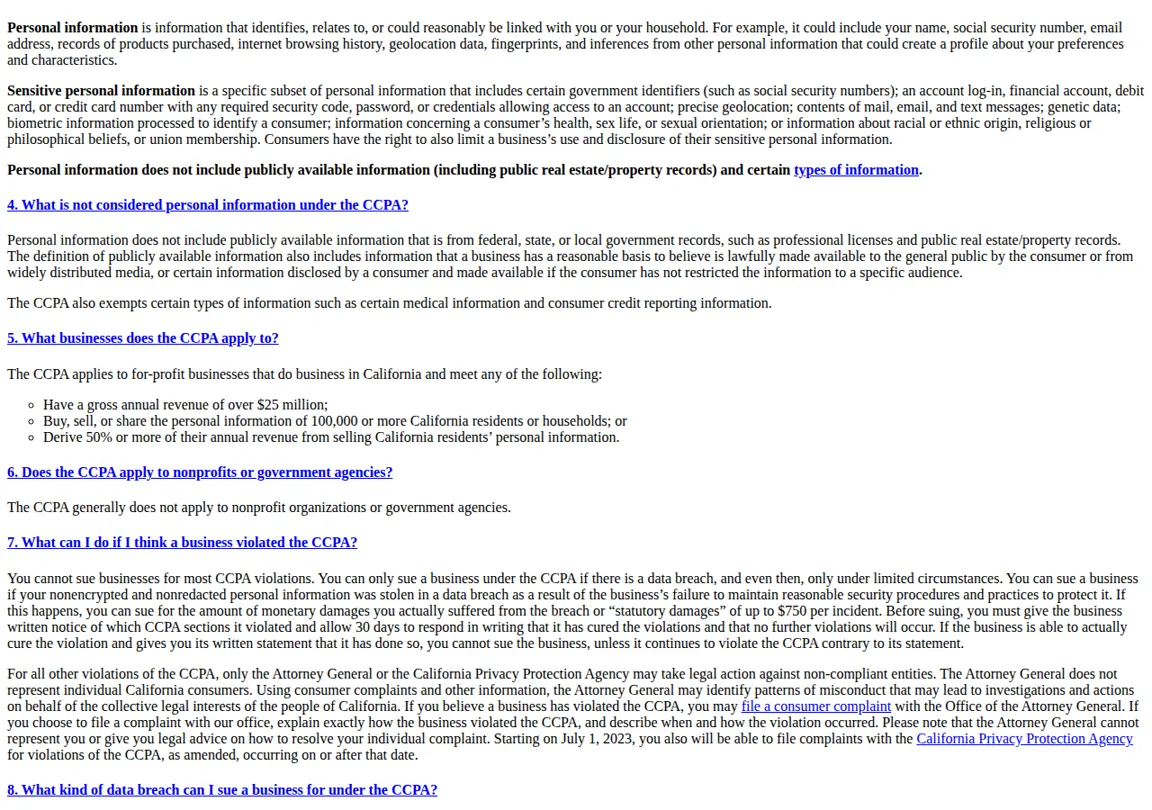
The practical consequence is a one-way trap. A company can be too small for the CCPA and fully covered by the GDPR at the same time, because the GDPR has no threshold. The reverse is also possible: a California-only business with $30 million in revenue and no EU customers is covered by the CCPA and untouched by the GDPR. Scope is tested per law, per data set, not once for the company.
The rights inventory
The rights overlap in name and differ in scope. The GDPR's rights sit in Articles 15 to 22: access, rectification, erasure, restriction of processing, data portability, objection, and the right not to be subject to solely automated decisions. The CCPA's rights sit in Civil Code sections 1798.100 to 1798.125: know what is collected, delete, correct, opt out of sale or sharing, limit the use of sensitive personal information, and non-discrimination for exercising rights.
| Right | GDPR | CCPA / CPRA | Authority |
|---|---|---|---|
| Know / access | Art. 15 — confirmation, a copy of the data, and eight mandatory information items | §§ 1798.110, 1798.115 — categories, sources, purposes, third parties, specific pieces | GDPR Art. 15; Cal. Civ. Code §§ 1798.110, 1798.115 |
| Delete / erase | Art. 17 — erasure, with six grounds and five exceptions | § 1798.105 — deletion, with nine exceptions including completing a transaction and legal obligations | GDPR Art. 17; Cal. Civ. Code § 1798.105 |
| Correct | Art. 16 — rectification without undue delay | § 1798.106 — correct inaccurate PI, commercially reasonable efforts | GDPR Art. 16; Cal. Civ. Code § 1798.106 |
| Portability | Art. 20 — receive data in a structured, machine-readable format | No standalone portability right; the right to know covers specific pieces | GDPR Art. 20 |
| Opt out of sale/sharing | No equivalent — objection under Art. 21 instead | § 1798.120 — opt out, honored within 15 business days | Cal. Civ. Code § 1798.120; CPPA § 7026 |
| Limit sensitive PI | Special-category data under Art. 9 needs a separate condition | § 1798.121 — limit use and disclosure of sensitive PI | GDPR Art. 9; Cal. Civ. Code § 1798.121 |
Two differences matter most. First, portability is a GDPR right with no CCPA equivalent: a California consumer can demand the specific pieces you hold, but not a machine-readable export for moving to a competitor. Second, the opt-out of sale or sharing is a CCPA right with no GDPR equivalent: the GDPR answers the same concern through objection and consent, not through a "Do Not Sell or Share" link. Both laws let the business verify identity before disclosing, and both require the response to be free of charge.
The clocks: two deadlines, one queue
The response clocks are the sharpest operational difference, and the one that breaks queues built for a single law. The GDPR gives one month. Article 12(3) requires the controller to provide information on action taken "without undue delay and in any event within one month of receipt," extendable by two further months where necessary, with notice inside the first month. The CCPA gives 45 calendar days. CPPA regulation section 7021 requires confirmation of receipt within 10 business days, a substantive response within 45 calendar days, and allows one additional 45-day extension for a maximum of 90 calendar days, with notice and an explanation. The regulation is explicit that the 45 days run from receipt, regardless of how long verification takes. The opt-out clock is shorter still: section 7026 requires an opt-out of sale or sharing to be honored as soon as feasibly possible, and no later than 15 business days from receipt.
A request received on November 1 is due under the GDPR by December 1, and under the CCPA by December 16 — but the CCPA also demands a confirmation by November 15, ten business days after receipt, which the GDPR does not require at all. The queue that satisfies both laws confirms in 10 business days and answers in one month.
The money: penalty ceilings
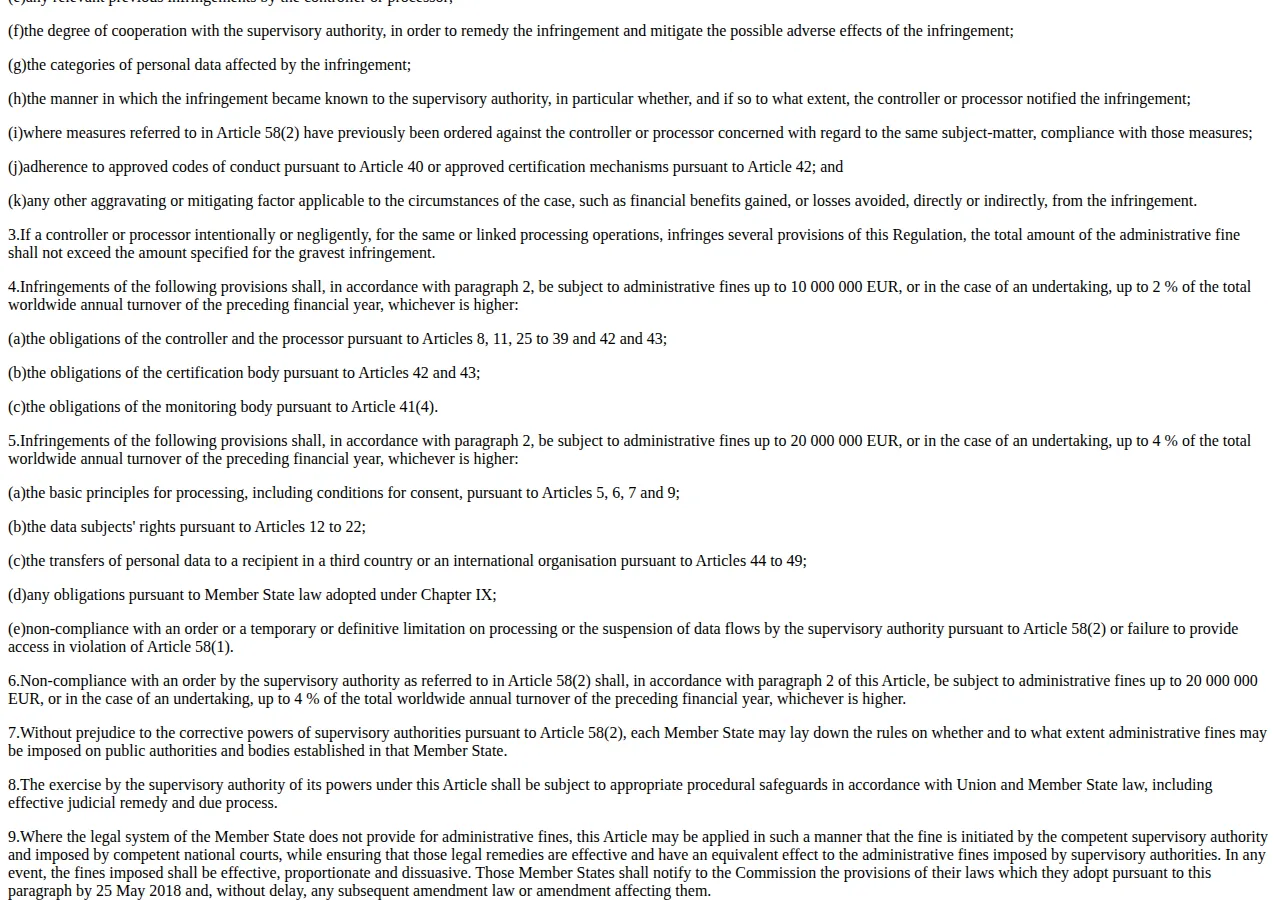
The penalty structures are opposites in shape. The GDPR fines a percentage of global turnover; the CCPA fines a flat amount per violation. Article 83 of the GDPR sets two tiers: the lower tier, up to €10 million or 2 percent of total worldwide annual turnover in the preceding financial year, whichever is higher, for infringements of the controller and processor obligations in Articles 8, 11, 25 to 39, and 42 and 43; and the upper tier, up to €20 million or 4 percent, whichever is higher, for infringements of the basic principles in Articles 5, 6, 7, and 9, data subject rights in Articles 12 to 22, and international transfers in Articles 44 to 49.
The CCPA fines per violation. Section 1798.199.90 makes a violator liable for a civil penalty of up to $2,500 for each violation, or $7,500 for each intentional violation and each violation involving the personal information of a minor, as adjusted for inflation, in a civil action brought by the Attorney General. Separately, section 1798.150 gives consumers a private right of action for certain data breaches, with statutory damages of $100 to $750 per consumer per incident, after a 30-day written cure notice.
The arithmetic shows why the two ceilings feel different. A company with €1 billion in worldwide turnover faces a GDPR upper-tier ceiling of €40 million — the percentage is the ceiling. A CCPA case with 10,000 violations faces $25 million in civil penalties, or $75 million if the violations are intentional. Run the exposure through the break-even calculator to find the compliance budget at which prevention is cheaper than the expected penalty.
Lawful basis versus notice, and the breach clock
The deepest difference is what makes processing lawful. The GDPR requires a lawful basis for every processing operation: Article 6 lists six, and processing is lawful only if and to the extent that at least one applies — consent, contract, legal obligation, vital interests, public interest, or the legitimate interests of the controller, balanced against the data subject's rights. The CCPA has no lawful-basis requirement. Section 1798.100 requires notice at collection — the categories of personal information, the purposes, whether it is sold or shared, and the retention period — and requires collection, use, retention, and sharing to be reasonably necessary and proportionate to the disclosed purposes.
The breach clocks differ the same way. Under GDPR Article 33, the controller must notify the supervisory authority without undue delay and, where feasible, not later than 72 hours after becoming aware of a personal data breach; the processor must notify the controller without undue delay, and every breach must be documented whether or not it is reported. The CCPA itself sets no breach-notification clock, which is why a breach plan built only from the CCPA misses the 72-hour duty entirely. The GDPR DSAR response playbook runs the one-month Article 12 clock step by step, and the CCPA deletion request playbook runs the 45-day section 7021 clock the same way.
The decision matrix
| Your situation | Build to | Why | Authority |
|---|---|---|---|
| EU customers only, no California presence | GDPR alone | No CCPA threshold met; the GDPR's one-month clock and Art. 6 basis govern | GDPR Arts. 3, 6, 12 |
| California customers only, no EU presence | CCPA alone | No GDPR trigger; the 45-day clock and the three thresholds govern | Cal. Civ. Code § 1798.140(d); CPPA § 7021 |
| Both EU and California customers | One queue, stricter rule per dimension | Confirm in 10 business days, answer in one month, opt-outs in 15 business days | GDPR Art. 12(3); CPPA §§ 7021, 7026 |
| Breach response plan | GDPR 72-hour clock first | The CCPA sets no breach clock; the 72-hour duty is the binding one | GDPR Art. 33 |
Who should NOT build two programs
Do not build two separate request pipelines, one for the GDPR and one for the CCPA. Two pipelines mean two intake forms, two verification steps, two clocks, and two places where a request can be lost — and the failure mode is a request that arrives under one law and is answered under the other's deadline. One intake, one verification, one queue, three clocks is cheaper to run and harder to get wrong.
The one-program checklist
- [x] Scope tested per law — GDPR Art. 3 and CCPA § 1798.140(d) applied separately, in writing, dated.
- [x] Thresholds re-tested quarterly — revenue, consumer count, and revenue mix, with the test dated.
- [x] One intake, one queue — a single form feeds both laws; the queue carries all three clocks.
- [x] Confirm in 10 business days — the CCPA rule, applied to every request including GDPR ones.
- [x] Answer in one month — the GDPR rule, applied to every request including CCPA ones.
- [x] Opt-outs in 15 business days — the CCPA rule, with the link and the Global Privacy Control signal both honored.
- [x] Breach plan has the 72-hour clock — authority notified where feasible within 72 hours, every breach documented.
Three mistakes that cost a program
- Verification starts the clock. Dating the clock from verification instead of receipt: both clocks run from arrival, and a queue that waits for verification before starting the clock is late on both laws before it begins.
- The 45-day program. Building the program to the CCPA's 45 days and missing the GDPR's one month.
- The missing confirmation. Forgetting the confirmation: the CCPA requires receipt to be confirmed within 10 business days, and a queue that answers on day 40 without ever confirming has already violated section 7021(a) even though the answer was on time.
Founder & CEO Insight — Enow A. Jovial