A founder who lives in Toronto and sells to customers in Texas faces a question that looks like paperwork and turns out to be tax, banking, and control: incorporate federally in Canada, or form a US LLC? A Canadian federal corporation is a separate taxpayer with a 9% federal small-business rate on the first $500,000 of active business income and a rule that at least 25% of its directors must be resident Canadians. A US LLC is a flow-through: the entity itself usually pays no income tax, the profit lands on the owner's return in the year it is earned, and there is no director-residency rule. Pick the Canadian corporation when your customers, team, and bank are Canadian. Pick the US LLC when your revenue, payment processing, and investors are American. Many founders end up with both, and that only works if you file both sides correctly.
The decision in one table
| Attribute | Canadian federal corporation (CBCA) | Delaware LLC | Wyoming LLC | Authority |
|---|---|---|---|---|
| Formation filing | CAD $200 online, 1 business day; $250 by mail | USD $110 | USD $100 | Corporations Canada / Delaware Div. of Corporations / Wyoming SOS |
| Annual state cost | CAD $12 annual return | USD $400 annual tax, due June 1 | USD $60 minimum license tax | Corporations Canada / Delaware Div. of Corporations / W.S. § 17-29-210 |
| Directors / managers | At least 25% resident Canadian; at least 1 if fewer than 4 directors | No residency rule | No residency rule | CBCA s. 105(3) / Del. § 18-401 / W.S. § 17-29-401 |
| Tax at the entity | 15% federal general; 9% federal small-business rate to $500,000 | None (flow-through by default) | None (flow-through by default) | CRA corporation tax rates / IRS LLC classification |
| Tax on the owner | Dividends taxed personally when paid out | Profit taxed to the owner in the year earned | Profit taxed to the owner in the year earned | ITA (Canada) / IRC §§ 701–704 |
| Name protection | Canada-wide under the CBCA | Delaware only | Wyoming only | CBCA s. 10 / state registration |
| Banking | Canadian business account, CAD payroll, Interac | US business account, USD Stripe and Mercury | US business account, USD Stripe and Mercury | Bank onboarding practice |
The Canadian federal corporation, step by step
Federal incorporation creates a corporation under the Canada Business Corporations Act, filed through Corporations Canada (Innovation, Science and Economic Development Canada). The online filing costs $200 and is processed in one business day; an express service adds $100 and cuts that to four business hours. Filing by email or mail costs $250 and takes ten business days. The name search is built into the online filing for a word name, so no separate NUANS report is needed; a name preapproval on its own costs $13.80. Once the certificate arrives, the corporation gets a federal business number and can open GST/HST, payroll, and corporation tax program accounts.
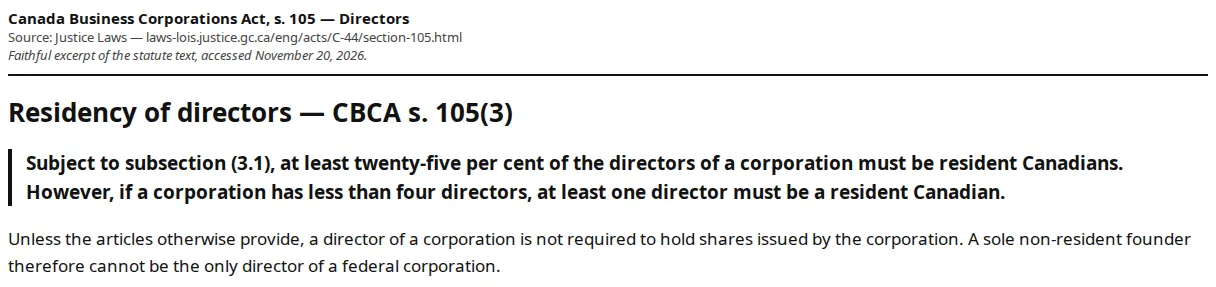
The rule that catches foreign founders is the director residency requirement. Under CBCA subsection 105(3), at least twenty-five per cent of the directors must be resident Canadians, and if the corporation has fewer than four directors, at least one director must be a resident Canadian. A sole non-resident founder cannot be the only director of a federal corporation. The fixes are a second director who is a resident Canadian, a larger board that clears the 25% line, or a provincial incorporation in a province without a residency rule, with the trade-off that provincial name protection stops at the provincial border.
The annual obligations are light but unforgiving about dates. The federal annual return costs $12 online and is due within 60 days after each anniversary, filed with current director, registered-office, and significant-control information. The return is separate from the corporate tax return (T2), due six months after the tax year-end. Missing it triggers loss of good standing, and a corporation that stays in default can be dissolved.
Federal incorporation does not, on its own, license the corporation to carry on business in any province. A federal corporation that operates in Ontario, British Columbia, or Quebec must register extra-provincially in each province where it carries on business, and each province charges its own fee and imposes its own annual filing. That is the hidden cost of the Canada-wide name.
The US LLC, step by step
A US LLC is formed under state law, and the two states cross-border founders actually use are Delaware and Wyoming. Delaware charges $110 to file a Certificate of Formation and a flat $400 annual tax, due June 1, for the 2026 tax year onward — up from $300 in earlier years. There is no annual report for a Delaware LLC. Wyoming charges $100 to file Articles of Organization and an annual report license tax of $60 or $0.0002 per dollar of Wyoming-located assets, whichever is greater — $60 for assets of $300,000 or less. Wyoming has no state income tax. Both states require a registered agent with a physical address in the state; agent services run roughly $50 to $300 a year.
The IRS does not tax an LLC as an LLC. A domestic LLC with one member is treated as an entity disregarded as separate from its owner unless it files Form 8832 and elects to be treated as a corporation; a domestic LLC with two or more members is classified as a partnership unless it elects otherwise. The election decides where the tax lands. A disregarded single-member LLC owned by a Canadian resident passes its profit to the owner's Canadian return in the year earned — no corporate deferral — and the owner files a US return for the US-source income and claims a foreign tax credit in Canada. A multi-member LLC files a US partnership return (Form 1065) and issues K-1s. An LLC that elects corporate treatment pays the 21% US federal corporate rate, and the owner is taxed again on dividends.
A Canadian founder forming a US LLC needs two numbers before the bank will talk to them. The LLC needs an Employer Identification Number, obtained by filing Form SS-4; a foreign applicant without a Social Security Number files by fax or mail and waits weeks rather than minutes. The founder personally needs an Individual Taxpayer Identification Number if they must file a US return. The bank account is the step founders underestimate: the bank will ask for the EIN, the operating agreement, the founder's passport and ITIN, and proof of the US address. For the account itself, the cross-border banking playbook is the foreign-founder US banking guide, which prices Mercury and Relay underwriting for exactly this founder.
The tax math: $200,000 of profit, two ways
Take a founder in Ontario with $200,000 of active business income. Inside a Canadian federal corporation that is a Canadian-controlled private corporation, the whole $200,000 sits inside the $500,000 small-business limit, so the federal rate is 9% and the Ontario lower rate is 2.2% — reduced from 3.2% on July 1, 2026. The combined rate is 11.2%.
The $177,600 stays inside the company until the founder pays it out as a dividend, taxed personally in the year it is paid. That is the deferral: $22,400 of tax now, the rest later, at the founder's choice of timing. Above the $500,000 limit the rate jumps to the general rate — 15% federal plus 11.5% Ontario, or 26.5% combined — so the small-business rate is a $500,000-wide window, not a permanent 11.2%.
Now run the same $200,000 through a single-member Wyoming LLC owned by the same Ontario founder, with the LLC disregarded for US tax. There is no entity-level tax and no deferral: the $200,000 is the owner's income in the year it is earned. The US taxes the US-source portion as effectively connected income, Canada taxes the worldwide income, and the foreign tax credit keeps the total from doubling — but the total is driven by the founder's personal marginal rate, which in Ontario reaches roughly 53.5% at the top, not by the 11.2% corporate rate. The LLC wins only when the founder's personal rate is lower than the corporate rate plus the eventual dividend tax.
The five-year state bill makes the same point in cash terms. A federal corporation costs $200 once plus $12 a year: $260 over five years, before extra-provincial fees. A Wyoming LLC costs $100 once plus $60 a year: $400 over five years, before the registered agent. A Delaware LLC costs $110 once plus $400 a year: $2,110 over five years, before the agent. With a $100-a-year agent, the five-year totals become $900 for Wyoming and $2,610 for Delaware.
The sales-tax and filing traps
A Canadian corporation that sells taxable supplies in Canada must register for GST/HST once it stops being a small supplier: worldwide taxable supplies over $30,000 in any single calendar quarter, or over $30,000 across four consecutive calendar quarters. Registration is required within 29 days. Exports to US customers are generally zero-rated at 0% — but zero-rated sales still count toward the $30,000 threshold, so a founder selling only to the US can still be forced to register. Run both entity scenarios through the profit calculator with your own marginal rate before you choose.
The US filing trap for a Canadian-owned LLC is Form 5472. A foreign-owned US single-member LLC that is disregarded for tax purposes must file Form 5472 with a pro forma Form 1120 every year, reporting related-party transactions with its foreign owner, and the penalty for failing to file is $25,000 per form per year under IRC § 6038A. The Form 5472 filing guide for foreign-owned US LLCs carries the full deadline and penalty ladder. A Canadian corporation that registers to do business in the US faces the mirror filing: as a foreign reporting company it must file a beneficial ownership report with FinCEN, while a domestic US LLC is exempt under FinCEN's August 2026 final rule.
Founder & CEO Insight — Enow A. Jovial
The decision matrix
| Your situation | The right first entity | Why |
|---|---|---|
| Canadian customers, Canadian team, profit to keep in the company | Canadian federal corporation | 11.2% small-business rate, CAD banking |
| US customers, USD revenue, US payment processing | Wyoming LLC | $100 to form, $60 a year, US bank account |
| US venture investors on the cap table | Delaware C-Corp (not an LLC) | Investors require preferred shares |
| No resident Canadian director available | US LLC, or a provincial corporation | The CBCA 25% rule blocks a federal corporation |
| Selling in Canada and the US from day one | Canadian corporation owning a US LLC | Each entity holds its own market |
The five-step cross-border setup
- Name the market first, then the entity. Where does the first $100,000 of revenue come from, in which currency, and which bank must receive it? Mostly Canada: CBCA corporation. Mostly the US: Wyoming LLC.
- Clear the director rule before you pay anything. For a federal corporation, confirm at least 25% of the board — at least one director on a board under four — is a resident Canadian. If you cannot clear it, incorporate provincially or form the LLC instead.
- File the formation and open the tax accounts in the same week. CBCA: $200 online, then a business number and GST/HST, payroll, and corporation tax program accounts. LLC: Articles of Organization, then Form SS-4 for the EIN, then the bank account.
- Register for the sales tax you actually owe. Canadian corporation: GST/HST registration once taxable supplies pass $30,000 in a quarter or across four quarters. US LLC selling into Canada: check non-resident GST/HST registration before the first Canadian invoice.
- Diary the recurring filings on day one. CBCA annual return ($12, within 60 days of the anniversary) and T2; Wyoming annual report ($60); Delaware annual tax ($400, June 1); Form 5472 for a foreign-owned disregarded LLC. One missed filing costs more than five years of the fees themselves.
Execution checklist
- [x] Market test: first $100,000 mapped to a country and a currency before filing.
- [x] Director test: CBCA board clears the 25% rule, or the LLC route chosen.
- [x] Formation filed: CBCA $200 online or Wyoming Articles $100.
- [x] Tax numbers issued: business number (Canada) or EIN via Form SS-4 (US LLC).
- [x] Bank account opened: Canadian account or US account via the foreign-founder banking route.
- [x] Sales tax registered: GST/HST once the $30,000 threshold is crossed; US nexus checked.
- [x] Annual diary set: CBCA return, T2, Wyoming report, Delaware tax, Form 5472 calendared with penalties noted.
- [x] Ownership recorded: significant-control register (Canada) or FinCEN filing (US) completed.