At 1,000 support conversations a month, an AI voice agent costs roughly $328 to $560 and an AI chatbot roughly $63 to $1,400 in vendor fees. The ranges overlap almost completely, so the sticker price does not decide this purchase. What decides it is the cost per resolved conversation — and what an unresolved conversation costs you next. A voice agent charges by the minute whether it solves the problem or not; a chatbot charges by the resolution, the conversation, or a flat monthly bundle. This guide prices both sides from the vendors' own published pages, works the math at stated volumes, and gives you the pilot that measures the one number no pricing page publishes: your resolution rate.
The two cost models
Voice agents and chatbots do not sell the same unit, and comparing them without converting to a common unit is how teams buy the wrong one. A voice agent sells minutes: every second of talk time, including greetings and repetitions. A chatbot sells outcomes or bundles: Intercom Fin charges $0.99 per resolution, Tidio Lyro sells a monthly conversation bundle. The honest common unit is the cost per conversation that arrives, and the honest formula carries the resolution rate in it, because a failed conversation is not free — it is a bot charge plus a human charge.
A voice call that lasts 4 minutes on Retell's example stack costs $0.44 in vendor fees. A chatbot resolution on Intercom Fin costs $0.99. The voice call looks cheaper until you remember that the $0.44 is charged on every call and the $0.99 only when Fin resolves one. At a 60% resolution rate, Fin's cost per arriving conversation is $0.594 — still more than the voice call's $0.44 — but the voice call's true cost is $0.44 plus the escalation cost on the 40% it fails to resolve. If a human escalation costs $4.17 — ten minutes of an agent at a $25-an-hour loaded cost — the voice side's real cost is $2.11 and the chatbot side is $2.26. The gap is fifteen cents, not fifty-five — and it flips if the voice agent resolves worse than the chatbot.
The voice agents: Vapi, Retell, and Bland
Vapi sells the platform and passes the model costs through at cost. The hosting fee is $0.05 per minute, with no minimum minutes and $5 of free credits to start. The models — the language model, the transcriber, and the voice — are billed at the provider's own rate on top. Vapi's own estimator puts 1,000 minutes at $82 to $129 a month all-in: $50 of hosting, $10 of Deepgram transcription, $8 to $45 of OpenAI model cost, and $15 to $24 of ElevenLabs voice. Four concurrent calls are included; extra lines cost $10 per line per month.
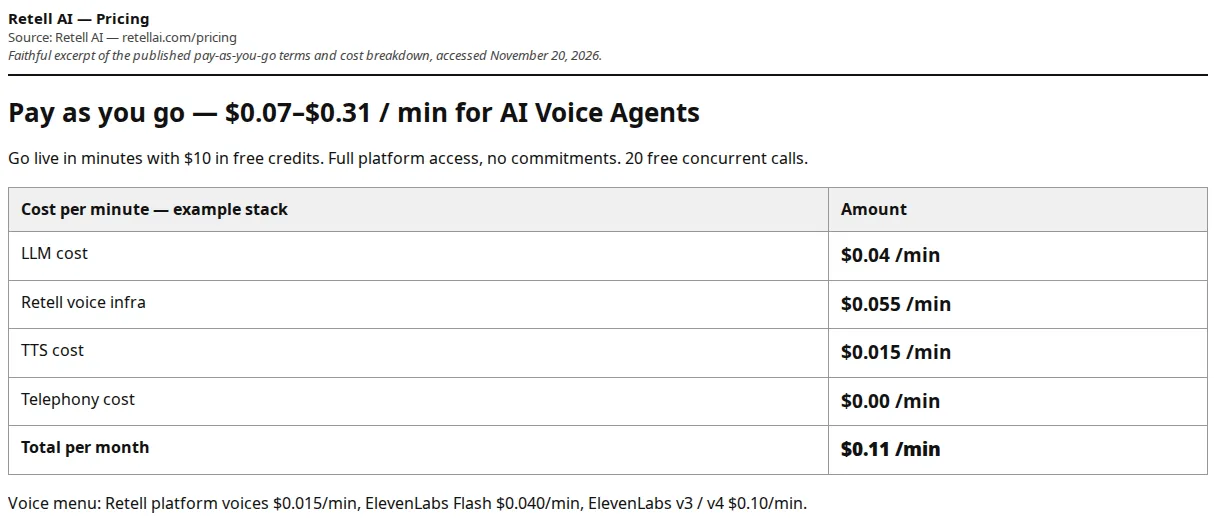
Retell sells a single per-minute number that includes the stack. Its pay-as-you-go plan runs $0.07 to $0.31 per minute depending on the model and voice, and its worked example totals $0.11 per minute: $0.04 for the language model, $0.055 for Retell's voice infrastructure, and $0.015 for text-to-speech. Twenty concurrent calls are included; chat agents start at $0.002 per message. The voice menu is where the price moves: a Retell platform voice costs $0.015 a minute, an ElevenLabs Flash voice $0.040, and an ElevenLabs v3 or v4 voice $0.10.
Bland sells one all-in per-minute rate covering the language model, speech-to-text, and text-to-speech, with telephony billed separately. The Start plan is $0.14 per minute with no platform fee, $0.05 per transfer minute, 10 concurrent calls, and a 100-call-per-day cap. The Teams plan is $0.12 per minute plus a $299-a-month platform fee, $0.04 per transfer minute, 50 concurrent calls, and 2,000 calls a day. Bland's own pricing page states the comparison plainly: typical production stacks run roughly $0.13 to $0.30 per minute on Vapi and $0.11 to $0.25 on Retell. Bland's rate is the simplest to budget — but also the highest headline rate of the three, and the $299 platform fee means Teams only beats Start above roughly 15,000 minutes a month.
| Vendor | Headline price | What the number includes | Free tier / credits | Concurrent calls |
|---|---|---|---|---|
| Vapi | $0.05/min hosting | Hosting only; models at cost | $5 free credits | 4 included; $10/line/mo extra |
| Retell | $0.07–$0.31/min | Full stack; example totals $0.11/min | $10 free credits | 20 included |
| Bland | $0.14/min Start; $0.12/min + $299/mo Teams | All-in; telephony separate | 2 credits + number | 10 Start; 50 Teams |
| Intercom Fin | $0.99 per resolution | AI resolution across chat channels | 14-day free trial | Seat-based helpdesk |
| Zendesk AI | $1.50 committed / $2.00 PAYG per extra resolution | 5–10 included per agent/mo; seats $19–$115 | 14-day trial | Seat helpdesk |
| Tidio Lyro | $33/mo Starter; from $63/mo Growth | 50 / 100+ conversations a month | 7-day free trial | Conversation bundle |
The chatbots: Intercom Fin and Tidio Lyro
Intercom Fin is the per-resolution chatbot, and its price is the cleanest in the whole comparison: $0.99 per outcome, where an outcome is a conversation Fin resolves without a human. The helpdesk it sits on is separate — Essential starts at $29 a seat a month, with a $19 promotional rate for new customers paying annually. Intercom's own estimator shows the shape of the bill: at a volume where 91 conversations are resolved by Fin, the Fin charge is $90.09 a month. There is no per-minute meter and no token bill; the bill is the resolution count times $0.99. That is also the risk: a bot that resolves everything costs $0.99 times every conversation, so the bill scales exactly with success and there is no discount for volume.
Tidio Lyro is the bundled chatbot: its price is a monthly conversation allowance. The Starter AI plan is $33 a month billed annually — $390 a year — for 50 AI and human conversations, with Lyro answering routine questions on chat and email and handing the rest to the team. The Growth AI plan starts at $63 a month billed annually — $750 a year — for 100 AI and human conversations, scaling to 1,000. Voice is a separate add-on priced per conversation. Lyro is the cheapest option in this guide at low volume — and the most dangerous at high volume, because the 50-conversation Starter allowance is exhausted by a single busy morning.
Zendesk prices its AI agents the same way Intercom prices Fin — per automated resolution — but the meter starts after a plan allowance. Every plan includes a monthly allowance of automated resolutions per agent: 5 on Support Team ($19 per agent a month billed yearly) and Suite Team ($55), 10 on Suite Professional ($115). Resolutions past the allowance cost $1.50 each on a committed plan or $2.00 each pay-as-you-go. At 1,000 conversations a month with five Professional agents and a 60% resolution rate, 600 resolutions use the 50 included and the remaining 550 cost $825 committed — $1,400 a month with the $575 seat bill. Zendesk is the most expensive chatbot in this guide at volume — the only one whose AI price is inseparable from its seat price.
The math at 1,000 conversations a month
Fix the volume at 1,000 arriving conversations a month and the average voice call at 4 minutes. That is 4,000 voice minutes a month. The vendor bill for each option, before any human escalation, is:
The chatbot spread is the widest number in this guide: $63 against $1,400 for the same 1,000 conversations, and the difference is the pricing model, not the quality. Lyro sells a bundle, Fin sells outcomes, and Zendesk sells seats plus outcomes; at 1,000 conversations Lyro's bundle is nearly ten times cheaper than Fin's meter — and Zendesk's seat-plus-meter is more than twice Fin's. The voice spread is narrower — $328 to $560 — because all three voice vendors meter minutes.
Now add the escalation, because no vendor bill is the whole cost. Assume a human escalation costs $4.17 — ten minutes of an agent at a $25-an-hour loaded cost. At a 60% resolution rate on both sides, 400 of the 1,000 conversations escalate, and the escalation bill is 400 times $4.17, or $1,668, on top of either vendor fee. The totals become $1,996 to $2,228 for voice and $1,731 to $3,068 for chat. The vendor fee is the smaller half of the real cost: every five points of resolution you gain saves $208 a month.
For the build-your-own route, the AI voice agents architecture guide prices the Twilio and WebRTC plumbing underneath a self-hosted agent, and the Help Scout vs Freshdesk vs Zoho Desk pricing playbook prices the human helpdesk escalations land in. Run the fees through the profit calculator with your own call length and resolution rate before you commit.
Latency, quality, and the cases each side loses
Voice is real-time and chat is not, and that single difference decides more deployments than price does. A voice agent answers in hundreds of milliseconds and interrupts cleanly when the caller corrects it. It is the right channel for a caller who is locked out, a delivery that is late, or a payment that failed. Chat is asynchronous and visual: it carries links, order numbers, and screenshots, and the customer can answer at their own pace. It is the right channel for a return label or a how-to question where the answer is a link.
Each side has a failure mode the other does not. Voice fails on noisy lines, heavy accents, and long strings of digits — an order number read aloud is a coin flip. Chat fails on long back-and-forths: a ten-message thread about a billing dispute is slower than a two-minute call. None of these are priced on a vendor page, and all of them are measurable in a two-week pilot with real tickets — which is the only honest way to pick.
Founder & CEO Insight — Enow A. Jovial
The decision matrix
| Your situation | The right first buy | Why |
|---|---|---|
| Under 200 conversations a month, mostly routine questions | Tidio Lyro Starter ($33/mo) | The bundle is cheaper than any meter |
| 1,000 conversations a month, chat-first customers | Tidio Lyro Growth ($63/mo) or Intercom Fin | Lyro's bundle is ten times cheaper than Fin |
| Phone-first customers, urgent issues, high emotion | Retell or Vapi voice agent | Real-time voice, interrupts cleanly |
| High call volume, simple transfers and bookings | Bland Teams ($0.12/min + $299/mo) | Platform fee pays off above ~15,000 min/mo |
| Already on Intercom or Zendesk, no new vendor wanted | Fin, or Zendesk AI at $1.50 per extra resolution | Lives where the tickets already live |
| Long calls, order numbers, screenshots | Chatbot first, voice second | Voice fails on digits and attachments |
The five-step rollout
- Baseline your queue for one week before you buy anything. Count arriving conversations, handle time, and the routine share.
- Pick one channel and one vendor for a two-week pilot. Voice or chat, not both; one vendor, not three. Give the bot your fifty most common questions, and route no more than a third of live traffic to it.
- Measure resolution, escalation, and handle time — not vendor fees. A resolved conversation is one the customer does not reopen within 48 hours. Record both daily, by intent.
- Price the pilot with your own numbers. Take the pilot's resolution rate, your average call length, and your loaded human cost, and run the formula. If the bot's resolution rate is under 40%, fix the knowledge base first.
- Scale the winner, keep the loser as the overflow. Move the winning channel to full traffic, keep the other channel for the cases it handles best, and re-price quarterly.
Execution checklist
- [x] Baseline taken: one week of conversations, handle time, and routine share counted first.
- [x] Common unit chosen: cost per arriving conversation, with resolution rate and escalation cost.
- [x] Stack priced, not the headline: voice with model, transcription, and the voice shipped; chat by resolution or bundle.
- [x] Pilot scoped: one channel, one vendor, two weeks, a third of traffic, fifty questions.
- [x] Resolution defined: resolved only if not reopened within 48 hours.
- [x] Escalation costed: the loaded human cost per escalation is in the business case.
- [x] Overflow planned: the losing channel is kept for the cases it handles best.
- [x] Re-price calendared: vendor pricing re-checked quarterly.