The three meters: one subscription, three different bills
Ahrefs, Semrush, and Moz Pro all sell the same promise — know where you rank, find the keywords that matter, and fix the pages that hold you back — and all three price it so the headline monthly figure is the least informative number on the page. Ahrefs charges by seat, keyword, and crawl-credit ceilings. Semrush charges by project and keyword ceilings, then adds AI-visibility tracking as a second meter. Moz Pro charges the lowest entry price and the fewest included seats. The same solo operator pays $468 a year on Moz Starter, $1,290 on Ahrefs Lite, and $1,407.96 on the Semrush SEO plan — and no two of those numbers buy the same thing. The bill is decided by which ceiling you hit first: keywords, sites, seats, or crawl credits.
> [!KEY TAKEAWAY]
> Compare these tools on the annual-billed price for the keyword count you actually track, not the monthly headline. At 1,500 tracked keywords the annual gap between Moz Medium ($143 a month) and Semrush Pro+ ($248.17 a month) is $1,262.04 a year for the same ceiling — and at 2,000 keywords Semrush forces a jump to Advanced at $455.67 a month while Ahrefs Standard covers the same count at $207.50.
Why it matters: the ceiling you hit first sets the price
An SEO tool subscription is a metered utility dressed as a flat fee. Every tier bundles four ceilings — tracked keywords, monitored sites, seats, and crawl or report volume — and the upgrade trigger is whichever ceiling your operation crosses first. A one-person consultancy tracking 400 keywords never touches a ceiling on any entry tier, so the cheapest entry wins outright. A five-person agency tracking 2,000 keywords across 12 client sites crosses the keyword ceiling on Semrush Pro+, the site ceiling on Moz Standard, and the seat ceiling on every one-user plan. That is why the same three vendors produce three different "cheapest" answers depending on the shape of the buyer, and why a pricing page read without your own numbers is a trap. SEO spend is sticky: keyword history and backlink data accumulate inside the tool, and migrating costs weeks of re-crawling. The switching cost is lost history, not the monthly fee.
!Ahrefs pricing page: Lite at $129, Standard at $249, and Advanced at $449 per month

Ahrefs lists its three self-serve tiers at $129, $249, and $449 per month (Lite, Standard, Advanced, in that order), with annual billing at $1,290, $2,490, and $4,490 a year.
The price ladders, read off the vendors' pages
All figures below are the prices each vendor lists on its pricing page, read on 2026-11-05, in US dollars, for one seat unless stated. Annual figures are the monthly equivalent when the year is paid up front. Moz's $39-a-month Starter annual figure comes from its pricing page as reported by two independent price trackers that agree on the ladder.
| Vendor | Entry tier | Mid tier | Top self-serve tier | Annual billing |
| :--- | :--- | :--- | :--- | :--- |
| Ahrefs | Lite $129/mo | Standard $249/mo | Advanced $449/mo | $1,290 / $2,490 / $4,490 per year |
| Semrush | SEO $139.95/mo | Starter $199/mo; Pro+ $299/mo | Advanced $549/mo | $117.33 / $165.17 / $248.17 / $455.67 per month |
| Moz Pro | Starter $49/mo | Standard $99/mo; Medium $179/mo | Large $299/mo | $39 / $79 / $143 / $239 per month |
The ceilings sit underneath the prices. Ahrefs Lite includes 750 tracked keywords, 100,000 crawl credits, and 5 non-verified projects; Standard raises those to 2,000 keywords and 500,000 crawl credits; Advanced to 5,000 keywords and 1,500,000 crawl credits. Semrush SEO and Starter both include 5 websites and 500 keywords tracked daily; Pro+ raises those to 15 websites and 1,500 keywords, and adds 100 AI prompts tracked daily; Advanced raises them to 40 websites, 5,000 keywords, and 200 AI prompts. Moz Starter includes 1 site and 50 tracked keywords; Standard 3 sites and 300 keywords; Medium 10 sites and 1,500 keywords with 2 users; Large 25 sites and 3,000 keywords with 3 users. Every plan includes one seat unless the table says otherwise — the second seat is where the bill grows.
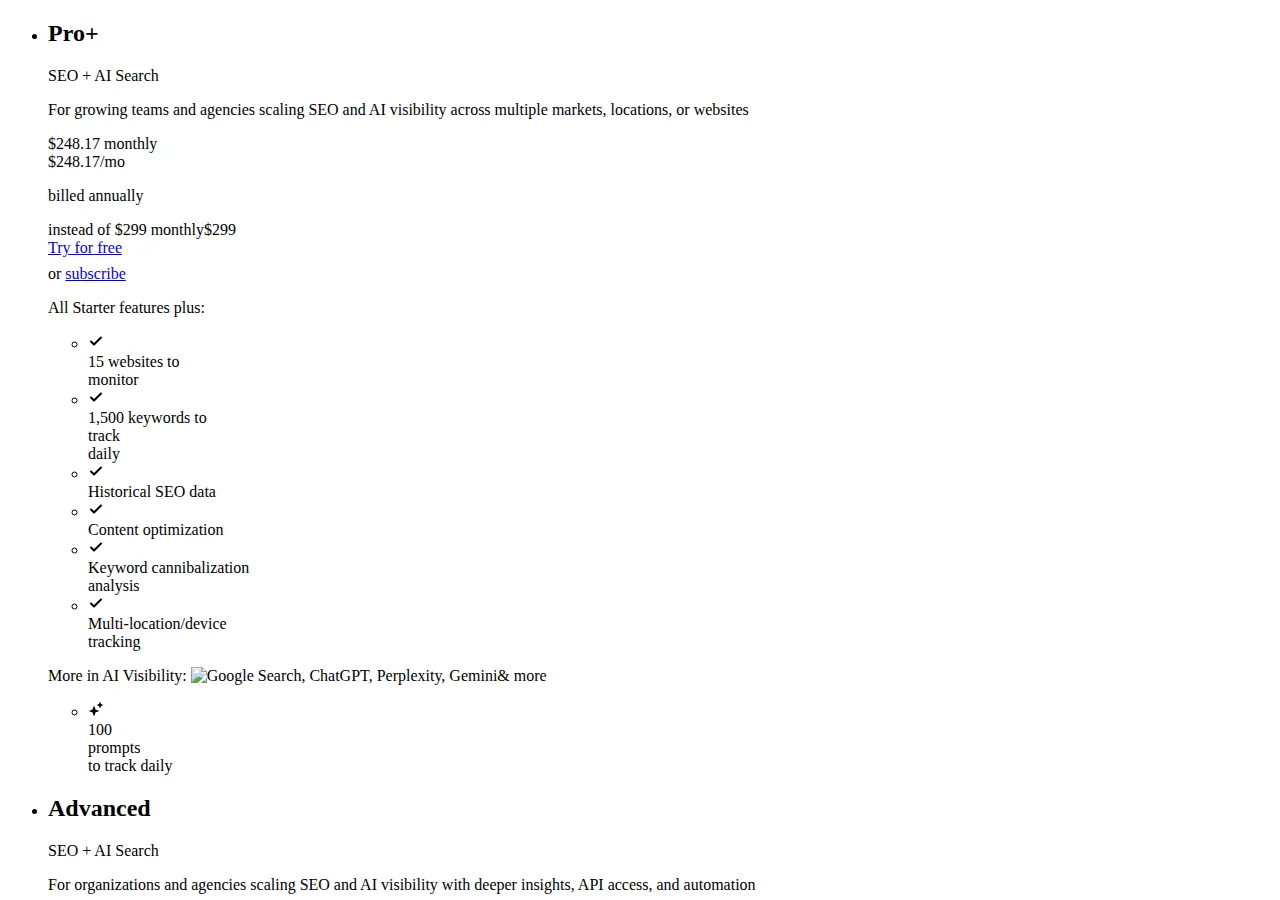
Semrush Pro+ at $248.17 a month billed annually instead of $299 monthly: 15 websites, 1,500 keywords tracked daily, historical SEO data, and 100 AI prompts tracked daily.
The cost-per-keyword ledger
The honest unit price for an SEO tool is the monthly cost divided by the tracked keywords the tier includes. It exposes that the cheapest headline is rarely the cheapest unit, and that the mid-tier is where the three vendors diverge hardest.
$
\text{Cost per tracked keyword} = \frac{\text{Monthly price (annual billing)}}{\text{Tracked keywords included}}
$
| Tier (annual billing) | Monthly price | Keywords | Cost per keyword |
| :--- | :--- | :--- | :--- |
| Moz Starter | $39.00 | 50 | $0.7800 |
| Semrush SEO | $117.33 | 500 | $0.2347 |
| Ahrefs Lite | $107.50 | 750 | $0.1433 |
| Moz Medium | $143.00 | 1,500 | $0.0953 |
| Ahrefs Standard | $207.50 | 2,000 | $0.1038 |
| Semrush Pro+ | $248.17 | 1,500 | $0.1654 |
| Moz Large | $239.00 | 3,000 | $0.0797 |
| Ahrefs Advanced | $374.17 | 5,000 | $0.0748 |
| Semrush Advanced | $455.67 | 5,000 | $0.0911 |
Three readings fall out of that table. First, Moz Starter is the worst unit price at $0.78 per keyword — its $39 headline is cheap only because it includes almost nothing. Second, at the mid-tier the same 1,500 keywords cost $143 on Moz, $248.17 on Semrush, and $207.50 on Ahrefs for 2,000 — Semrush charges $105.17 a month more than Moz for the identical ceiling, which is $1,262.04 a year, and the difference buys AI-visibility tracking, not more keywords. Third, at the top tier the unit prices converge: $0.0748 on Ahrefs, $0.0797 on Moz, $0.0911 on Semrush — the choice there is the rest of the bundle.
The annual-billing discount, priced
All three vendors discount annual prepayment, and the discount is large enough to change the ranking. The saving is the monthly price times twelve minus the annual total.
$
\text{Annual saving} = (\text{Monthly price} \times 12) - \text{Annual total}
$
| Vendor and tier | Monthly | Annual total | Saving | Saving rate |
| :--- | :--- | :--- | :--- | :--- |
| Ahrefs Lite | $129.00 | $1,290.00 | $258.00 | 16.7% |
| Ahrefs Standard | $249.00 | $2,490.00 | $498.00 | 16.7% |
| Ahrefs Advanced | $449.00 | $4,490.00 | $898.00 | 16.7% |
| Semrush SEO | $139.95 | $1,407.96 | $271.44 | 16.2% |
| Semrush Pro+ | $299.00 | $2,978.04 | $609.96 | 17.0% |
| Moz Standard | $99.00 | $948.00 | $240.00 | 20.2% |
| Moz Medium | $179.00 | $1,716.00 | $432.00 | 20.1% |
| Moz Large | $299.00 | $2,868.00 | $720.00 | 20.1% |
Moz discounts deepest at about 20 percent; Ahrefs and Semrush sit near 17 percent. The practical rule: never compare a monthly price on one vendor against an annual price on another. The three-year totals at the mid-tier, all annual-billed, are Moz Medium $5,148, Ahrefs Standard $7,470, and Semrush Pro+ $8,934.12 — a $3,786.12 spread between Moz and Semrush over three years for the same ceiling. Pay annually if the budget is annual; the monthly price is the real price if cash flow is monthly.
The five-seat team test
Seats are the second meter, and they punish Semrush and Ahrefs harder than Moz because both include exactly one user per self-serve tier. Moz Medium includes two users and Large three, so a five-person team needs three extra seats on Moz Medium, four on Ahrefs Standard, and four on Semrush Pro+. The extra-seat prices are published: Ahrefs charges $40, $60, and $80 per additional power user per month on Lite, Standard, and Advanced; Semrush lists extra users from $45 a month. Moz publishes no extra-user price, so no Moz five-seat total is stated here.
$
\text{Five-seat monthly total} = \text{Base price (annual billing)} + (\text{Extra seats} \times \text{Seat price})
$
| Five-seat team, annual billing | Base | Extra seats | Seat price | Monthly total | Annual total |
| :--- | :--- | :--- | :--- | :--- | :--- |
| Semrush Pro+ | $248.17 | 4 | $45.00 | $428.17 | $5,138.04 |
| Ahrefs Standard | $207.50 | 4 | $60.00 | $447.50 | $5,370.00 |
| Moz Medium | $143.00 | 3 | Not published | Not stated | Not stated |
On a five-seat team the ranking flips: Semrush Pro+ at $428.17 a month undercuts Ahrefs Standard at $447.50, because Semrush's cheaper seat outweighs its dearer base. The solo ranking and the team ranking are different answers, and the pricing page will not tell you which one you are buying.
The 2,000-keyword scenario
Take a concrete operation: a small agency tracking exactly 2,000 keywords across 12 client sites, one seat, annual billing. Ahrefs Standard includes 2,000 keywords at $207.50 a month, which is $2,490 a year. Moz Large includes 3,000 keywords at $239 a month, $2,868 a year — $378 a year more than Ahrefs for 1,000 keywords the agency does not need yet. Semrush Pro+ caps at 1,500 keywords, so the agency cannot buy it at all; the next tier is Advanced at $455.67 a month, $5,468.04 a year — $2,978.04 a year more than Ahrefs for the same 2,000 keywords. The keyword ceiling, not the brand, decides this scenario: Semrush's ladder has a gap between 1,500 and 5,000 keywords with nothing in between, and any operation in that gap pays the top-tier price. Count the keywords you track today and in twelve months; between 1,501 and 5,000, Semrush costs more than either rival.
Decision table
| Operator shape | Buy this | Why | Authority |
| :--- | :--- | :--- | :--- |
| Solo consultant, under 500 keywords | Moz Starter or Semrush SEO | Cheapest entry; Moz $39 a month annual, Semrush $117.33 with deeper data | Moz and Semrush pricing pages |
| Solo consultant, 500 to 750 keywords | Ahrefs Lite | $107.50 a month annual covers 750 keywords; cheapest per keyword at this band | Ahrefs pricing page |
| Small team, 1,500 keywords, 2 seats | Moz Medium | $143 a month annual, 2 users included, lowest mid-tier unit price at $0.0953 per keyword | Moz pricing page |
| Agency, 2,000 keywords, 1 seat | Ahrefs Standard | $207.50 a month annual covers exactly 2,000 keywords; Semrush needs Advanced at $455.67 | Ahrefs and Semrush pricing pages |
| Agency, 5,000 keywords, API access | Semrush Advanced or Ahrefs Advanced | Semrush $455.67 with API eligibility and share of voice; Ahrefs $374.17 with the cheapest unit price at $0.0748 | Semrush and Ahrefs pricing pages |
Who should NOT buy any of these
Do not buy a full SEO platform if your site has fewer than 50 pages and you track fewer than 50 keywords — free Google Search Console plus a one-off audit covers that operation, and the $468-a-year Moz Starter minimum buys nothing you will open weekly. Do not buy Semrush Advanced for AI-visibility tracking alone: the AI prompt tracking is bundled into Starter at $199 a month, and Advanced buys keyword volume and API access, not more AI prompts per dollar. Do not buy Ahrefs if your work is mostly content briefs and on-page scoring — Ahrefs sells crawl and backlink depth, and its keyword research is the thinner half of the bundle. And do not buy any of the three on a monthly plan while telling yourself you will switch to annual later: the 17 to 20 percent discount is $240 to $898 a year per tier, and nobody remembers to flip the toggle.
> [!FOUNDER]
> "Every SEO tool pitch leads with the rank tracker and hides the keyword ceiling in the footnote. Count your keywords before you count your dollars — the ceiling is the price, and the vendor who wins is the one whose ceiling sits just above your count, not the one with the lowest headline."
> — Enow A. Jovial, Founder & Chief Executive Officer
> [!WARNING]
> Prices here were read from the vendors' own pricing pages on 2026-11-05. All three change prices without notice, and Semrush restructured its ladder in 2026, retiring Pro, Guru, and Business. Re-check the live page before committing, and confirm the extra-user price in writing — Moz publishes none, and Semrush's $45 is a starting price that rises by tier.
> [!TIP]
> Run the free tier or the 7-day trial on the cheapest vendor first and export your keyword list before you pay. The trial answers the only question the pricing page cannot: whether your keyword count fits inside the cheapest tier's ceiling, or one tier higher.
Switch in five steps
Step 1: export the keyword list from the current tool and count it. Step 2: count the sites to monitor and the seats to buy. Step 3: price the annual total on all three vendors at that keyword count. Step 4: trial the cheapest tier for one week on live data. Step 5: pay annually only after a ceiling is actually hit.
Execution checklist
Related reading on this site: the programmatic SEO framework for B2B SaaS for building the landing pages these tools measure, the technical SEO guide for decoupled web apps for the Core Web Vitals work that makes rankings stick, and the featured snippet pillar guide template for turning a tracked keyword into a position-zero result. Run the three-vendor annual total through the ROI calculator before you commit: the seat math here gives you the monthly bill, and the calculator turns it into the payback period against the revenue the rankings produce.